Pomegra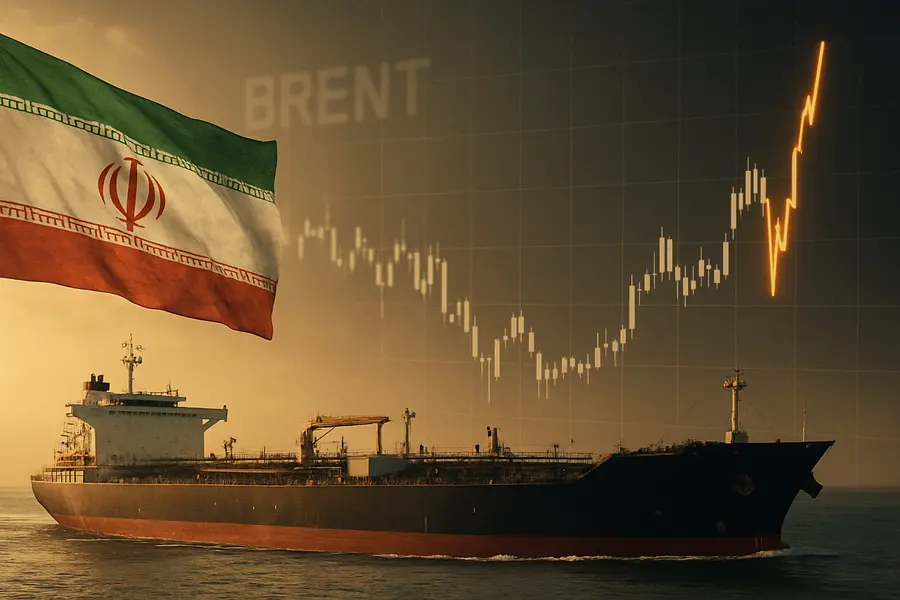
Iran's IRGC declared the Strait of Hormuz closed to all vessels Thursday after fresh U.S. strikes, sending Brent crude $5 higher before a Trump deal signal reversed the rally.
- Iran's IRGC declared the Strait of Hormuz "closed to all vessels," including oil tankers, after U.S. forces struck seven coastal sites on June 10–11.
- Brent crude surged $5 intraday to $93.50 before settling at $90.38, down nearly 3%, on signals of a near-term U.S.-Iran agreement.
- Tanker traffic through the strait has fallen roughly 95% since the conflict began February 28, choking approximately 20% of global seaborne oil supply.
Lead
Brent crude surged approximately $5 per barrel to an intraday high of $93.50 on Thursday after Iran's Islamic Revolutionary Guard Corps declared the Strait of Hormuz — the world's most critical oil chokepoint — "closed to all vessels, including oil tankers and commercial ships." The announcement followed fresh U.S. air strikes on seven coastal targets, including Bandar Abbas, Sirik, Qeshm Island, and Hengam Island, triggering heavy exchanges between U.S. forces and IRGC naval units in the strait. Brent reversed to settle at $90.38, down nearly 3% on the day, after President Donald Trump signaled that a peace agreement was days from signing.What Happened
U.S. forces struck Iranian coastal sites on the night of June 10–11, 2026, in a fresh escalation of the conflict that began February 28 when the United States and Israel launched sustained air operations against Iran. The IRGC responded by formally declaring the Strait of Hormuz "closed to all vessels," warning that any ship attempting to transit the 33-kilometer-wide channel would be targeted.
The closure declaration is the most explicit such warning since hostilities began. Iran first announced the strait was closed on March 4, 2026, a designation that caused tanker traffic to fall roughly 70% within weeks and eventually 95% below pre-war levels. The IRGC has carried out attacks on vessels attempting to transit, and following a U.S. Navy blockade of Iranian ports that began April 13, commercial shipping through the waterway has operated at a near-standstill.
Market Reaction
Brent crude oil futures jumped sharply in early Asian and European trading Thursday, rising to a session high of $93.50 per barrel — a gain of approximately $5 from the prior session — on news of the overnight U.S. strikes and the IRGC closure announcement. WTI crude tracked higher, trading above $90 in early hours. Oil prices reversed in the afternoon session after Trump told reporters the U.S. had "made a great settlement of the war with Iran," describing it as "subject to finalization of documents" and expecting a formal signing ceremony in Europe within days. Brent settled at $90.38, a loss of nearly 3% on the session. WTI closed at $87.71, down more than 2%. In extended trading, both benchmarks fell further, with Brent touching $89.15 and WTI sliding to $86.51 as investors priced in the probability of near-term diplomatic resolution.The intraday volatility — a $5 spike followed by a near-equivalent retreat — encapsulates the market dynamic that has prevailed since late May: every fresh escalation is partially offset by recurring signals of a deal.
Strategic Context
The Strait of Hormuz carries approximately 20% of the world's seaborne oil trade and a comparable share of global liquefied natural gas volumes. No viable large-scale alternative route exists for Persian Gulf producers. Before the conflict began, Brent crude traded near $72.50 per barrel. By late April 2026, prices had surged past $108 and intraday records exceeded $119 per barrel as the U.S. Navy began blockading Iran's ports. Since May, oil prices have retreated as alternative logistics, record U.S. crude exports, and diplomacy reduced the perceived probability of a total, indefinite closure.
Rystad Energy noted Thursday that the market was better-positioned to absorb disruptions than in previous crises, citing record U.S. crude exports, softer Chinese demand, and alternative logistics corridors that have reduced — though not eliminated — dependence on the strait.
Geopolitical Dimension
The fresh U.S. strikes appear tied to Israeli military operations in Lebanon against Hezbollah, which Iran has cited as a violation of informal ceasefire understandings. Iran suspended negotiations with U.S. interlocutors in early June 2026 and vowed to activate additional chokepoints, including the Bab al-Mandeb Strait — a Red Sea corridor that functions as a relief valve for the market precisely because flows through Hormuz have collapsed. An extended closure of both waterways simultaneously would reintroduce supply disruption on a scale not seen in the modern energy era.
The UAE and Iran held rare direct talks in recent weeks, signaling back-channel diplomatic activity alongside the public military escalation. U.S. Energy Secretary Chris Wright stated that ship traffic through Hormuz was "rising very meaningfully," with JPMorgan analysts estimating that approximately 2 million barrels per day has been moving out of the Persian Gulf on tankers transiting without transponders under informal U.S. Navy coordination.
What Comes Next
A formal U.S.-Iran agreement, if signed within days as Trump indicated, would be the first durable halt to the conflict and could trigger a rapid repricing of crude benchmarks toward their pre-war range below $75. Analysts warn that previous deal signals have not materialized, and that even a signed agreement may require weeks before tanker traffic returns to a level sufficient to normalize global supply chains.
An activated Bab al-Mandeb threat would add a secondary choke on global oil flows, compounding pressure on spot markets and refinery margins in Europe and Asia. U.S. strategic petroleum reserves remain sharply below pre-conflict baselines, constraining Washington's policy buffer.
Outlook
The Strait of Hormuz crisis enters its fourth month with no durable resolution in place. Brent crude oil prices continue to trade in a wide band between $85 and $95, driven by daily shifts between escalation and diplomatic signal. A finalized U.S.-Iran deal would likely push oil prices sharply lower; a verified expansion of the conflict to the Bab al-Mandeb would retest April highs above $100. Energy markets remain in a regime of structured uncertainty, with the pace of diplomatic progress — not physical supply — as the primary price driver in the near term.
Mentioned tickers: BNO, USO, XLE, XOM, CVX, BP, SHELGeopolitics