Pomegra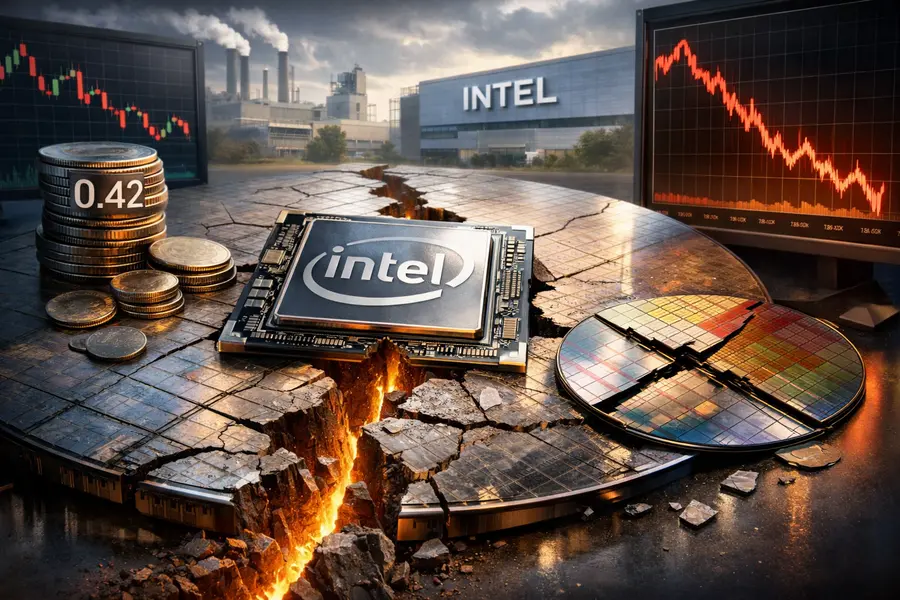
Intel doubled Wall Street's earnings forecast in the second quarter of 2026 — then watched its stock shed nearly 8% as investors questioned whether the company's soaring capital spending will ever translate into a self-sustaining silicon wafer business.
- Intel posted Q2 adjusted EPS of $0.42, doubling the $0.21 consensus, on revenue of $16.1B (+25% YoY).
- Shares fell 7.89% on July 24, reversing a 13% after-hours surge, on capex and foundry customer concerns.
- Intel Foundry external revenue reached only $293M while the segment posted a $2.1B quarterly loss.
Lead
Santa Clara, CA — July 24, 2026. Intel Corporation (INTC) reported second-quarter 2026 adjusted earnings per share of $0.42 on revenue of $16.128 billion, beating the $0.21 consensus estimate by 100% and topping the $14.42 billion revenue forecast by 12%. Year-over-year revenue growth of 25% marked Intel's fastest expansion since 2011. The market reaction was the opposite of the headline: INTC closed down 7.89% on July 24, erasing a 13% after-hours gain from the prior evening as investors weighed what the results did not answer.What Happened
Intel's strongest quarterly performance in fifteen years was driven by an acceleration across its core compute businesses. The Data Center and AI segment surged 59% year over year, fueled by enterprise server refresh cycles and AI infrastructure buildout. Consumer and commercial PC demand contributed to broad-based revenue gains across product lines.
The company also issued above-consensus guidance for the third quarter, projecting revenue of $15.8 billion to $16.8 billion — a midpoint of $16.3 billion against the $15.1 billion Wall Street had anticipated — and adjusted EPS of $0.38.
Despite the seventh consecutive quarterly beat, net income for the period included an $11 billion accounting loss tied to previously disclosed restructuring and impairment charges, a figure that surfaced in headlines and renewed scrutiny of the company's cost structure.
Market Reaction
INTC's whipsaw trading — a 13% pre-market gain followed by a 7.89% close-day decline — illustrated the gap between Intel's operational narrative and investor confidence in its long-term investment thesis. The stock's reversal was driven by two overlapping concerns.
First, capital expenditures. Intel raised its full-year 2026 capex outlook from approximately $18 billion to more than $20 billion and indicated that 2027 spending would be "significantly higher." For a company still posting foundry segment losses, the prospect of accelerating cash outflows before external revenue scales raised questions about return timelines.
Second, foundry traction. Despite technical progress, Intel Foundry generated only $293 million in external revenue during the quarter while recording a $2.1 billion segment operating loss. The intel fab network — spanning multiple nodes including Intel 3 and the advanced 18A process — continues to manufacture primarily for internal Intel products. No major third-party anchor customer was announced on the earnings call, a gap the market had been watching closely.
Strategic Context: The Silicon Wafer Pivot
CEO Lip-Bu Tan, who took the helm in early 2025, stated his confidence in Intel's process roadmap has "grown significantly" since assuming leadership. Factory performance across Intel 7, Intel 3, and Intel 18A exceeded internal volume targets in Q2, driven by yield improvements, faster cycle times, and higher silicon wafer starts. The 18A-P node entered risk production during the quarter, offering additional performance-per-watt advantages intended to attract external chip designers.
The intel fab strategy — positioning Intel as a contract manufacturer competitive with TSMC and Samsung — remains central to the company's long-term valuation argument. External wins would transform the foundry from a cost center into a revenue-generating asset, spreading fixed infrastructure costs across a broader customer base. That inflection has not yet arrived. External foundry revenue of $293 million represents a fraction of total fab throughput, and the segment's $2.1 billion quarterly loss underscores how much the business model depends on outside volume to reach breakeven.
AI and Technology Angle
The 59% growth in Intel's Data Center and AI segment reflects genuine demand: enterprise customers are deploying AI inference and training infrastructure at a pace that is consuming server silicon broadly. Intel's CPU roadmap and advanced packaging capabilities have drawn renewed interest as hyperscalers diversify supplier bases. The CFO cited "unprecedented demand for silicon" and noted that customer demand currently exceeds available supply — a supply constraint that capital spending is intended to address but cannot resolve in the near term.
Outlook
Intel's Q2 results confirm a meaningful operational recovery underway. Revenue growth, segment expansion, and above-consensus guidance for Q3 establish a trajectory that was difficult to envision twelve months ago. The friction point is structural: the intel fab and broader foundry transformation requires years of capital deployment, yield maturation, and external customer wins before the investment case closes. Until Intel signs a high-volume outside customer for its advanced silicon wafer nodes, each capex revision will renew the same market skepticism that turned a 100% earnings beat into a 7.9% decline.
Mentioned tickers: INTC