Pomegra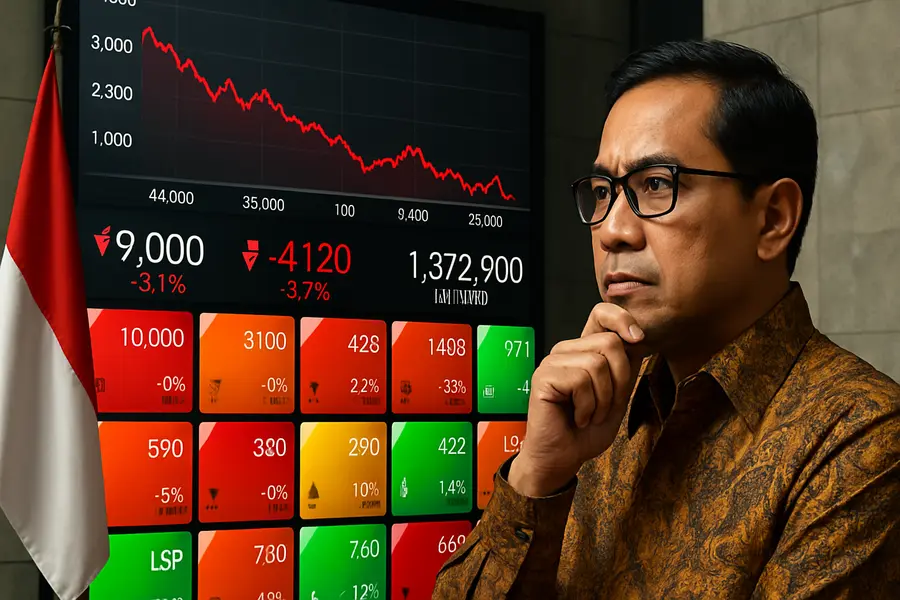
I now have sufficient data to write the article. Let me compose it.
- Jeffrey Hendrik, a 20-year brokerage veteran who served as interim IDX chief since January, is confirmed as president director through 2030.
- The IDX Composite has shed nearly 30% in 2026, erasing roughly $370 billion in market value — the worst performance among major equity markets globally.
- MSCI extended its downgrade review to November 2026, threatening to strip Indonesia of its emerging-market status in a move that would force index-linked funds to exit Indonesian equities.
---
Indonesia names capital markets veteran Jeffrey Hendrik to lead the IDX as the Jakarta Composite sinks nearly 30% in 2026 and MSCI weighs a frontier-market downgrade.
Lead
Indonesia's Financial Services Authority (OJK) on June 22 named Jeffrey Hendrik as president director of the Indonesia Stock Exchange (IDX) for a four-year term through 2030, formalizing the tenure of an interim chief who has steered the bourse through its deepest crisis in a generation. The appointment — to be ratified at a shareholders' meeting on June 29 — arrives as the IDX Composite (Jakarta Composite Index, JCI) has surrendered nearly 30% of its value year-to-date, erasing roughly $370 billion in market capitalization and cementing Indonesia's position as the world's worst-performing major stock market.What Happened
Hendrik joined IDX's board in 2020 as director of business development, after spending more than two decades at brokerage firm Phintraco Sekuritas, where he last served as president director. He assumed the role of acting president director on January 30, when his predecessor Iman Rachman resigned following a two-day selloff that wiped more than $80 billion in market value. That rout also cost OJK chair Mahendra Siregar his position, producing the most sweeping leadership turnover at the exchange in its modern history.
The OJK's decision to elevate an insider reflects a deliberate choice of continuity over disruption at a moment when the exchange's market architecture is being rebuilt under international scrutiny. Hendrik's familiarity with the IDX's broker-dealer ecosystem and index mechanics is viewed as an operational advantage as the bourse implements structural reforms against a hard November deadline.
Market Reaction and Context
The scale of the Indonesia stock market decline places it in a category of its own among major emerging economies. Foreign investors have net sold $3.89 billion in Indonesian equities in 2026, a pace of outflows reflecting structural rather than purely cyclical concerns. The JCI at one point fell below the 6,000 threshold, logging a single-session decline of 3.56% to 5,883.
At the center of investor unease is the practice locally known as "goreng-goreng saham" — translated as "stock frying" — in which affiliated parties pass shares among themselves to generate artificial price momentum. MSCI cited the practice, alongside opaque ownership structures and inadequate free-float requirements, as fundamental barriers to the market's investability under global index standards.
MSCI Threat and the November Deadline
MSCI placed Indonesia on formal review in January 2026 for potential reclassification from emerging market to frontier market status — a designation that would compel index-tracking funds benchmarked to MSCI's Emerging Markets Index to reduce or liquidate Indonesian holdings entirely. In June, MSCI announced an extension of the review to November, sparing Indonesia an immediate reclassification but narrowing the timeline for reform. The index provider flagged persistent concerns over shareholder ownership transparency, free-float validity, and coordinated trading, warning that "a range of options, potentially including a consultation on reclassification," remained under consideration.
A frontier-market designation would place Indonesia alongside markets a fraction of its economic size, structurally reducing global capital accessibility and deepening the liquidity discount already embedded in Indonesian equities.
Structural Reforms Underway
Indonesia's economy and its regulators have moved on multiple fronts since January. Amendments enacted on March 31 doubled the minimum free-float requirement for listed companies to 15% and broadened disclosure thresholds. A mandate requiring disclosure of all shareholders holding above 1% of any listed company is expected in the coming months. Indonesian police have also launched a crackdown on stock manipulation, and the OJK has publicly aligned itself with enforcement actions.The government is simultaneously accelerating IDX demutualisation — converting the exchange from a member-owned cooperative structure into a profit-oriented corporate entity open to outside investors. Coordinating Minister for Economic Affairs Airlangga Hartarto described the move as urgent in order to eliminate conflicts of interest and bring governance in line with international standards. The revised framework creates a pathway for IDX to pursue a public listing through a phased private-placement process.
Danantara, the state-backed sovereign wealth fund, has signaled interest in acquiring an IDX stake following demutualisation. The proposal has drawn pointed criticism from governance advocates who warn that a government-linked entity simultaneously holding exchange equity and listing state-controlled companies on it could compromise regulatory independence and undercut the very reforms the market needs to retain its MSCI status.Geopolitical and Macro Dimension
The Indonesia stock market crisis has unfolded against a harsh external backdrop. Middle East conflict has roiled commodity flows and risk appetite across emerging markets finance, while U.S.-China trade friction has amplified volatility for export-dependent Southeast Asian economies. Indonesia recorded GDP growth of 5.61% in the first quarter of 2026 — broadly in line with consensus — providing a degree of macroeconomic insulation. President Prabowo Subianto's fiscal deficit is projected at 2.68% of GDP, below the statutory 3% ceiling, but ambitious social programs including a national school meals initiative are compressing the buffer. The combination of domestic governance concerns, MSCI uncertainty, and global risk aversion has produced what observers characterize as a "perfect storm" for Indonesian assets.
Outlook
With Hendrik now confirmed at the helm, the IDX faces a November review that functions simultaneously as a deadline and a credibility test. The pace of disclosure implementation, the demonstrated effectiveness of anti-manipulation enforcement, and the governance structure of a demutualised exchange will determine whether MSCI concludes its review without action or escalates toward a reclassification that would fundamentally reshape Indonesia's standing in emerging markets finance. Macroeconomic fundamentals — growth above 5%, contained deficits, a large domestic consumer base — remain broadly intact. The equity market's recovery, however, will depend less on GDP arithmetic than on whether the structural reforms now underway can persuade foreign investors, who have been exiting consistently since January, that the rules governing Indonesia's economy's capital markets have materially and verifiably changed.
Mentioned tickers: IDX, JCI