Pomegra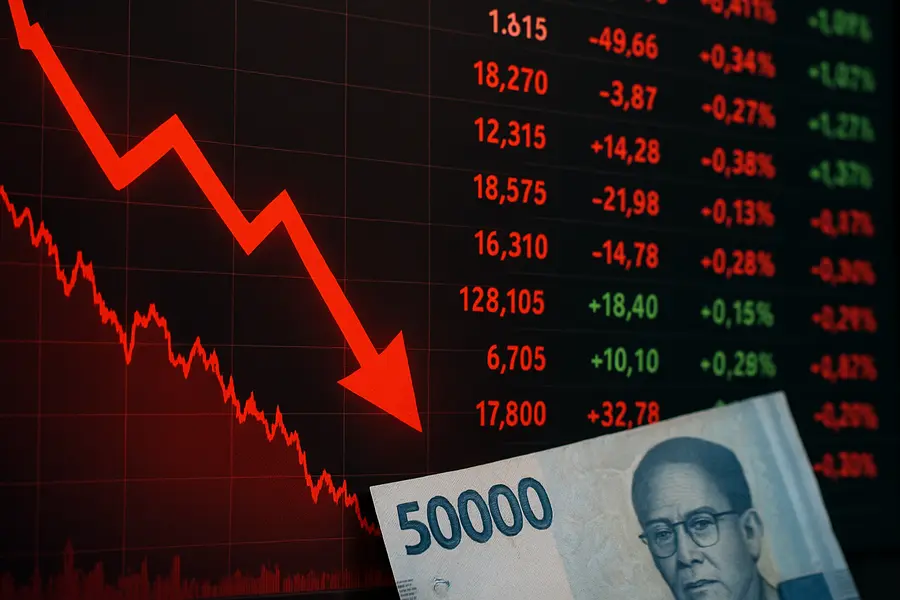
Jakarta's benchmark equity index drops 3.6% as the rupiah breaches 18,000 per dollar for the first time on record, hammered by $3.36 billion in foreign outflows and surging oil prices.
- The Jakarta Composite Index has shed roughly 37% from its 2026 peak, ranking as one of the worst-performing major equity benchmarks globally.
- Bank Indonesia delivered a surprise off-cycle rate hike to 5.5% on June 9, 2026, the second increase in less than a month, yet the rupiah continues to weaken.
- Cumulative net foreign equity outflows from the Indonesia Stock Exchange reached Rp 61.3 trillion ($3.36 billion) in 2026 amid a broad "Sell Indonesia" investor posture.
Lead
Jakarta, June 11, 2026 — The Jakarta Composite Index (JCI) shed 3.6% in Wednesday's session, extending a prolonged rout that has erased more than a third of the index's value from its 2026 peak. The Indonesian rupiah simultaneously weakened past the psychologically critical 18,000 per US dollar threshold, marking a record low and adding fresh urgency to an accelerating capital-flight episode that has rattled the broader emerging markets universe.What Happened
The JCI's decline reflected selling across virtually all sectors, with the materials subgauge leading losses, falling more than 9% on the heaviest-volume days of the broader selloff. The index has now posted a sequence of multi-year-low closes, with individual sessions recording intraday swings of up to 5.7% before partial recoveries. Wednesday's 3.6% drop brought the benchmark to its weakest level since mid-2021.
The rupiah traded at approximately 18,047 per US dollar at its weakest, surpassing its prior record set just weeks earlier at 17,706. The currency has depreciated more than 7% against the dollar year-to-date, ranking it among the hardest-hit emerging markets currencies in Asia in 2026.
Rupiah Under Pressure
A confluence of forces has driven the rupiah to historic lows. Elevated global oil prices have stoked fears over Indonesia's fiscal and current-account balances, as the country remains a net oil importer despite being a major commodity exporter. Broader dollar resilience, fueled by lingering risk-off sentiment tied to geopolitical tensions, has amplified outflows from emerging markets assets.
An additional structural pressure emerged earlier in the year when index compiler MSCI removed six Indonesian equities from its Global Standard Index during its May 2026 review. Although MSCI ultimately retained Indonesia's emerging market classification — averting a feared downgrade to frontier status — the deletion of stocks triggered automatic rebalancing by index-tracking funds, accelerating foreign selling pressure.
Foreign investors dumped a further Rp 3.7 trillion ($204 million) of Indonesian equities in a single session, pushing cumulative 2026 net outflows on the Indonesia Stock Exchange to Rp 61.3 trillion. Parallel selling in the bond market compounded the pressure on the rupiah, forcing Bank Indonesia to deploy foreign exchange reserves to defend the currency.
Bank Indonesia's Response
Bank Indonesia has responded with increasingly aggressive policy tightening. At its May 21 meeting, the central bank raised its benchmark 7-day reverse repo rate by 50 basis points to 5.25% — its first increase in two years and larger than the 25 basis points markets had anticipated. When the rupiah continued to deteriorate, the bank convened an emergency off-cycle meeting on June 9, delivering a further 25 basis point increase to 5.5%.Despite two hikes totaling 75 basis points in under three weeks, the currency has not stabilized. Bank Indonesia's foreign exchange reserves fell $1.3 billion to $144.9 billion at the end of May 2026 — the lowest level since June 2024 — reflecting the scale of intervention required to limit the rupiah's decline. Prior to the rate moves, the central bank had raised yields on its Rupiah Securities (SRBI) instrument from roughly 4.9% to 6.5% by early May, drawing approximately Rp 78 trillion in net foreign inflows through April; those inflows have since reversed.
Strategic and Structural Context
The selloff reflects both cyclical and structural vulnerabilities. Indonesia's inflation rate rose to 3.08% year-on-year in May, above consensus, narrowing Bank Indonesia's room to prioritize growth over currency stability. Investor concern has also focused on governance of the commodities sector, where fears of increased state intervention have weighed on equities in mining and energy — critical weights in the JCI.
President Prabowo Subianto's administration has publicly downplayed the rupiah's decline, with officials attributing the move to global dollar strength rather than domestic fundamentals. That framing has done little to reassure institutional investors, whose cumulative outflows in 2026 already exceed those recorded during the 2018 and 2020 stress periods.
The broader emerging markets context is mixed: while some Asian peers have also faced pressure from a strong dollar, Indonesia's combination of commodity-sector uncertainty, MSCI index rebalancing, and questions about central-bank independence has produced a sharper repricing than regional peers.
Outlook
Stabilization of the rupiah depends on a reversal in global risk appetite, a credible central-bank communication strategy, and evidence that inflation has peaked — none of which appears imminent. Bank Indonesia's rate at 5.5% provides some carry support, but further reserve drawdowns remain likely if foreign selling continues. The JCI's trajectory will hinge on whether global funds conclude the Indonesia market has repriced to levels that warrant re-entry, or continue treating the country as an emerging markets outlier requiring a wider risk premium. Near-term catalysts to watch include the MSCI August review, monthly trade balance data, and any policy signals on commodity-sector regulation.
Markets