Pomegra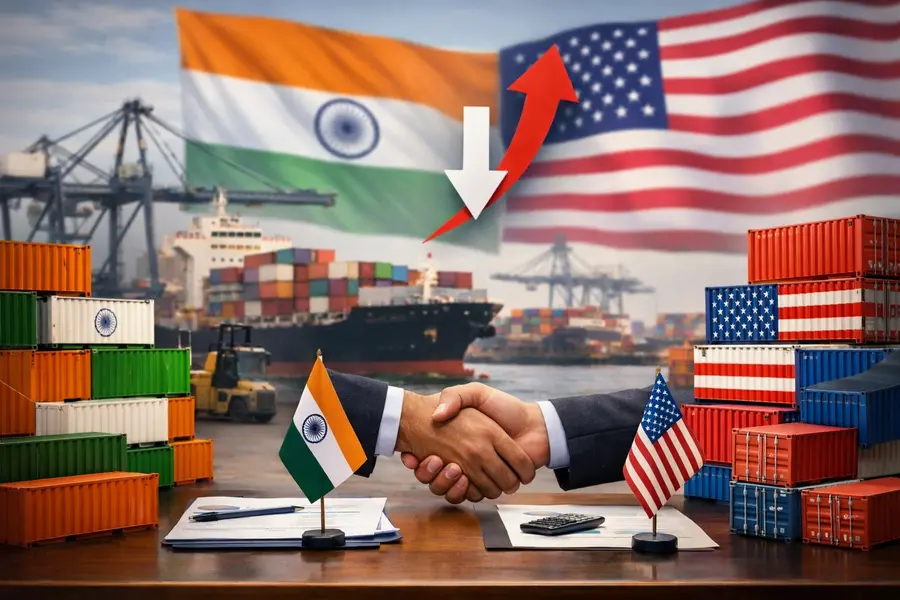
India reaffirms its commitment to bilateral trade negotiations even as the Trump administration imposes a 10% forced-labor tariff on 60 partners, sparing key Indian export categories.
- Washington imposed a new 10% tariff on Indian goods on July 25, citing forced-labor import violations, with a lower rate than peers.
- About 45% of India's US exports — including pharmaceuticals, smartphones, steel, and auto parts — are exempt from the new levy.
- New Delhi confirmed it remains committed to finalizing the India-US Bilateral Trade Agreement (BTA), calling engagement "ongoing."
Lead
New Delhi, July 25 — India's commerce ministry said it would continue engaging with the United States on a comprehensive bilateral trade agreement, hours after the Trump administration imposed a fresh 10% tariff on Indian goods as part of a sweeping new global duty regime targeting 60 trading partners. The announcement, effective July 25, replaced a temporary 10% tariff that had governed nearly all US imports since earlier in the year and drew on Section 301 of the Trade Act of 1974, with the White House citing inadequate enforcement of forced-labor import bans across the affected nations.What Happened
The Trump administration unveiled duties of 10% to 12.5% on goods from roughly 60 countries — covering an estimated 99.4% of all US imports by value — hours before a prior temporary tariff regime expired at midnight. Countries that adopted forced-labor prohibitions acceptable to Washington received the 10% rate; the remaining 41 nations face 12.5%.
India landed in the lower tier. The fresh 10% duty is also below the 12.5% rate that Washington had floated in June, a meaningful concession that New Delhi's negotiators had pushed for in weeks of talks.India's commerce ministry confirmed that approximately 45% of Indian exports to the United States fall entirely outside the new tariff's scope. Exempt categories include generic pharmaceuticals, smartphones, steel, aluminium, and auto parts — sectors that collectively represent some of India's highest-value and fastest-growing US-bound shipments.
Strategic Context
The new tariff round arrives at a delicate moment in India-US trade deal negotiations. A bilateral framework announced in February 2026 had already reduced the headline US tariff rate on Indian goods from 50% to 18%, with India committing to zero duties on US goods in select categories and an end to Russian oil purchases. That framework was designed as a bridge toward a full Bilateral Trade Agreement, covering services, investment, intellectual property, government procurement, and non-tariff barriers.
India-US trade relations have gained urgency in 2026 as both sides targeted a July interim agreement. Indian Commerce Secretary Sunil Barthwal stated in mid-July that the framework for an interim deal was "ready," while negotiating teams extended their Washington stay for additional rounds. The two-day talks concluded in late June had focused on product-specific tariff concessions and India's efforts to secure rates below those applied to competing Asian exporters including Bangladesh, Vietnam, Malaysia, and Pakistan.Geopolitical Dimension
Washington's forced-labor justification for the new global tariff wave signals a structural shift in US trade policy beyond purely reciprocal tariff logic. The tariff impact on emerging markets is asymmetric: nations with significant export exposure in apparel, electronics assembly, and manufactured goods face the sharpest headwinds, while countries — like India — that secured partial exemptions for high-margin sectors are better positioned to absorb the shock.
India's willingness to stay at the negotiating table despite the new measures reflects a calculated posture. New Delhi has consistently framed the India-US trade deal as a priority strategic relationship rather than a transactional exchange, investing political capital in securing preferential treatment relative to regional competitors. The lower 10% rate and extensive product exclusions are a partial vindication of that approach.
The broader global trade relations landscape is unsettled. Australia's trade minister called the new duties "completely unjustified," and New Zealand's prime minister described a 12.5% levy on his country as "extremely disappointing." The European Union and China, also in the 60-nation list, have not yet signaled retaliatory measures, but diplomatic channels are active across capitals.
Market and Economic Dimension
The tariff impact on emerging markets carries measurable weight for India specifically. The Global Trade Research Initiative had estimated that Indian exports to the US could decline from approximately $86.5 billion to around $50 billion in 2026 under an adverse tariff scenario. The product exclusions announced July 25 materially narrow that risk for sectors like generic pharmaceuticals — where India supplies roughly 45% of US dispensed prescriptions — and electronics, where Apple and its contract manufacturers have accelerated India-based production.
At the same time, elevated tariffs on competing exporters in Southeast Asia may accelerate multinational supply-chain diversification toward India, partially offsetting the direct cost of the new duty on affected goods.
What Comes Next
India's negotiating team is expected to return to Washington for further talks in coming days, with both sides working toward a final text on the interim trade agreement. Key outstanding issues include US demands for labor-standard guarantees from Indian exporters and India's push to lock in tariff rates below those faced by its regional rivals. A concluded interim deal would mark the most significant structural upgrade to bilateral trade ties in two decades and set the stage for a broader long-form agreement covering services and investment flows.
Outlook
New Delhi's decision to sustain dialogue after the July 25 tariff announcement reflects the strategic weight both governments assign to the India-US Bilateral Trade Agreement. With a 10% duty rate, extensive product exclusions, and an active negotiating track, India is better insulated from the new global trade relations disruption than most of the 60 targeted countries. The path to a finalized interim deal remains open, though the compressed timeline and unresolved labor and non-tariff-barrier questions mean the outcome is not yet assured.