Pomegra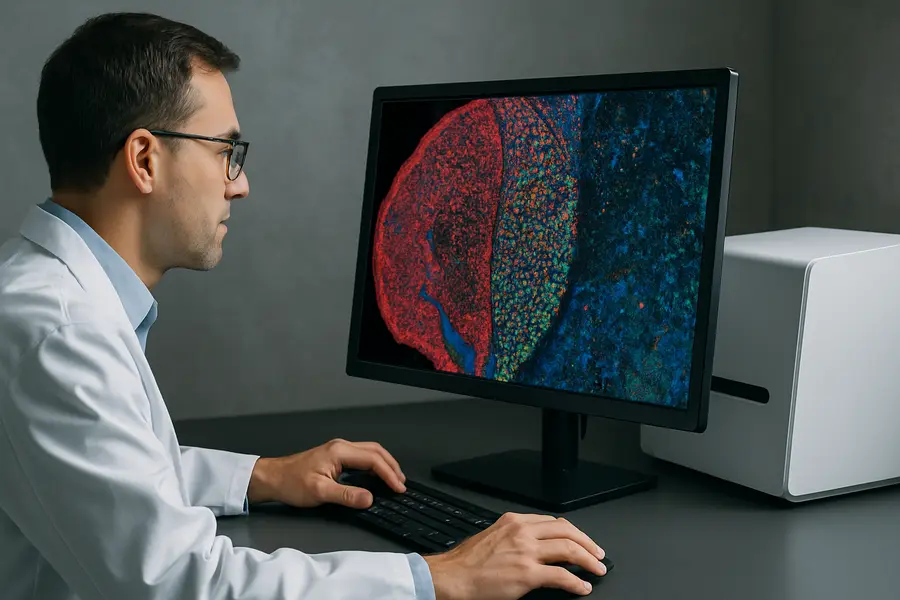
Illumina's StrataMap Spatial delivers end-to-end spatial research at single-cell resolution, detecting 2x more genes per sample than competing genomics tech platforms.
- StrataMap Spatial detects 2x more unique genes per sample than probe-based competitors and processes 2,000+ samples annually.
- The platform supports sample-to-insight workflows in under 5 days, with 22-hour sequencing on existing NovaSeq and NextSeq systems.
- Illumina targets a spatial transcriptomics market valued at up to $750M in 2026, projected to exceed $1B by the early 2030s.
Lead
Illumina (NASDAQ: ILMN) on June 8, 2026, launched StrataMap Spatial, an end-to-end sequencing-based platform for spatial whole-transcriptome spatial research, available to order immediately. The solution maps gene expression across a 7.5 cm² tissue capture area at single-cell resolution, detecting twice as many unique genes per sample as competing probe-based spatial biology technologies and completing full sample-to-insight workflows in under five days.What Happened
Illumina StrataMap integrates hardware, reagents, and bioinformatics into a single workflow designed to take researchers from raw tissue sample to actionable data without manual handoffs. Sequencing runs complete in as few as 22 hours on Illumina's existing NovaSeq and NextSeq platforms, allowing laboratories already committed to the company's infrastructure to adopt spatial workflows without additional capital equipment.The platform's 7.5 cm² capture area accommodates multiple fresh-frozen tissue sections simultaneously, including serial sections that support three-dimensional tissue reconstruction. Whole-transcriptome coverage extends to noncoding gene detection — a capability absent from panel-based competitors that restrict measurement to predefined gene sets.
Illumina Connected Multiomics and DRAGEN software manage end-to-end bioinformatics, from initial imaging through spatial clustering, filtering, and downstream biological interpretation. Throughput reaches more than 2,000 samples per year, addressing a key scalability constraint that has limited adoption of earlier spatial platforms.Early Research Applications
Researchers at Beth Israel Deaconess Medical Center conducted a pilot using StrataMap Spatial to profile lymphatic collector vessels — tissue types historically resistant to spatial analysis due to low cell density and structural fragility. The study produced the first whole-transcriptome spatial datasets for human lymphatic collector vessels, a result that illustrates the platform's sensitivity in challenging sample types.
Scientists at Cancer Research UK Cambridge Institute applied the platform to large central nervous system tumor sections, generating whole-transcriptome, single-cell-level data on tissue types that had previously eluded comprehensive spatial profiling. Both early applications demonstrate the platform's utility in discovery-stage research where the biology of interest is not yet defined well enough to be captured by targeted gene panels.
Strategic Context
The launch positions Illumina directly in a spatial transcriptomics segment valued between approximately $500 million and $750 million globally in 2026, with forecasts placing the market above $1 billion by 2031. The segment has grown rapidly as oncology, neuroscience, and developmental biology shift from bulk sequencing toward spatially resolved approaches that preserve the positional context of gene expression within intact tissue.
10x Genomics, NanoString Technologies, and Thermo Fisher Scientific hold established positions in probe-based spatial platforms. Illumina's whole-transcriptome, sequencing-based approach offers higher sensitivity for discovery research, at the cost of greater sequencing depth and computational demand — a trade-off that favors institutions running high-throughput research programs over clinical diagnostic settings where predefined panels are standard. ILMN shares traded in a range of $157.57 to $164.00 on June 8, with the stock near $157.81 during the session. The company's market capitalization stands at approximately $23.88 billion.Genomics Tech Competitive Dynamics
The broader genomics tech landscape is intensifying as spatial biology transitions from specialist technique to standard research infrastructure. Probe-based platforms offer reproducibility and lower data volumes but constrain discovery to known biology. Whole-transcriptome approaches reveal previously undetected signals — an advantage particularly relevant in oncology, where tumor microenvironment heterogeneity and novel biomarker identification remain central research priorities.
Illumina's distribution position reinforces the commercial case. Laboratories with existing NovaSeq or NextSeq capacity face no new hardware cost to begin spatial research, lowering adoption friction relative to platforms that require dedicated instruments. An FFPE-optimized version of StrataMap Spatial — targeting formalin-fixed paraffin-embedded archival tissue, the most common format in clinical biobanks — is scheduled for initial customer enablement in 2027, extending the platform's reach into translational and retrospective clinical research.