Pomegra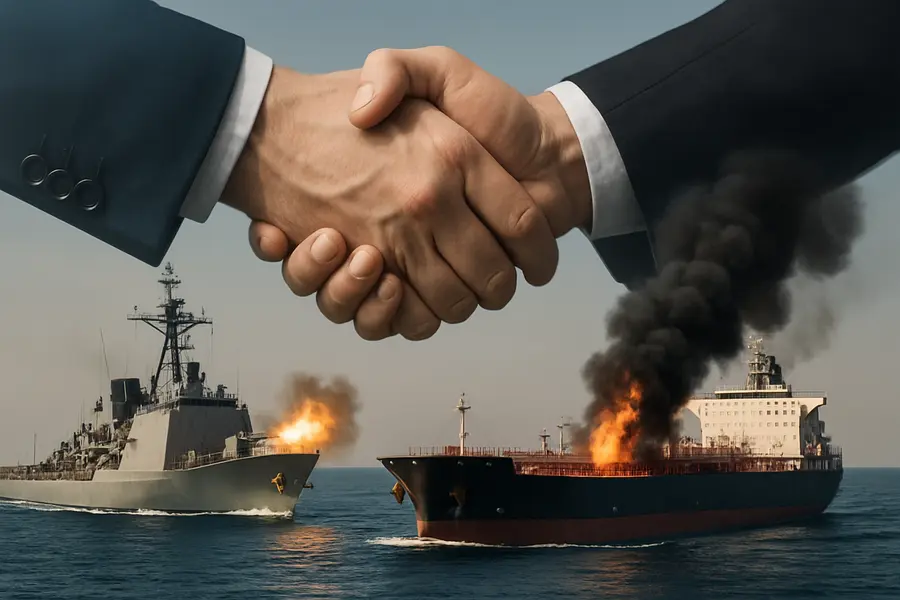
An Iranian drone strike on a Singapore-flagged cargo ship in the Strait of Hormuz halts a UN evacuation program, reigniting global shipping risk under a fragile peace deal.
- Iran's IRGC struck the Singapore-flagged Ever Lovely on June 25, damaging its bridge with no reported casualties.
- The IMO suspended its voluntary ship evacuation program, launched just 48 hours prior, as Brent crude surged as much as 4%.
- The attack raises urgent questions about the durability of a 60-day U.S.-Iran memorandum of understanding struck the previous week.
Lead
A drone launched by Iran's Islamic Revolutionary Guard Corps struck the Singapore-flagged cargo vessel Ever Lovely on June 25, 2026, approximately 7.5 nautical miles southeast of Dahit, Oman, as the ship exited the Strait of Hormuz. The strike damaged the vessel's bridge; no casualties or environmental impacts were reported. Within hours, the International Maritime Organization suspended its newly launched program to escort ships and seafarers out of the Persian Gulf, delivering the first serious stress test to a U.S.-Iran interim peace deal agreed the prior week — and triggering a fresh spike in global shipping risk assessments.
What Happened
The Ever Lovely was transiting under the IMO's voluntary evacuation initiative, which had launched on June 23 and offered two corridors — one through Iranian-controlled waters, one through Omani waters with U.S. oversight. The IRGC's strike came as the ship took the Omani route, a path Tehran had not sanctioned. Iran's Revolutionary Guards subsequently issued a formal warning: safe passage through the strait would be permitted only via routes designated by Tehran, and vessels that failed to comply would face consequences. The statement implicitly invoked a transit-fee framework that Iran had been pressing as part of ongoing negotiations.
Three tankers previously on course to depart the Gulf through Hormuz reversed direction, while three others diverted, according to vessel-tracking data reviewed by multiple maritime security firms. The IMO did not give a timetable for resuming escort operations.
Market Reaction
Brent crude futures jumped as much as 4% on June 25 before partially retreating. By June 26, Brent had retraced 1.80%, reflecting traders' uncertainty about whether the attack represented a deliberate escalation or a boundary-enforcement action. Prior to the incident, Brent had been trading near $78.24 per barrel — its lowest level since March 3 — as markets priced in the peace deal's promise of renewed Hormuz access. The partial rebound in oil prices illustrates the geopolitical tension premium that has shadowed energy markets since the crisis began in late February 2026. War-risk insurance premiums, which had eased modestly following the interim agreement, remain historically elevated. Insurers that were charging roughly 0.25% of vessel value for Hormuz transits before the February 2026 conflict now command between 3% and 8%, translating to insurance bills of $3 million to $8 million per large-tanker crossing. A Lloyd's-led consortium facility has assembled $400 million in aggregate marine war-risk capacity — an extraordinary measure reflecting a market under sustained strain.Strategic Context
The attack is the first confirmed vessel attack since Washington and Tehran signed a 60-day memorandum of understanding — an extension of a fragile ceasefire first struck in April 2026. The MOU's key terms committed Iran to a non-nuclear-weapons posture and authorized resumed Iranian oil exports, while Washington pledged to lift its naval blockade of Iranian ports and allow commercial tanker traffic to flow through Hormuz. Full implementation steps, including demining and removal of naval restrictions, had not been completed before the Ever Lovely was struck.
The Strait of Hormuz handles approximately 20% of global seaborne oil and a significant share of liquefied natural gas exports. Daily ship traffic through the strait had fallen roughly 95% from an average of 178 vessels per day before the February crisis. Most major carriers rerouted to the Cape of Good Hope, adding up to 14 days of transit time and tying up capital across just-in-time supply chains already running lean.
Geopolitical Dimension
Iran's willingness to strike a vessel transiting under IMO supervision — and to justify the strike on the basis of unauthorized routing — reflects Tehran's effort to convert military leverage into a durable economic mechanism. By asserting control over which corridors are permissible, the IRGC is effectively seeking to institutionalize a transit-fee regime and retain strategic influence over the waterway even under a formal peace framework. That posture directly challenges the U.S. insistence on freedom of navigation as a non-negotiable principle.
The episode also illustrates the enforcement gap in the MOU: the accord contains no explicit mechanism for resolving disputes over routing designations or adjudicating IRGC actions in real time. Diplomats involved in the negotiations acknowledged the ambiguity, and U.S. officials confirmed the Iranian origin of the drone strike while stopping short of characterizing it as a violation of the peace deal.
The maritime security news cycle around Hormuz has historically fed back into broader geopolitical tension between Washington, Tehran, and regional partners, including Gulf Arab states whose own hydrocarbon export revenues depend on unimpeded strait access.
What Comes Next
Negotiating teams from both sides were expected to meet in the days following the attack, with U.S. officials stating that dialogue remained open. Absent a clear remediation mechanism, however, shipping operators and insurers face a structurally uncertain environment. The IMO has indicated it will reassess resuming escort operations once the security situation is re-evaluated, but has provided no specific criteria for doing so.
Analysts tracking the 2026 Hormuz crisis note that a single incident of this kind, if left unaddressed within the MOU framework, risks normalizing IRGC interdiction as a tool of statecraft — raising the bar for any lasting peace accord.
Outlook
The IRGC drone strike on the Ever Lovely exposes a critical vulnerability in the U.S.-Iran interim agreement: the deal lacks enforceable maritime rules of engagement. With the IMO evacuation program suspended, tankers diverted, and war-risk premiums still at historic highs, the global shipping risk environment has worsened despite weeks of diplomatic progress. The path to reopening the Strait of Hormuz to normal commercial traffic now hinges on whether negotiators can translate a broadly worded MOU into operational protocols — and on whether Tehran's actions inside the strait reflect deliberate strategy or decentralized IRGC decision-making. Either answer carries significant consequences for energy markets, supply chains, and the durability of the peace deal itself.
Mentioned tickers: BNO, USO, FRO, STNG, INSW