Pomegra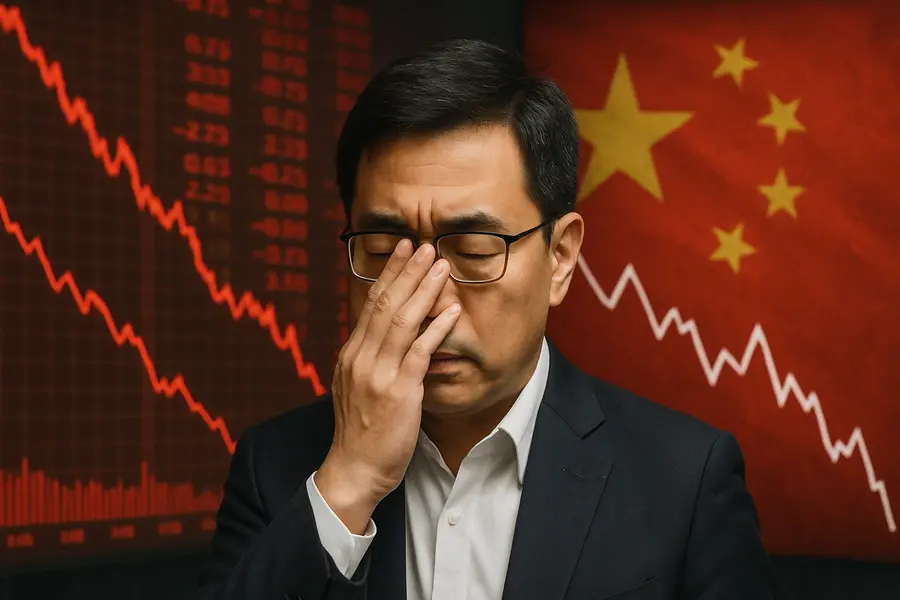
Chinese stocks listed in Hong Kong slid sharply on Monday as weak mainland consumption data pushed the Hang Seng China Enterprises Index to the brink of a 20% decline from its October 2025 peak — the technical threshold for a bear market.
- The HSCEI dropped as much as 2.3% on June 22, leaving it within fractions of a 20% drawdown from its Oct. 2, 2025 high.
- The index ranks as the second-worst performer among more than 90 global benchmarks tracked so far this year.
- Alibaba, Tencent, and Xiaomi led declines as investors rotated out of internet and consumer names after the June 19 holiday.
Lead
Hong Kong, June 22 — The Hang Seng China Enterprises Index slumped as much as 2.3% on Monday, pushing Hong Kong stocks to the cusp of a formal bear market as investors returned from a holiday break to find China's consumption picture darker than expected. The selloff left the index a fraction below the 20% decline from its October 2, 2025 peak that conventionally defines bear market territory, placing it among the worst-performing equity benchmarks globally in 2026.What Happened
Trading in Hong Kong resumed Monday following a one-day market closure on June 19. The reopening triggered immediate selling pressure across consumer-facing and internet stocks, with Alibaba Group (9988.HK), Tencent Holdings (0700.HK), and Xiaomi Corp (1810.HK) leading broad-based declines. Meituan (3690.HK) shed 3.5%, while Lenovo Group (0992.HK) fell 4.4%.
The broader Hang Seng Index has also come under sustained pressure, having touched a multi-month low of 24,494 in recent sessions — a level last seen in March 2026. The Hang Seng Tech Index has fared no better, logging a 2.71% single-session decline earlier this month to close at 4,755.91, underscoring the breadth of the retreat in Chinese tech stocks.
China Economy 2026: The Growth Concern
The immediate catalyst for Monday's move was fresh data pointing to weakening domestic consumption on the mainland, the demand engine that policymakers have been trying to ignite as the export-driven growth model faces increasing external headwinds in 2026.
Retail sales growth across China has barely exceeded 1% on a year-over-year basis, and consumer surveys reflect what analysts describe as a structural shift toward "thrift culture," with secondhand goods markets expanding and discretionary spending contracting. The bifurcation between resilient export activity and fragile domestic demand has become the defining tension of the China economy 2026 narrative.
The property sector remains a critical drag. In its fifth consecutive year of contraction, residential construction activity — measured by new home starts, sales volumes, and property investment — sits 50% to 80% below 2020–2021 peak levels. No clear bottom is in sight, and the sector's woes continue to suppress household wealth, consumer confidence, and local government finances simultaneously.
GDP growth forecasts for full-year 2026 range from 4.3% to 4.8%, below Beijing's approximate 5% target and representing a meaningful deceleration from the prior year's momentum. Deflation risk persists, with weak domestic demand failing to provide the pricing power needed to lift producer or consumer price indices into positive territory in a sustained fashion.
Market Reaction
The Hang Seng index news on Monday reflected the cumulative weight of these macro headwinds. The HSCEI's proximity to a 20% decline from its peak is not merely a symbolic threshold — it signals a potential reassessment of position sizing among institutional investors who benchmark against the index, which could amplify selling pressure in the near term.
The Hang Seng Tech Index has also faced a paradox: despite a wider surge in artificial intelligence-related equities globally, Hong Kong's technology benchmark has underperformed. Investors appear skeptical that near-term AI monetization will materialize quickly enough to offset the drag from slowing consumer spending at companies whose revenues depend heavily on advertising, e-commerce, and food delivery volumes across the mainland.
Rotation within the market is visible. Capital is shifting from internet and consumer-facing names into hardware and semiconductor-adjacent Chinese tech stocks with more direct AI infrastructure exposure — a pattern that reflects a flight to what the market perceives as more defensive secular growth, rather than broad conviction in the Hong Kong equity story.
Strategic and Structural Context
The current selloff has geopolitical and structural dimensions that extend beyond the immediate data. China's ongoing trade tensions with the United States have complicated the export engine at the same moment that domestic consumption is faltering, leaving policymakers with limited levers that have not already been deployed.
Stimulus measures introduced over the prior 18 months — rate cuts, property purchase relaxation, consumer goods trade-in subsidies — produced a rally from mid-2024 through the October 2025 peak. That optimism has since unwound as the market confronted the reality that policy support can smooth the path but cannot substitute for genuine private-sector demand recovery.
Foreign institutional flows into Hong Kong stocks have also moderated relative to the late-2024 surge, as global allocators weigh the structural risks in the mainland economy against valuations that, while lower than Western markets, no longer appear as compelling given the earnings growth slowdown.
Outlook
The Hang Seng China Enterprises Index stands at an inflection point. A close below the formal 20% bear market threshold would likely intensify institutional attention and could prompt further re-rating of Chinese tech stocks dependent on mainland consumer spending. The key variables to watch over the next three to six months are the trajectory of retail sales data, the pace of property market stabilization, and whether Beijing introduces meaningful additional fiscal support before year-end. Absent a credible improvement in domestic consumption — the central pillar of the China economy 2026 recovery thesis — Hong Kong stocks face continued headwinds, with the Hang Seng index struggling to find a technical floor.
Mentioned tickers: 9988.HK, 0700.HK, 1810.HK, 3690.HK, 0992.HK, ^HSI, ^HSCE