Pomegra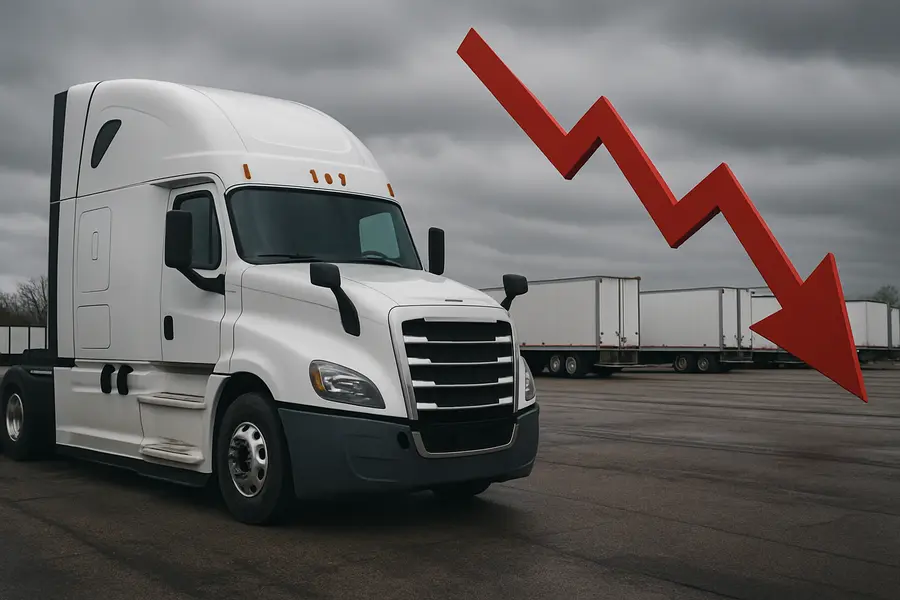
Heavy truck sales have plunged to four-year lows, a pattern that has historically preceded every major US recession since 1979, raising concern among economists and fleet operators alike.
- Class 8 truck sales fell 13.3% year-over-year in 2025, with Daimler Truck North America posting a 39% unit decline in Q3 alone.
- Industry forecasters project an additional 10–25% drop in H1 2026, with full-year volume forecast at approximately 171,000 units.
- The freight market recession, now in its fourth year, is depressing orders as tariff uncertainty, excess capacity, and weak goods demand compound.
Lead
WASHINGTON — Sales of heavy-duty commercial trucks in the United States have fallen to their lowest level in four years, reinforcing a signal that has reliably foreshadowed recessions for nearly half a century. Class 8 truck sales — the 18-wheelers that move the bulk of American goods — declined 13.3% year-over-year through 2025, with monthly order volumes touching their weakest readings since early 2010. As a leading economic indicator, collapsing US trucking demand is drawing fresh scrutiny from institutional investors and policymakers weighing the odds of a broader contraction.What Happened
The deterioration is broad-based and accelerating. Daimler Truck North America reported Q3 2025 unit sales of 30,225 vehicles, down 39% from 49,346 in the same period a year earlier. Revenue for the division fell 33% to €4 billion. Through the first nine months of 2025, Class 8 sales across North America dropped 12% year-over-year.
McKinsey projects a further 10–25% decline in the first half of 2026, with full-year Class 8 volume estimated at approximately 171,000 units — an 18% reduction from 2025 levels. ACT Research placed January 2026 Class 8 net orders at roughly 30,800–32,500 units on a seasonally adjusted basis, a figure that, while modestly improved, remains far below the levels that historically accompany expansion.The Recession Connection
The link between heavy truck sales and the broader US economic cycle is one of the more durable relationships in macro forecasting. Since 1979, sharp collapses in Class 8 demand have coincided with or directly preceded every major recession, including the downturns of 1981–82, 1990–91, 2001, and 2008. The intuition is straightforward: businesses buy new trucks when they anticipate strong freight demand and growing industrial output. When confidence falters and order books thin, fleets defer capital expenditure — and the signal reaches the broader economy within two to four quarters.
The current downturn has now stretched across 24 consecutive months of predominantly negative year-over-year growth in heavy truck sales. Full-year US GDP growth for 2025 is projected at 1.8%, with goods-transport sector volume growing just 2.5% in inflation-adjusted terms — a pace inconsistent with robust industrial expansion.
Freight rates tell the same story. The for-hire carrier population remains approximately 35% above pre-pandemic levels, flooding the market with capacity and suppressing spot rates. Contract rate growth is running at roughly 2% annually — below the inflation threshold needed to restore carrier margins. Active truck utilization, while recovered from its 2022–23 nadir, has stalled.
Structural Shifts Clouding the Signal
The relationship between truck sales and recession has grown more complex since 2009, as services and technology now represent a larger share of GDP than in previous downturns. Periods of declining Class 8 demand have occasionally been "mid-cycle corrections" rather than recession harbingers, with the broader contraction following years later or not at all.
The economy's shift away from goods production toward intellectual and service-sector activity means fewer physical goods require hauling for every dollar of GDP generated. As ACT Research president Kenny Vieth observed, tariff-driven price increases effectively function as a consumption tax: "Goods cost 5% more… we're just going to get 5% less stuff, and stuff is what trucks haul."
Manufacturing offered one counterpoint. The Purchasing Managers' Index broke into expansionary territory in January 2026 and has held there through April — the longest streak of manufacturing expansion in approximately four years, providing a partial offset to the freight volume decline.
Market Reaction
PACCAR — maker of Kenworth and Peterbilt trucks — has guided US and Canada Class 8 retail sales for 2026 in a range of 230,000–270,000 units, a wider band than usual reflecting persistent uncertainty. The company's services segments posted record results in 2025, partially cushioning the blow from lower truck volumes. Daimler Truck has stated that any sustained North American recovery is unlikely before mid-2026, and has implemented a tariff surcharge that remains in effect.Shares of major truck OEMs have underperformed broader industrial indices over the trailing twelve months, reflecting compressed order visibility and margin pressure from input cost inflation.
Geopolitical and Trade Dimension
Tariff uncertainty is not merely a cost story — it is a timing story. With trade policy in flux, fleet operators are deferring purchases rather than committing to multi-year capital cycles. McKinsey notes that "what's driving the postponement of purchases is uncertainty more than actual profitability." This behavioral effect has the potential to produce a sharp rebound order surge once policy clarity emerges, distorting the signal value of near-term data.
Separately, Chinese truck OEMs have achieved 20–50% cost advantages over North American and European manufacturers through domestic production scale, a competitive pressure that will intensify as trade architecture evolves over the next five years.
Outlook
Heavy truck sales remain a credible leading economic indicator for the US even as the goods-to-services shift dilutes its predictive precision. A 24-month contraction in Class 8 demand, an extended freight recession, and 1.8% GDP growth collectively suggest an economy operating at diminished industrial capacity. The path to recovery hinges on freight rate normalization — projected no earlier than mid-2026 — tariff resolution, and an improvement in carrier profitability sufficient to restart fleet replacement cycles. Until those conditions align, the truck sales signal points toward continued caution.
Mentioned tickers: PCAR, DTG.DEAnalysis