Pomegra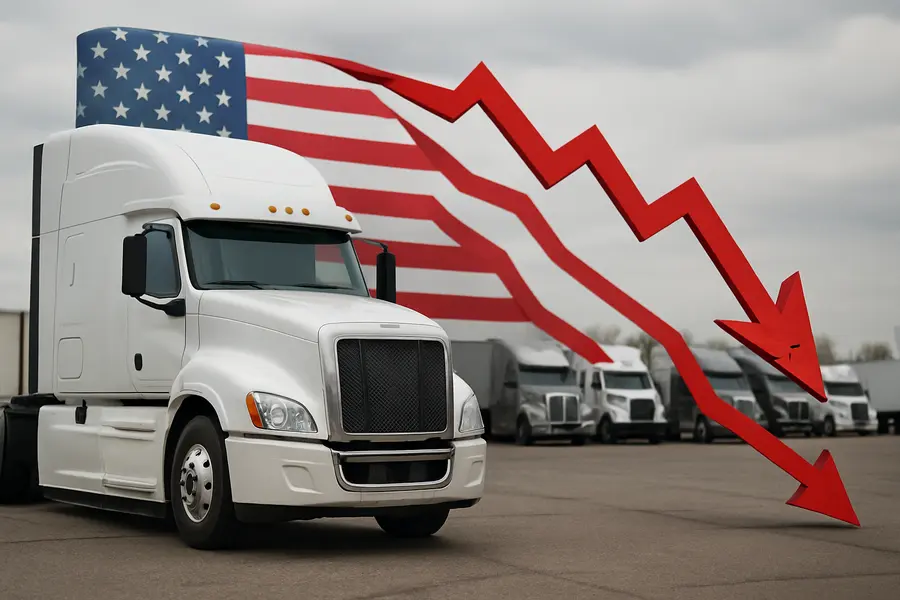
U.S. Class 8 truck deliveries fell 17.7% in Q1 2026, extending the longest freight recession in modern trucking history amid tariff pressure and weak freight demand.
- Q1 2026 commercial truck sales totaled 86,891 units, down 17.7% year-over-year; January deliveries hit a post-pandemic low of 12,287 units.
- Heavy truck sales have preceded all seven U.S. recessions recorded since 1973, with an average lead of roughly 13 months.
- Excess capacity, tariff-driven trade uncertainty, and elevated borrowing costs are keeping fleet operators on the sidelines through mid-2026.
Lead
Heavy truck sales in the United States continued their extended contraction in the first quarter of 2026, with commercial vehicle deliveries totaling 86,891 units — a 17.7% decline from the same period a year earlier, according to data from the American Truck Dealers association. January's Class 8 retail count of 12,287 units marked a post-pandemic low, down 24% from 16,175 units in January 2025. The breadth and duration of the downturn is reviving debate over whether heavy truck sales drop patterns are transmitting a credible US recession signal to policymakers and investors.What Happened
The weakness in Class 8 truck sales is not a recent development. Full-year 2025 saw U.S. heavy truck sales decline 13.6%, and the contraction has now stretched across more than two years of predominantly negative growth — a duration that exceeds every previous freight contraction of the modern era. November 2025 preliminary order data from FTR Intelligence showed North American Class 8 net orders of 20,200 units, down 17% month-over-month and 44% year-over-year, before a partial recovery in subsequent months.
The transportation economic data paints a picture of fleet operators reluctant to commit capital. Trucking companies, buffeted by low spot freight rates and compressed margins, have delayed or cancelled equipment upgrades. PACCAR (PCAR), the manufacturer of Kenworth and Peterbilt trucks, and engine supplier Cummins (CMI) both confronted softer order pipelines through the cycle trough, as fleet customers prioritized cash preservation over fleet renewal.
The Recession Indicator Debate
The historical record gives the current decline economic weight. Federal Reserve Bank of St. Louis data document that heavy truck sales fell in advance of all seven U.S. recessions recorded since 1973, with an average lead time of approximately 13 months. The logic is straightforward: fleets only purchase new trucks when they expect sustained freight demand; order cancellations reflect deteriorating cargo volumes and reduced business confidence before those trends fully appear in GDP figures.
Three prior episodes, however, produced similarly sharp declines in trucking news without a subsequent broad contraction, illustrating the signal's imperfection as a standalone indicator. In the current cycle, real GDP growth averaged 2.7% across the 24 months during which truck sales growth was predominantly negative — an unusual and notable divergence. FTR now projects full-year 2026 GDP expansion of 1.8%, well below trend, as tariff-distorted import and inventory swings suppress the headline figure.
Strategic and Macro Context
Three structural forces are holding back the heavy truck sales cycle simultaneously. First, excess trucking capacity accumulated during the post-pandemic freight boom has yet to fully clear. Carrier bankruptcies have been rising, but supply reduction has lagged the pace needed to rebalance the market. Second, in 2025 alone, more than 100 trade-policy announcements generated persistent uncertainty that paralyzed capital expenditure planning across shippers and carriers alike. Tariffs on imported goods reduced cross-border freight volumes and disrupted routing patterns, while raising the cost of truck components. Third, elevated financing rates have increased the hurdle rate for fleet acquisition, making the lease-versus-buy calculus consistently unfavorable for smaller operators.
ACT Research projected that tariff headwinds would extend the for-hire freight recession into 2026 following a temporary Q3 2025 lift driven by front-loading ahead of trade deadlines. The forward order picture shows some sequential recovery — March 2026 preliminary orders surged 130% year-over-year and May 2026 orders rose 103% — but analysts caution those comparisons reflect the extraordinarily weak baseline of early 2025 rather than a fundamental demand inflection.Market Reaction
Trucking stocks and logistics carriers including J.B. Hunt Transport (JBHT), Old Dominion Freight Line (ODFL), and Saia (SAIA) have faced persistent investor scrutiny over rate outlooks and volume trends. The prolonged freight recession has compressed operating margins sector-wide, and management commentary from large public carriers has pushed meaningful rate recovery expectations into 2027, with 2026 characterized as a stabilization year rather than a recovery year.
Outlook
The weight of transportation economic data suggests the U.S. heavy truck market remains in a cyclical trough with recovery conditions forming slowly rather than snapping back. Excess capacity clearing through attrition, aging fleet populations eventually forcing replacement orders, and a gradual improvement in freight fundamentals are the building blocks most cited for a 2027 recovery. Whether the sustained heavy truck sales drop this cycle translates into a broader US recession signal depends largely on whether tariff uncertainty abates enough to reactivate freight volumes and business investment. For now, the indicator is flashing caution without crossing into confirmed contraction — a distinction that policymakers and corporate planners are monitoring closely as 2026 unfolds.