Pomegra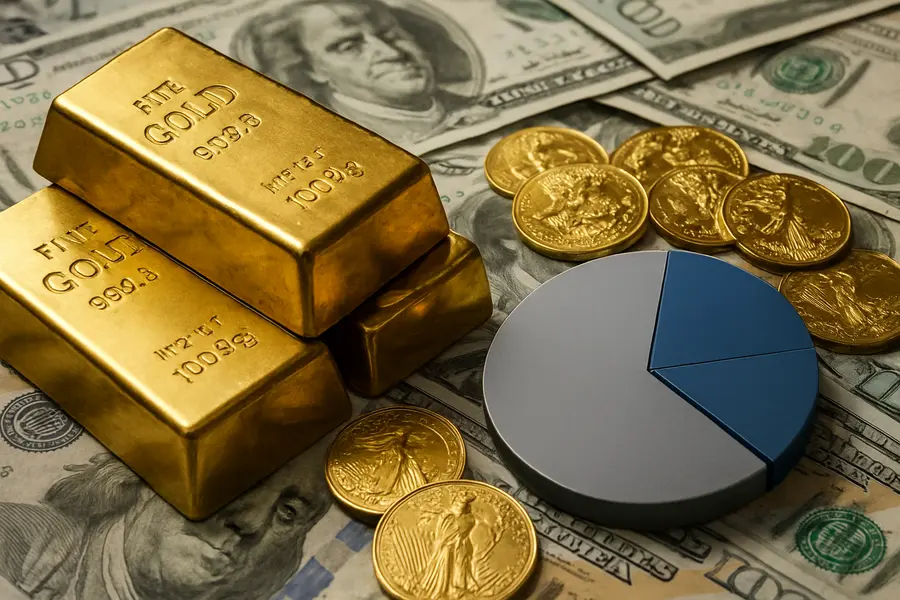
Jeffrey Gundlach's call for a 25% gold investment weighting has been validated by the metal's run past $5,500 — and the DoubleLine chief still sees upside as inflation and dollar weakness persist.
- Gundlach described a 25% portfolio allocation to gold as "not excessive," calling it an insurance policy in a weaker-dollar environment.
- Gold hit an all-time high of $5,595.42 on January 29, 2026, and trades near $4,440 as of June 3, following a correction from peak levels.
- Persistent U.S. inflation at 3.8% as of April 2026 and structural central bank demand continue to underpin the bull case for the metal.
Lead
Jeffrey Gundlach, chief executive of DoubleLine Capital and one of the most closely followed voices in fixed income, has repeatedly argued that institutional and individual investors are underweight gold by a wide margin. In a position that departs sharply from conventional portfolio theory, Gundlach has stated that allocating as much as 25% of a portfolio to the metal is "not excessive" — framing the holding not as a speculative wager but as a structured economic hedge against dollar debasement, sticky inflation, and a fiscal trajectory he regards as unsustainable. With gold having surged to an all-time high of $5,595.42 in January 2026 before retracing to $4,440 per troy ounce in early June, the thesis has delivered outsized returns even as it now tests investors' resolve during a meaningful correction.What Gundlach Said
Gundlach's position on gold crystallized publicly in a September 2025 CNBC appearance, where he predicted the metal would close above $4,000 before year-end 2025 — a threshold it cleared decisively before continuing higher. His reasoning was multi-layered. "I still think a 25% type weighting in gold is not excessive," he said. "I think that is an insurance policy. It's in a winning mode because of the weaker dollar and I believe that's going to continue."
The comment reframed how a growing segment of institutional capital views precious metals: not as a zero-yield liability in a high-rate world, but as a mandatory line item in an era of currency debasement and expanding sovereign debt. For context, conventional portfolio construction has historically pegged commodity or gold exposure at 3–7% of total assets. Gundlach's 25% figure is roughly four times that upper bound.
The call has been refined through 2026. By January, Gundlach outlined a macro portfolio framework: 30% non-U.S. equities, 20% real assets, 30% high-quality bonds, and 20% cash. Within the real assets sleeve, he specified 10% in gold and 5% in a diversified commodity basket. By May 2026, he raised the total real assets allocation back to 20% as commodity-linked inflation showed renewed vigor.
The Macro Case
Several interlocking forces drive Gundlach's sustained conviction in Jeffrey Gundlach gold positioning.
Market Reaction and Institutional Demand
Gold's price action since Gundlach's original call has been dramatic. The metal appreciated more than 25% from early 2025 levels, breaching $5,000 for the first time in history and printing an all-time high of $5,595.42 on January 29, 2026. The correction since that peak — roughly 21% to current levels near $4,440 — mirrors historical consolidations following parabolic advances and has drawn fresh buying interest from institutional participants.
Central bank accumulation remains a structural pillar. J.P. Morgan projects combined institutional and central bank demand averaging approximately 585 tonnes per quarter through the balance of 2026, well above historical norms. The BRICS-adjacent economies — including China, India, Russia, and several Gulf states — have been systematic buyers as they reduce U.S. Treasury exposure and seek non-dollar reserve assets.
Physical gold ETFs have seen renewed inflows in 2026 after a period of outflows during 2022–2023, reflecting the shift in institutional positioning that managers like Gundlach began advocating well ahead of the consensus.Strategic Context
The gold investment narrative in 2026 is not occurring in isolation. Rising equity valuations in the United States, compressed credit spreads, and an inverted or flat yield curve have left institutional allocators searching for uncorrelated return streams. Gold's -0.05 to +0.15 long-run correlation with U.S. equities gives it diversification properties that few other liquid assets can match at scale.
Gundlach's preference for non-U.S. equities alongside gold also signals a broader strategic bet on dollar weakness. A falling dollar benefits foreign equity returns on a currency-adjusted basis, amplifies commodity prices, and historically supports precious metals. The three positions — non-U.S. stocks, real assets, and cash — form a coherent macro framework for a world in which U.S. asset exceptionalism recedes.
Outlook
Gold's correction from the January 2026 peak to approximately $4,440 per ounce has reintroduced a valuation conversation that was absent at the highs. Gundlach's stated willingness to add exposure aggressively near $3,500 implies he views the current range as acceptable, not distressed. The structural drivers — dollar erosion, above-target inflation, central bank demand, and sovereign debt pressures — remain intact. Whether gold reclaims the $5,000 level or consolidates further near current prices, the case Gundlach has made for treating the metal as a core portfolio allocation rather than a tactical trade continues to find institutional support in 2026.
Mentioned tickers: GLD, GDX, IAUAnalysis