Pomegra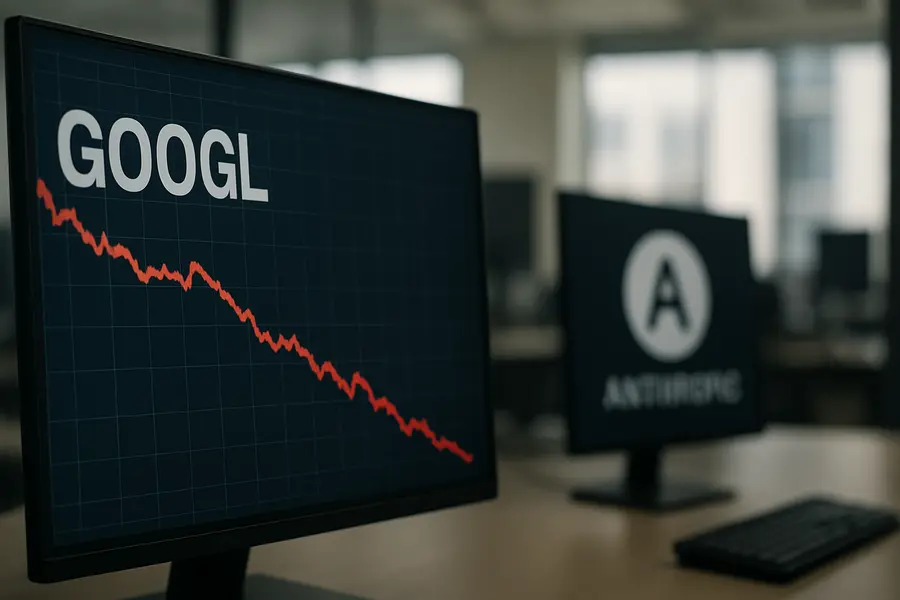
Alphabet shares extended their steepest slide in more than a year after Nobel Prize-winning DeepMind scientist John Jumper departed for Anthropic, completing a catastrophic week for Google's AI talent roster.
- GOOGL fell an additional 2.59%, extending a 6–7% single-session collapse on June 22—Alphabet's worst trading day in over a year
- John Jumper, 2024 Nobel Chemistry laureate and AlphaFold co-creator, announced his exit from DeepMind after nine years to join Anthropic
- Alphabet has shed roughly $269 billion in market capitalization since its May 18 all-time high of $408.61, as back-to-back elite researcher departures reshape the competitive landscape
Lead
Alphabet Inc. (NASDAQ: GOOGL) extended its worst losing streak in more than a year on Monday, June 23, shedding an additional 2.59% as markets processed the departure of John Jumper—2024 Nobel Prize laureate in Chemistry and co-creator of the landmark AlphaFold protein-prediction system—from Google DeepMind to rival Anthropic. The exit, announced June 19, follows Noam Shazeer's move to OpenAI by less than a week, compressing two of the most consequential AI talent departures in recent memory into a single trading week and erasing roughly $269 billion in Alphabet market value from the stock's record high.What Happened
John Jumper, who spent nearly nine years at DeepMind and shared the 2024 Nobel Prize in Chemistry with DeepMind CEO Demis Hassabis, disclosed his departure on X on June 19, noting he planned to recharge before beginning his role at Anthropic. Jumper co-developed AlphaFold2, which predicted the three-dimensional structures of more than 200 million proteins across approximately one million species—an achievement that compressed decades of biological and pharmaceutical research into months and made the results freely available to more than two million scientists across 190 countries.
The announcement compounded the blow delivered four days earlier when Noam Shazeer—co-author of the 2017 "Attention Is All You Need" paper that established the transformer architecture underpinning virtually every major large language model—announced his departure for OpenAI. Alphabet had spent approximately $2.7 billion to bring Shazeer back to the company through its 2024 acquisition of CharacterAI.
Market Reaction
GOOGL fell an additional 2.59% Monday, continuing a sell-off that began when Shazeer's exit was reported and accelerated sharply after Jumper's announcement. The June 22 session alone saw shares decline approximately 6–7%, marking Alphabet's worst single-day performance in over a year. From the stock's all-time high of $408.61 on May 18, the cumulative drawdown has now erased roughly $269 billion in market capitalization.Volume in both sessions was elevated well above the 90-day average, with institutional sellers pacing the decline. Alphabet notably underperformed the broader Nasdaq Composite across both sessions, signaling that investors are pricing in company-specific competitive risk rather than reacting to sector-wide macro pressure.
Strategic Context
The dual exits crystallize a dynamic that has been intensifying across the AI industry: concentrated foundational research talent has become the primary determinant of competitive differentiation, and startup compensation structures increasingly rival those of the most resource-rich hyperscalers.
The loss of Shazeer to OpenAI, meanwhile, carries particular symbolic weight. His co-authorship of the transformer paper gives OpenAI a figure whose intellectual fingerprint is on virtually every large language model in commercial use today—including the Gemini models he co-led before his departure.
AI and Technology Angle
AlphaFold's significance extends well beyond a single DeepMind product. The system's freely accessible protein structure database has accelerated drug discovery pipelines at pharmaceutical companies, academic institutions, and government health agencies globally, with researchers in oncology, infectious disease, and materials science reporting that timelines formerly measured in years have contracted to weeks. Its success demonstrated that deep learning could resolve century-old scientific problems that had resisted brute-force computational approaches.
Jumper's transition to Anthropic is likely to intensify competition specifically in AI for science—the emerging frontier where breakthroughs in chemistry, biology, and materials are increasingly dependent on foundational model capabilities. That market segment, which DeepMind has claimed as its defining competitive territory, now faces a better-resourced challenge from a startup that just added the field's most credentialed practitioner.
What Comes Next
Alphabet leadership faces simultaneous pressure on two fronts: retaining the research talent that underpins long-term AI competitiveness while justifying an accelerating capital expenditure program. The company raised its full-year 2026 capex guidance by $5 billion to a range of $180–$190 billion and completed an equity capital raise of approximately $84.75 billion in early June to fund infrastructure expansion.Investors will scrutinize whether the exits reflect structural or cultural conditions within DeepMind and Alphabet that could threaten further retention, or whether they represent isolated competitive poaching at the extreme high end of a historically tight market for AI research talent.