Pomegra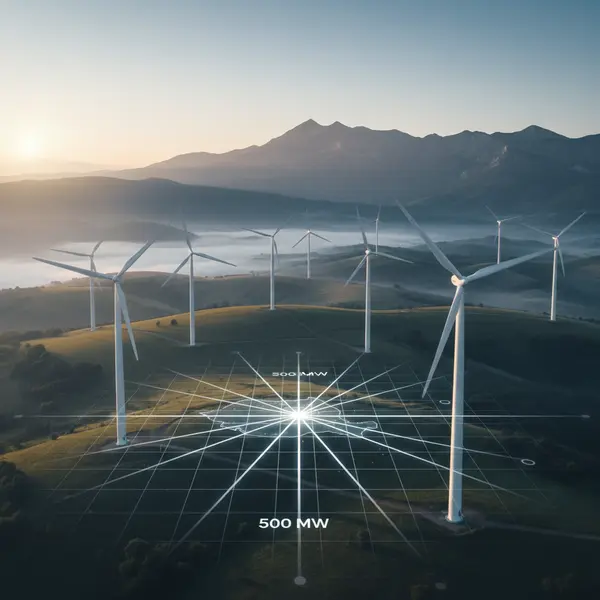
Lead
GE Vernova (NYSE: GEV) agreed in late 2025 to supply a combined 84 onshore wind turbines to Greenvolt International Power across two sites in Romania, anchoring approximately 500 MW of new generation capacity. Deliveries of the 6.1 MW–158m units are scheduled to begin in 2026 across both projects, which will together produce enough electricity to power more than 110,000 Romanian homes and businesses each year.What Happened
The first contract, covering the Ialomița wind farm in Ialomița county, was booked in the third quarter of 2025. GE Vernova agreed to supply, install, and commission 42 turbines rated at 6.1 MW each, producing approximately 252 MW at full output.
- GE Vernova will supply 84 of its 6.1 MW–158m turbines across two Romanian sites, producing approximately 500 MW of combined capacity.
- Both 42-turbine projects begin deliveries in 2026, supporting Romania's drive toward 7 GW of installed Romania wind capacity by 2030.
- GEV shares gained 71% in 2026, touching an all-time high of $1,181.95, even as the Wind segment posted a Q1 EBITDA loss of $382 million.
A second agreement, disclosed on December 4, 2025, added an identical 42-turbine package for the Gurbanești wind farm in Călărași county. The two contracts together complete Greenvolt's 500 MW Romanian expansion program. GE Vernova has also separately signed a smaller agreement with PPC Renewables — the clean-power arm of Greek utility Public Power Corporation — to install 14 of the same turbines at a site in Vaslui county.
The 6.1 MW–158m model is GE Vernova's flagship onshore unit, with more than 1,500 installations across 20 countries and the highest cumulative operating hours among turbines of comparable size outside China. Its 158-meter rotor diameter is well-suited to the lower average wind speeds found across Romania's southern plains.
Strategic Context
The Romanian agreements advance GE Vernova's European onshore wind growth strategy at a moment when the company is working through a difficult Wind segment recovery. Wind revenue fell 23% year over year to $1.4 billion in the first quarter of 2026, and the segment recorded an EBITDA loss of $382 million — the result of softer order activity in the first half of 2025, slower equipment deliveries, and an anticipated $250 million to $350 million tariff headwind for the full year. Management expects the segment to post a low double-digit revenue decline and approximately $400 million in EBITDA losses across 2026 as a whole.
At the consolidated level, GE Vernova's position remains markedly stronger. First-quarter 2026 revenue rose 16% to $9.3 billion, overall order backlog climbed to $163 billion — up 71% year over year — and the company raised its full-year revenue guidance to $44.5 billion to $45.5 billion. Free cash flow guidance increased to a range of $6.5 billion to $7.5 billion. The Romanian bookings, captured in the Wind backlog during 2025, represent deliverable revenue beginning this year.
Geopolitical Dimension
Romania's build-out of Romania wind and broader renewable energy infrastructure is driven by intersecting pressures: domestic decarbonization commitments, European energy-security imperatives following the disruption of Russian gas flows, and EU funding mechanisms that now directly underwrite grid expansion. Installed wind capacity stood at roughly 3,150 MW at the end of 2024; the government's updated National Energy and Climate Plan targets 7 GW by 2030, requiring annual additions of 450 MW to 600 MW throughout the remainder of the decade. Romania has also revised its overall renewable electricity target upward to 34% by 2030.
To sustain that pace, Bucharest has implemented Contracts for Difference that guarantee 15-year fixed-price floors for wind and solar developers. The inaugural CfD round awarded contracts covering more than 1.5 GW of capacity. The EU Modernization Fund has separately allocated EUR 400 million to the national transmission operator Transelectrica, including upgrades to a key high-voltage corridor in the Dobrogea-Constanța region that will enable connection of 600 MW of new renewable capacity.
Market Reaction
GEV shares reached an all-time high of $1,181.95 on April 23, 2026, following a first-quarter earnings release that beat consensus estimates, and the stock has gained approximately 71% since January 1. Renewable energy stocks broadly re-rated higher in the period, propelled by AI-driven data-center power demand and European energy-security capital flows. Despite the Wind segment's near-term headwinds, investors have continued to reward GE Vernova for its dominant positioning across gas turbines, grid electrification hardware, and a maturing onshore wind order book.Outlook
GE Vernova's dual Romanian contracts mark a concrete step in the Wind segment's order-to-revenue conversion as the business works toward restoring profitability. For Romania, the 500 MW Greenvolt footprint — together with the PPC Renewables agreement in Vaslui — brings the country meaningfully closer to the annual installation thresholds required to reach its 2030 wind target. With CfD pricing secured, grid investment committed, and turbine supply contracted, execution risk has shifted predominantly to permitting timelines and construction logistics, the variables that will ultimately determine the pace of Romania's energy transition.
Mentioned tickers: GEV