Pomegra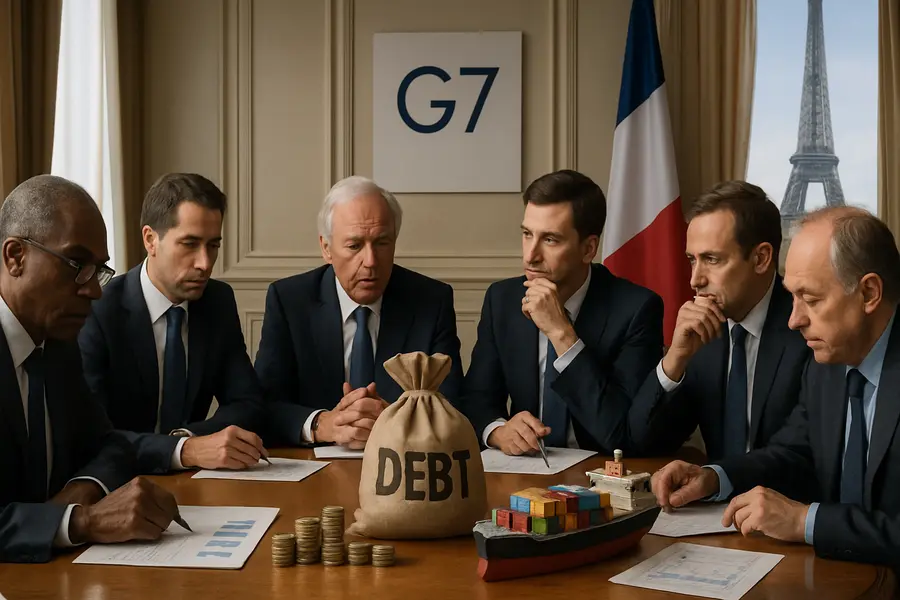
I have sufficient data to write the article now.
- G7 finance ministers met May 18–19 in Paris as Gulf oil disruptions of at least 10 million barrels per day stoked inflation and bond market stress.
- Global imbalances — China under-consuming, the U.S. over-consuming, Europe under-investing — framed the core of the Paris debt and trade agenda.
- A 15% universal U.S. import tariff is set to expire July 24, leaving G7 allies uncertain whether Washington will extend, escalate, or negotiate.
---
G7 finance ministers gathered in Paris on May 18–19 to confront surging public debt, bond market turbulence, and fracturing global trade as the Iran conflict and U.S. tariff deadlines sharpened the pressure on allied economies.
Lead
Finance ministers and central bank governors from the Group of Seven convened in Paris on May 18 and 19, 2026, alongside the heads of the International Monetary Fund, World Bank, OECD, and Financial Stability Board — a gathering that participants described as among the most consequential the bloc has held in years. The G7 Paris 2026 meeting faced a compounding set of crises: an active conflict in the Middle East that the International Energy Agency characterised as the largest oil supply disruption in the history of global energy markets, a looming U.S. tariff deadline, and a global debt crisis trajectory that has left most G7 sovereign balance sheets structurally strained heading into the late 2020s.What Happened
The finance ministers meeting produced a formal communiqué that acknowledged widening macroeconomic imbalances and committed members to policy coordination on fiscal consolidation, bond market stability, and supply chain security. France, holding the 2026 G7 presidency, had set the reduction of structural global imbalances as the headline ambition — a framework that implicitly targeted the pattern of Chinese under-consumption, American over-consumption, and European under-investment that French officials argued has made the global economy "clearly unsustainable" over the past decade.
Ministers endorsed Financial Stability Board recommendations on non-bank financial institutions, citing specific vulnerabilities including liquidity mismatch, hidden leverage, and opaque cross-border linkages in private credit markets. A dedicated G7 workshop on private credit was scheduled for the second half of 2026.
On fiscal policy, the communiqué called on countries with large and persistent external deficits to pursue domestic savings and fiscal consolidation — language that applies most directly to the United States, which carries the G7's second-largest debt burden, with Japan remaining the outlier at a projected gross debt-to-GDP ratio exceeding 254%.
Trade Tensions and the Tariff Clock
G7 trade tensions had already crystallised two weeks earlier, when trade ministers met in Paris on May 5–6 and issued a communiqué that stopped short of naming any country directly but reaffirmed "shared concerns regarding non-market policies and practices" — a formulation widely understood to address Chinese industrial subsidies, state-owned enterprise distortions, and forced technology transfer. Ministers called for deeper coordination to reduce "excessive dependencies" in strategic supply chains covering critical technologies, rare earths, and clean energy inputs.The finance ministers' session added urgency. A 15% universal U.S. import tariff — a residual legacy of the Trump administration's trade architecture — faces a legal expiration on July 24, 2026. G7 allies remain divided over Washington's intentions, and uncertainty over the tariff's fate has contributed to volatility in currency markets and corporate investment timelines across Europe and Japan. The communiqué called for dialogue and cooperation but produced no binding trade framework.
The Iran Variable
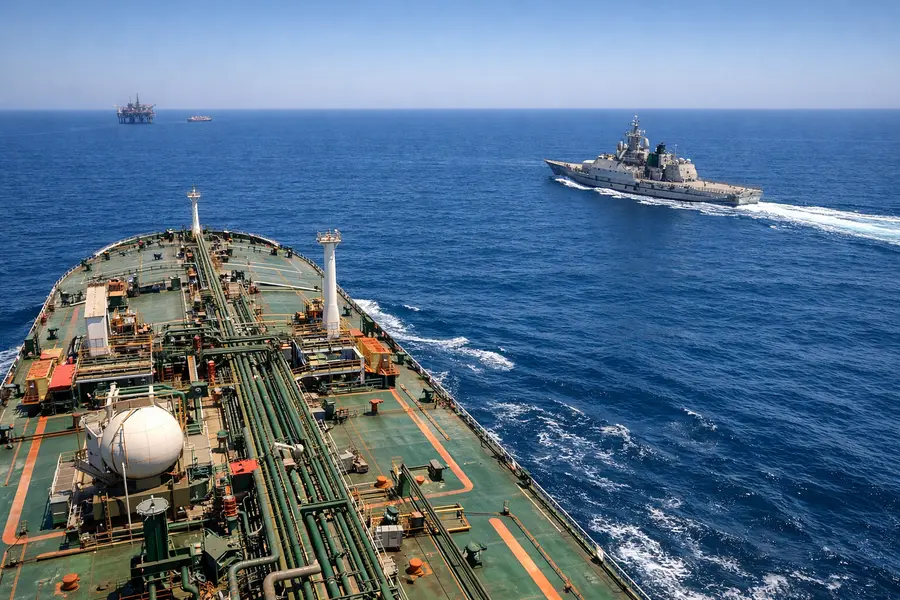
Geopolitical risk dominated the meeting's background conditions. The ongoing conflict involving Iran has produced what the IEA characterised as the largest supply disruption in the history of global oil markets. Collective output from Kuwait, Iraq, Saudi Arabia, and the United Arab Emirates fell by a reported 6.7 million barrels per day in early March, worsening to at least 10 million barrels per day by mid-month — a shock that fed directly into energy prices, food costs, fertiliser supply chains, and sovereign borrowing costs for commodity-importing economies.
The G7 communiqué acknowledged that the Middle East conflict posed heightened risks to both growth and inflation, pressuring energy, food, and fertiliser supply simultaneously. Shortly before the finance ministers' session, President Trump had announced what he described as a potential settlement with Iran that could reopen the Strait of Hormuz, but no signed agreement had materialised by the time the Paris communiqué was finalised, leaving the energy disruption unresolved.
Debt and Market Stability
Bond market volatility emerged as a parallel stress point throughout the Paris discussions. Inflation expectations, elevated by the energy shock, had pushed sovereign yields higher across G7 markets in the weeks preceding the meeting, complicating fiscal planning for governments already carrying elevated post-pandemic debt loads. The communiqué's emphasis on fiscal consolidation reflected a consensus that the combination of high debt levels and rising debt-service costs represents the central medium-term risk to G7 financial stability.
European economies, meanwhile, face their own structural challenge: the communiqué's implicit diagnosis of chronic under-investment applies most directly to the eurozone, where capital formation has lagged behind both the United States and China across multiple business cycles. France used its presidency to push partners toward a coordinated response, though the communiqué language remained aspirational rather than prescriptive.
Critical Minerals and Supply Chain Security
Beyond the immediate macroeconomic pressures, ministers addressed the accelerating competition for critical minerals. European data cited at the Évian summit preparation process estimated that the critical-minerals shortage had already cost affected European economies an estimated $1.5 trillion in aggregate economic impact. The G7 agreed to continue deepening exchanges to identify vulnerabilities in strategic sectors, with an explicit focus on reducing dependence on single-source supply chains for materials essential to defense, renewable energy, electric vehicles, and advanced technology manufacturing.
Outlook
The G7 Paris 2026 finance ministers meeting produced a record of shared concern but limited binding action — a pattern consistent with the group's recent history under conditions of elevated geopolitical stress. The immediate test arrives July 24, when the U.S. tariff deadline forces a concrete decision on G7 trade tensions. Beyond that, the communiqué's framework of fiscal consolidation and supply chain diversification sets the agenda for the leaders' summit at Évian-les-Bains, where heads of state will be expected to add political weight to the technical language agreed in Paris. The global debt crisis trajectory and the unresolved Iran conflict remain the two variables most likely to determine whether the Paris commitments hold or fracture under market pressure in the second half of 2026.
Mentioned tickers: USO, BNO, TLT, DXY, GLD, EWJ, EWG, EWQ, VGK