Pomegra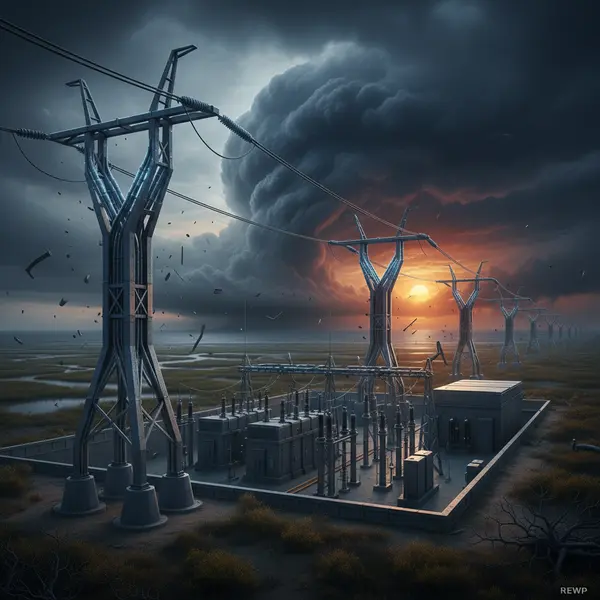
Florida Power & Light activates $1 billion in annual storm-hardening investments as the 2026 Atlantic hurricane season begins, deploying 246,000 intelligent grid devices across Florida.
- NOAA forecasts 8–14 named storms for hurricane 2026, with 1–3 reaching major status; El Niño suppresses activity but rapid intensification remains the key underweighted risk.
- FPL prep encompasses 2,000 miles of underground power lines and 246,000 smart-grid devices; self-healing technology prevented 1.6 million customer outages in 2025.
- Energy grid resilience costs hit up to $5 million per mile for storm-damaged transmission lines, concentrating financial exposure even in below-normal seasons.
Lead
Florida Power & Light (FPL), the nation's largest electric utility serving approximately 12 million customers, declared its 2026 hurricane readiness on June 1, the official start of the Atlantic season, as the National Oceanic and Atmospheric Administration (NOAA) issued a below-normal seasonal outlook forecasting 8 to 14 named storms, three to six of which could reach hurricane strength, with one to three becoming major hurricanes. While a developing El Niño pattern has dampened top-line activity expectations, FPL and federal regulators are warning that rapid intensification—storms that jump from Category 1 to Category 3 or stronger in under 24 hours—remains a poorly modeled and potentially severe threat to energy grid resilience throughout Florida and the Gulf Coast.What Happened
NOAA's 2026 Atlantic outlook assigns a 55% probability of a below-normal season and just 10% to an above-normal outcome. Intensifying El Niño conditions are expected to generate elevated upper-level wind shear across the Atlantic basin, suppressing tropical storm formation. AccuWeather projects 11 to 16 named storms, while Colorado State University centers its consensus estimate at 13 named storms, six hurricanes, and two major hurricanes—below the 30-year historical average.
However, sea surface temperatures in both the Atlantic and Gulf of Mexico remain above seasonal norms, providing a latent energy source that could fuel rapid storm development. Forecasters note that a single well-placed major hurricane striking a densely populated coastal corridor can cause tens of billions of dollars in economic damage irrespective of the total seasonal count.
FPL Prep: A Decade of Infrastructure Investment
FPL prep for hurricane 2026 rests on a capital program that allocates approximately $1 billion annually to storm hardening—a figure recovered from customers through a Storm Protection Plan monthly charge approved by the Florida Public Service Commission. The investments have materially altered the physical profile of the utility's distribution network.Some 97% of all FPL transmission structures statewide are now made of steel or concrete, resistant to wind loads that routinely destroy wooden poles. More than 250 miles of main power lines across Northwest Florida have been reinforced on hardened infrastructure since the prior season. The flagship Storm Secure Underground Program (SSUP) has converted 2,000 miles of neighborhood distribution lines to buried conduit; underground lines demonstrated up to 15 times greater storm resilience than overhead equivalents during the 2024 hurricane season.
Smart technology layers on top of the physical hardening. FPL has installed 246,000 intelligent devices statewide that continuously monitor line conditions, isolate faults, and reroute electricity automatically—a self-healing capability that the utility credits with preventing 1.6 million customer interruptions in 2025 without any direct storm event. In 2026, Miami-Dade County will see 203 new SSUP projects, Broward County 175 additional undergrounding conversions alongside 24 new intelligent devices, and St. Johns and Okeechobee counties are receiving targeted hardening reinforcements. A LiDAR-guided vegetation management program and a full companywide storm simulation drill round out the FPL prep posture.
Energy Grid Resilience: National Context
The investments reflect a broader national imperative around energy grid resilience. The North American Electric Reliability Corporation (NERC) reported that the North American grid added more than 58 gigawatts of new generation capacity since summer 2025—including 16.4 gigawatts of solar and 14.7 gigawatts of battery storage—yet cautioned that aggregate capacity gains do not eliminate concentrated geographic risk. Early summer heat events and planned maintenance outages can overlap, reducing available reserves precisely when seasonal demand peaks.
Florida's exposure is structurally acute. Transmission equipment, power lines, and transformers can cost up to $5 million per mile to replace and procurement lead times of several weeks are standard, meaning that rapid intensification events—which compress emergency preparation windows to hours—can translate to months of partial grid restoration in the most affected zones. The Federal Energy Regulatory Commission (FERC) has moved to strengthen nationwide reliability standards, while Florida policymakers continue to press utilities to accelerate SSUP timelines and expand smart-grid coverage into underserved inland corridors.
Market Implications
NextEra Energy (NYSE: NEE), FPL's Juno Beach-based parent, operates one of the most heavily capitalized utility infrastructure programs in North America. Regulated utilities typically pass storm hardening costs through approved rate structures, insulating per-share earnings from the bulk of catastrophic weather exposure. Below-normal seasonal outlooks historically temper near-term risk premiums on Florida-exposed utility bonds and equity, though that effect reverses sharply with named storm formation. NEE's renewable energy and grid technology segments also benefit from the broader national push toward distributed generation and battery storage that underpins energy grid resilience investments.Outlook
The 2026 hurricane season runs through November 30, with peak climatological activity between mid-August and mid-October. NOAA will revise its seasonal forecast in early August as El Niño's trajectory becomes clearer. FPL's multi-year hardening program provides a documented structural buffer, but Florida's geography—extending some 1,200 miles of coastline into warm Atlantic and Gulf waters—means that storm track variability remains the single variable no engineering investment can control. The test of the utility's energy grid resilience posture will ultimately be set by what hurricane 2026 delivers between August and October.
Mentioned tickers: NEE