Pomegra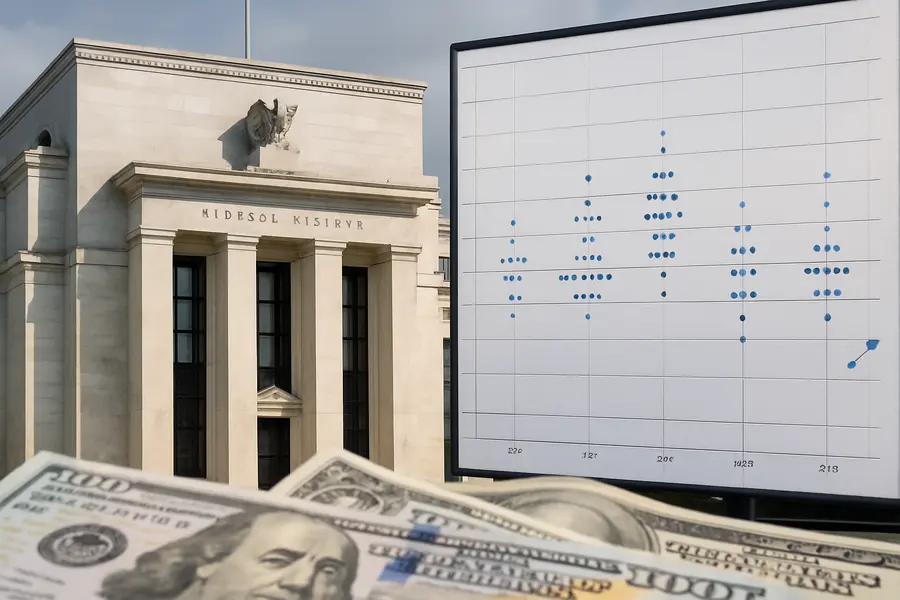
The Federal Reserve kept its benchmark rate unchanged at the June 2026 FOMC decision while projections flipped to show a majority of officials now expect at least one rate hike before year-end.
- FOMC voted 12-0 to hold the federal funds rate at 3.5%–3.75% on June 17, 2026.
- Nine of 18 officials now project at least one rate hike in 2026; median year-end rate forecast rose to 3.8% from 3.4% in March.
- Median PCE inflation projection for 2026 surged to 3.6%, up from 2.7% in March, the highest forecast in over three years.
Lead
The Federal Open Market Committee voted unanimously 12-0 on June 17, 2026, to leave the federal funds rate target range unchanged at 3.5% to 3.75%, even as updated economic projections revealed a sharp pivot in the committee's rate outlook. For the first time since the current tightening cycle began, the median dot-plot projection for 2026 moved above the current policy rate — signaling that the FOMC decision 2026 era of patient holds may be giving way to renewed rate increases. The meeting was the first chaired by Kevin Warsh, who succeeded Jerome Powell, and it delivered a clear message: central bank policy remains on hold for now, but the next move is more likely to be up than down.
What Happened
The committee held the benchmark overnight borrowing rate at a range that has been in place since the Fed interest rates were cut by a cumulative 75 basis points in the latter half of 2025. That pause reflected a period of assessed disinflation, but the June 2026 Summary of Economic Projections (SEP) overturned that assumption.
The median projection for the federal funds rate at year-end 2026 rose to 3.8%, a 40-basis-point increase from the 3.4% median in the March SEP. The shift erased any remaining expectation for a 2026 cut: eight officials placed their dot at the current 3.625% midpoint, one sat below it, and nine — exactly half the committee — placed projections above it. Six of those nine foresaw two separate 25-basis-point hikes before December.
Inflation is the driver. The June SEP lifted the median PCE inflation forecast for 2026 to 3.6%, a 90-basis-point revision from the 2.7% projected just three months earlier. Core PCE was revised to 3.3% from 2.7%. Seventeen of 18 officials judged risks to inflation as tilted to the upside. Meanwhile, the 2026 real GDP growth forecast was trimmed modestly, to 2.2% from roughly 2.4%, suggesting policymakers see elevated prices without a proportional output gain. The Fed interest rates path now implies a stagflationary tilt rather than a soft-landing glide.
New Leadership, New Tone
Warsh's inaugural meeting introduced visible stylistic and procedural changes at the central bank. The post-meeting statement was dramatically shortened compared with the format maintained under Powell, eliminating explicit forward guidance language and dropping the catalogue of data points the committee had previously committed to monitoring. The new chair described the shift as an effort to reduce the Fed's tendency to over-signal its intentions.
Warsh also announced five internal task forces to review the Fed's communication approach, the data sources used in policy deliberations, and the analytical frameworks for assessing inflation. The structural review carries implications for how investors read future guidance, as the traditional reliance on specific language triggers — phrases such as "meeting-by-meeting" or "data-dependent" — is under active reconsideration.
The unanimous vote masked an underlying tension: the SEP distribution showed a committee genuinely split on 2026. The absence of dissents reflected procedural deference to the new chair rather than philosophical consensus.
Market Reaction
Fixed-income markets registered the hawkish shift immediately. The 2-year Treasury yield — the maturity most sensitive to near-term rate expectations — rose approximately 11 basis points on the day, as the rate hike possibility moved from fringe to base-case for a portion of the market. The 10-year yield moved in sympathy, steepening the curve modestly. Equity markets turned lower. The S&P 500 fell roughly 0.6% in the session following the 2:00 p.m. statement release and Warsh's press conference, as investors repriced the cost of capital and downgraded the likelihood of rate relief in 2026. Rate-sensitive sectors — utilities, real estate investment trusts, and long-duration growth equities — underperformed the broader index. Futures markets shifted to price in a first hike as early as October, with roughly even odds of a second by December.Strategic Context: Inflation and the Middle East
The inflation revision is not occurring in isolation. Elevated energy prices linked to the ongoing conflict in the Middle East have transmitted into consumer price indices across the United States, contributing to what officials describe as supply-driven price pressures. The June SEP characterized economic activity as expanding at a solid pace despite heightened uncertainty, and noted that inflation remains elevated relative to the 2% target, in part reflecting supply shocks that have lifted energy-sector prices.
The committee's projection assumes the inflation spike is concentrated in 2026: median PCE is forecast to fall to 2.3% in 2027 and return to the 2.0% target by 2028. That path depends on geopolitical stabilization that is far from assured, and it anchors the case for resuming hikes in the second half of this year if price data does not soften.
Outlook
The FOMC decision 2026 delivered a status-quo rate hold with a distinctly hawkish revision to the forward projection set. With nine policymakers now penciling in at least one rate hike, the burden of proof has shifted: the committee will need to see material disinflationary progress before it can stand pat through December. Warsh's structural review of Fed communications adds uncertainty to how precisely that progress will be telegraphed. Treasury yields have reset higher, equities have absorbed an initial repricing, and the next scheduled FOMC meeting — in July — arrives before the energy-price and core-inflation trajectory becomes appreciably clearer. The central bank news cycle will increasingly center on whether the July data package justifies what the dot plot has already implied.
Mentioned tickers: SPY, TLT, IEF, SHY, BND