Pomegra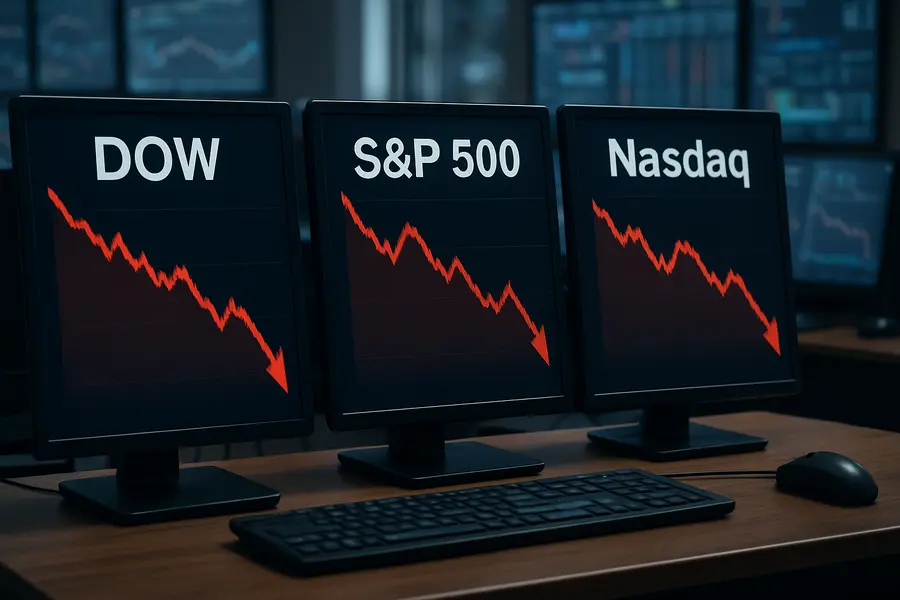
Lead
U.S. equity futures extended Monday's losses in early Tuesday trading on June 23, 2026, as a broad retreat from high-valued artificial intelligence positions compounded geopolitical uncertainty surrounding U.S.-Iran ceasefire negotiations. Futures tied to the Nasdaq 100 (NQ=F) slid 2.1% before the bell, those on the S&P 500 (ES=F) dropped 1.2%, and Dow Jones Industrial Average contracts (YM=F) eased 0.5%, setting the stage for one of the weaker opens in several weeks. The sell-off follows a session in which the S&P 500 shed 0.4% and the Nasdaq fell 1.3%, closing the prior day under pressure from Big Tech and a continued collapse in SpaceX stock.
- Nasdaq 100 futures fell 2.1%, S&P 500 futures sank 1.2%, and Dow futures slid 0.5% in Tuesday's premarket.
- Alphabet dropped 5% after a second top AI researcher departed for a rival; Amazon lost 4.8%, Microsoft fell 3%.
- SpaceX shares tumbled a third consecutive session, erasing roughly $600 billion in market value from its recent peak.
What Happened
The immediate trigger is a fracture in the AI investment thesis that has underpinned much of 2026's equity rally. Alphabet (GOOGL) plunged roughly 5% after a second senior AI researcher announced a departure to a competitor, raising questions about the durability of the company's technical edge in large-language-model development. The move follows months of concern that elite research talent is increasingly fragmented across better-funded rivals, startups, and internal projects at competing hyperscalers.
The damage radiated across the mega-cap complex. Amazon (AMZN) lost nearly 4.8%, Microsoft (MSFT) shed more than 3%, and Meta Platforms (META) fell 2.3%. Together, those five names account for a disproportionate share of S&P 500 and Nasdaq 100 index weight, amplifying index-level moves.
SpaceX (SPCX), the aerospace and satellite company that went public in May, extended its post-IPO slide into a third consecutive session, shedding roughly 16% in the prior close and dragging another estimated $600 billion off its market capitalisation. The stock had surged to an all-time high in the days after its debut, but SpaceX has since given back nearly a quarter of peak value as momentum traders exit and near-term growth-to-valuation scrutiny intensifies.Market Reaction
Asian markets reflected the U.S. weakness overnight. Japan's Nikkei 225 declined 3.6%, South Korea's Kospi fell 1.0%, and Hong Kong's Hang Seng dropped 2.1%. South Korean chipmakers were especially hard hit: Samsung Electronics and SK Hynix, both highly exposed to AI infrastructure demand, each fell more than 4%.
Defense stocks also came under pressure following reports that President Trump summoned major prime contractors and Pentagon officials to the White House to discuss U.S. munitions shortfalls. Lockheed Martin (LMT) lost 3.4%, L3Harris Technologies (LHX) fell 3.2%, Northrop Grumman (NOC) shed 2.6%, General Dynamics (GD) eased 1.9%, and RTX Corp. (RTX) declined 1.6%.Oil markets absorbed contradictory signals. Brent crude futures edged around $78 per barrel while U.S. crude hovered near $72.72 a barrel — both reflecting cautious optimism that U.S.-Iran talks are nearing a framework, which would reopen the Strait of Hormuz and ease supply constraints. Crude nonetheless failed to provide the traditional haven bid for energy equities.
Geopolitical Dimension
The U.S.-Iran diplomatic track remains the central macro variable for global markets. Mediators from Qatar and Pakistan have indicated both sides agreed on a roadmap to reach a final deal within 60 days. However, President Trump stated that Iran "will have to pay the price" for the pace of negotiations, injecting fresh uncertainty into the timeline. Any resumption of hostilities — or a breakdown in talks — would likely push Brent crude back above $80 per barrel, reignite inflation expectations, and force a reassessment of Federal Reserve rate-cut timing.
The Strait of Hormuz handles roughly 20% of global oil flows. A credible resolution keeps energy prices contained and provides a disinflationary tailwind for equities broadly; a collapse in talks reverses that dynamic quickly.
AI and Technology Angle
The Alphabet talent story is the latest manifestation of a widening crack in the AI-trade consensus. The thesis — that a handful of hyperscalers would capture outsized returns from generative AI by combining proprietary data, compute, and talent — is being tested as researcher mobility rises and open-source model performance closes the gap with frontier closed models. Markets had priced a significant talent moat into Alphabet, Microsoft, and Amazon valuations. Each departure reprices that assumption.
The sell-off also sets up a binary reaction to upcoming earnings. Cerebras Systems (CBRS) — the AI chip company that went public in May — reports Tuesday in its first earnings release as a public company. Micron Technology (MU) reports Wednesday. Both results will be read as proxy votes on whether AI infrastructure demand remains intact or is beginning to plateau.
What Comes Next
Thursday's release of the May PCE deflator — the Federal Reserve's preferred inflation gauge — looms as the week's most consequential macro data point. A hotter-than-expected reading would diminish the probability of a September rate cut and likely compound the current rotation out of high-multiple technology names.
The Russell 2000 closed at 3,000 for the first time on Monday, a signal that at least some institutional capital is rotating into small-caps and value sectors less exposed to AI multiple compression. That dynamic could deepen if large-cap tech continues to struggle.
Outlook
The convergence of an AI-trade unwind, geopolitical uncertainty around Iran, defense-sector caution, and pre-earnings positioning has produced the sharpest premarket pressure in several weeks. Near-term direction will be shaped by Cerebras and Micron earnings, the pace of U.S.-Iran negotiations, and Thursday's PCE release. Until clarity emerges on those fronts, the path of least resistance for the Nasdaq 100 and the broader S&P 500 remains lower.
Mentioned tickers: GOOGL, AMZN, MSFT, META, SPCX, LMT, LHX, NOC, GD, RTX, MU, FDX, CBRS