Pomegra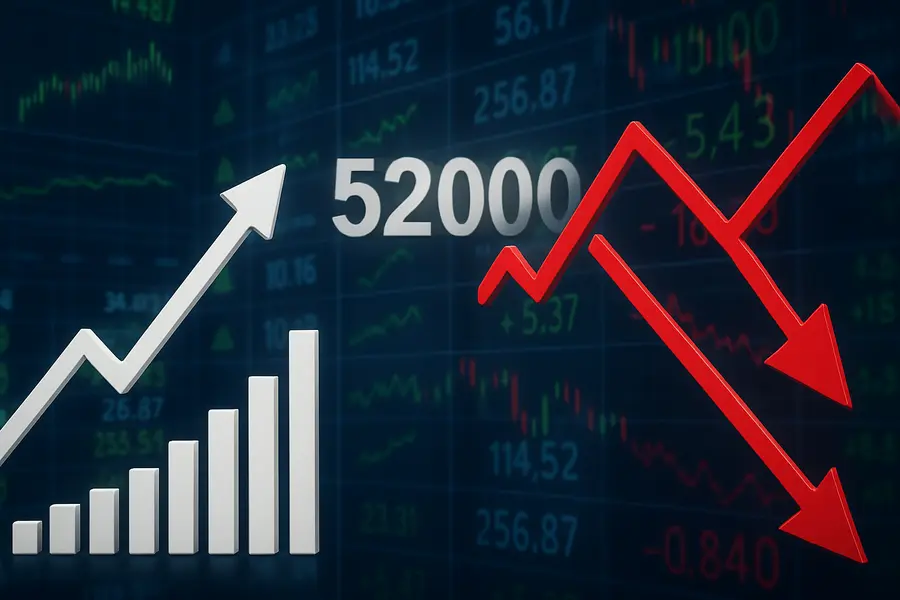
The Dow Jones crossed 52,000 for the first time as financials and industrials rallied, even as a semiconductor selloff dragged the Nasdaq to multiweek lows.
- The Dow closed at a record 52,003 on June 16, fueled by a 1.52% surge in financials and 1.26% gain in industrials as oil prices collapsed on a U.S.-Iran peace deal.
- The Nasdaq Composite has shed more than 1,300 points from its early-June highs, with roughly $1.4 trillion in AI semiconductor market value erased in the sector's worst week since April 2025.
- The Fed held rates at 3.50–3.75% but a hawkish June dot plot, with nine of 18 officials favoring a hike, amplified selling pressure on rate-sensitive growth stocks.
Lead
The Dow Jones Industrial Average closed at a record 52,003 on Tuesday, June 16, its first-ever finish above the 52,000 milestone, even as the Nasdaq Composite tumbled 307 points to 26,376 in the same session — a split that encapsulates a sweeping rotation out of high-multiple technology shares and into financials and industrials. Stretching across two weeks of volatile trading, the divergence reflects both the unwinding of an extreme semiconductor rally and shifting rate expectations under new Federal Reserve Chair Kevin Warsh.
What Happened
The Dow touched an intraday high of 52,190 before settling at 52,003, a gain of 328 points or 0.64%. Financials led every sector, rising 1.52%, while industrials added 1.26%, materials gained 0.77%, and utilities ticked up 0.76%. Goldman Sachs and Caterpillar were among the index's biggest contributors, benefiting from the Dow's price-weighted construction, which amplifies moves in high-priced components.
The same session saw the S&P 500 slip 43 points, or 0.57%, to 7,511, while the Nasdaq's 1.2% decline marked one of the widest single-session divergences between the blue-chip Dow and the tech-heavy Nasdaq recorded this year. Microsoft, Meta Platforms, Alphabet, and Amazon all closed in the red.
The Chip Selloff
The Nasdaq selloff traces directly to the semiconductor sector. Broadcom's fiscal second-quarter earnings on June 4 projected third-quarter AI chip revenue of $16 billion, below analyst estimates of $17.2 billion, and the company declined to raise its full-year AI revenue forecast. The miss punctured a rally that had carried the iShares Semiconductor ETF (SOXX) to its 32nd record close of 2026 just days earlier — a level representing approximately 89% in year-to-date gains.
On June 6, the Nasdaq fell 4%, its worst single session since April 2025. More than $1.4 trillion in AI semiconductor market value was erased across that week. Nvidia alone shed $279 billion in market capitalization; its shares sat at $204.65 as of June 17, down from an all-time high of $235.47 reached on May 14. AMD and Marvell Technology also posted sharp losses. The SOXX plunged roughly 10% to the $540 level in a single session, triggering a broader reassessment of AI-driven valuations across the index.
Oil, Iran, and the Cyclical Lift
The Dow record high drew additional fuel from a macro catalyst unrelated to technology: oil prices. Brent crude fell more than 5% to below $83 per barrel following the announcement of a preliminary U.S.-Iran peace agreement, with the Strait of Hormuz expected to reopen upon formal ratification. Lower energy costs eased input-price pressure for industrials and reduced the inflation risk premium that had been embedded in bond yields — a direct tailwind for the cyclical, dividend-paying names that anchor the Dow's composition.
That catalyst accelerated a rotation already in motion. With semiconductors facing a fundamental reassessment after the Broadcom miss, institutional capital moved into sectors with more direct leverage to a normalizing cost environment, particularly financials, which benefit from a stable-to-inverted yield curve, and industrials, where margin expansion follows falling commodity inputs.
The Fed Factor
Markets absorbed a further complication on June 17, when the Federal Reserve concluded its two-day FOMC meeting — the first presided over by Chair Warsh. The central bank held rates steady at the 3.50–3.75% range, but the accompanying dot plot showed nine of 18 officials favor at least one rate increase before year-end. The hawkish signal sent the Dow down 507 points to 51,493 the following day, retracing a portion of its record-session gains. The S&P 500 declined 1.21% to 7,420 and the Nasdaq selloff resumed, with the composite shedding a further 1.34% to 26,022.
Higher-for-longer rate expectations compress the present value of future earnings most severely for long-duration growth stocks, the category that dominates Nasdaq weighting. The FOMC outcome effectively reinforced the rotation trade: cyclicals and financials price off near-term cash flows, while megacap technology multiples remain sensitive to the discount rate at which those future profits are valued.
Intramarket Divergence in Context
The year-to-date performance gap between indices reflects how uneven 2026's equity rally has been. The Nasdaq gained roughly 16% since January, far ahead of the S&P 500's approximately 11% advance and the Dow's 6% rise. The semiconductor-led surge was always exposed to a rotation once valuations stretched beyond earnings growth trajectories — the AI capital expenditure cycle that drove SOXX to 89% gains created the conditions for exactly the kind of profit-taking now underway.
The Dow record high, by contrast, reflects a different kind of market confidence: one grounded in falling energy prices, resilient corporate credit, and financial sector earnings power rather than AI infrastructure spend projections.
Outlook
Two variables will determine the trajectory heading into next week. First, whether the U.S.-Iran peace agreement is formally signed — any breakdown would reverse the oil-price tailwind that powered the financials and industrials surge. Second, whether the Fed's hawkish dot plot translates into a confirmed rate hike announcement, which would further compress growth stock multiples and extend the Nasdaq selloff. The semiconductor sector's ability to stabilize after the Broadcom miss will also be closely monitored as an indicator of broader AI trade sentiment. With June 19 a federal market holiday for Juneteenth, the next full trading session brings the first test of whether the rotation holds or reverses.
Mentioned tickers: DJI, COMP, SPX, NVDA, AVGO, AMD, SOXX, CAT, GS, MSFT, META, GOOGL, AMZN, MRVL