Pomegra
The Dow Jones Industrial Average fell 561 points to 50,198 as the S&P 500 lost a fifth straight session and Nvidia closed down 2.9% after reversing early gains.
- The Dow fell 1.11% to 50,198.17; the S&P 500 slipped 0.23% to 7,323.63, its longest losing streak since June.
- Nvidia (NVDA) jumped 2.7% after earnings, then closed down 2.9%. The Nasdaq Composite still rose 0.42%.
- Federal Reserve minutes showed nearly all officials saw further rate increases as likely appropriate, lifting rate concerns.
Lead
Wall Street closed mixed on Wednesday, November 18, as the Dow Jones Industrial Average dropped 561.25 points, or 1.11%, to 50,198.17. The S&P 500 declined 16.90 points, or 0.23%, to 7,323.63, its fifth consecutive loss and its longest slide since June. The Nasdaq Composite gained 101.50 points, or 0.42%, to 24,429.88, and the Russell 2000 added 0.46% to 2,714.31.
The split reflected a session driven by two competing forces: a hawkish read of Federal Reserve minutes and a sharp reversal in the market's most closely watched AI stock.
What Happened to Nvidia After Its Earnings Report?
Nvidia (NVDA) erased a post-earnings rally within hours and closed down about 2.9%. The shares had jumped as much as 2.7% after the chipmaker reported profit and revenue above expectations, along with a stronger-than-expected forecast for the current quarter.Quarterly revenue reached $115.8 billion, up 103% from a year earlier, and guidance for the next quarter stands at roughly $130 billion, plus or minus 3%. The company said demand for AI computing infrastructure continues to accelerate.
The reversal showed how elevated expectations have become. A result that more than doubled year-over-year sales was not enough to hold gains when investors were already positioned for strength. Other chip names were uneven, with Micron Technology (MU) down about 1% and CoreWeave (CRWV) down about 4.1%.
Why Did the Dow Fall More Than the Nasdaq?
The Dow fell harder because of broad declines in energy, health care and other value-oriented stocks, while parts of the technology and consumer sectors held up. Energy shares dropped as Brent crude fell 1.3% to settle near $91.95 a barrel. Exxon Mobil (XOM) and Chevron (CVX) each lost about 4%. Health insurers also declined, including UnitedHealth Group (UNH), a heavily weighted Dow component.
Retail earnings offered some offset. TJX Companies (TJX) rose about 8% on better-than-expected results, and Target (TGT) gained about 4% after stronger third-quarter profit and a 5.6% rise in comparable sales.
How Do Fed Minutes Affect Interest Rates and Stocks?
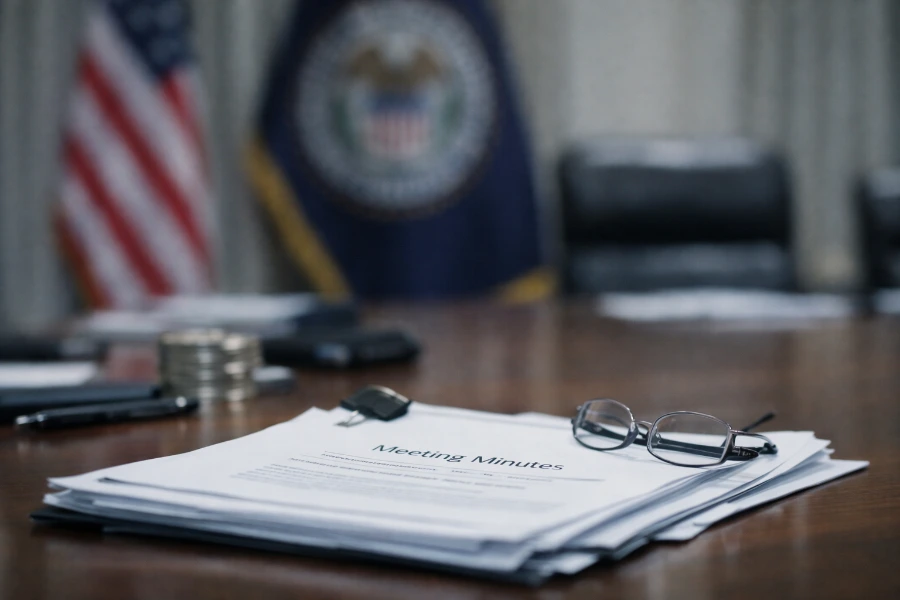
Minutes from the Federal Reserve's October meeting showed that nearly all participants judged additional rate increases appropriate if the economy evolves as expected. Some officials said a quarter-point increase could merit consideration at the next meeting if inflation data disappoint. The S&P 500 turned lower after the release.
Higher interest rates raise the discount rate applied to future earnings, which weighs most on richly valued growth stocks. The 10-year Treasury yield eased to about 5.06% from 5.10% the previous day, but it remains above 5%, a level that competes directly with equities for investor capital.
What Is the Stock Market Today Telling Investors?
The stock market today shows a narrowing of leadership rather than a broad retreat. The S&P 500 has fallen only modestly across five sessions, but the losses coincided with rising rate expectations and a market that now sells good news in its largest AI names. The Nasdaq's gain on Wednesday indicates that buyers remain active in selected technology and consumer stocks even as the large-cap benchmarks weaken.
The five-day streak is the longest since June. It leaves the index close to the 7,300 level, which is now a closely watched marker for near-term direction.
What Comes Next for Wall Street?
Attention turns to Thursday's Nasdaq debut of Anthropic, a gauge of appetite for new AI listings, and to the next batch of inflation data. A soft reading would ease pressure for a December rate increase and could end the S&P 500's losing run. A firm reading would reinforce the case for tighter policy and keep long-duration technology stocks under pressure.
Outlook
Wednesday's session ended with the Dow lower by 561 points, the S&P 500 stuck in its longest decline since June, and Nvidia unable to hold gains despite record revenue. The direction of rate expectations, shaped by incoming inflation data and Fed communication, is the main variable for the sessions ahead.
Mentioned tickers: NVDA, MU, CRWV, XOM, CVX, UNH, TJX, TGT