Pomegra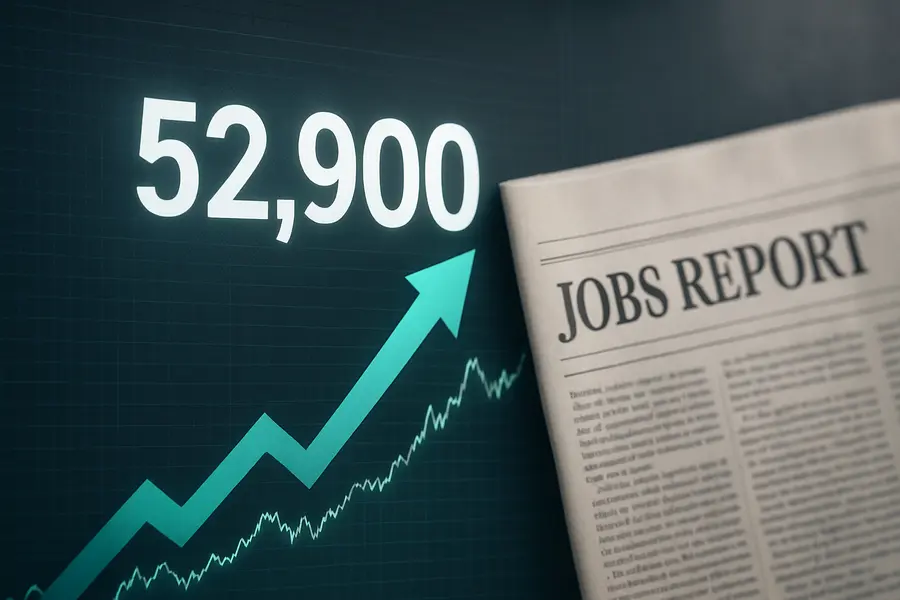
The Dow 30 set a fresh stock market record of 52,900 on July 2, driven by a weak US jobs report that added only 57,000 June payrolls, easing rate-hike fears and sparking a broad rotation into value.
- The Dow Jones Industrial Average surged 594.83 points, or 1.14%, to close at an all-time high of 52,900.07 on July 2, 2026, with an intraday peak of 52,903.85.
- June nonfarm payrolls rose just 57,000—below the 115,000 consensus—while prior months were revised down a combined 74,000.
- The Nasdaq fell 0.8% as chip stocks sold off sharply, underscoring a decisive rotation from growth into rate-sensitive value.
Lead
The Dow Jones Industrial Average surged to a fresh stock market record on Thursday, July 2, closing at 52,900.07—up 594.83 points, or 1.14%—after the US jobs report for June revealed a labor market cooling faster than expected. The Bureau of Labor Statistics reported nonfarm payrolls expanded by just 57,000 last month, less than half the 115,000 consensus forecast, triggering a rotation into value sectors that dominate the Dow 30 while leaving technology indexes behind heading into the Independence Day weekend.
What Happened
The Dow record high arrived on the final session of a holiday-shortened week, with markets scheduled to close July 3. The US jobs report, released Thursday morning, showed the economy added 57,000 nonfarm payrolls in June—a steep deceleration from May's downwardly revised 129,000 and roughly half the jobs market expected. The unemployment rate edged down to 4.2%, against a 4.3% forecast, but only because the labor force participation rate dropped 0.3 percentage points to 61.5%, its lowest reading since March 2021. Average hourly earnings rose 0.3% for the month, keeping the year-over-year pace at 3.5%.
Downward revisions compounded the softness. April's payroll count was cut by 31,000 to 148,000, and May's was trimmed by 43,000 to 129,000, leaving the two-month combined total 74,000 short of original readings.
Market Reaction
The divergence across indexes was stark. While the Dow 30 set its stock market record, the S&P 500 rose less than one point to 7,483.24, and the Nasdaq Composite fell 0.8% to 25,832.67. The rotation was driven by the jobs miss recalibrating rate expectations: a cooling labor market reduces pressure on the Federal Reserve to hold rates restrictive for longer, benefiting the Dow 30's heavier concentration in financials, industrials, and healthcare—sectors that gain from a lower-for-longer rate environment. Technology, having rallied sharply over recent months, offered the most obvious source of profit-taking.
Chip stocks absorbed the sharpest losses. The VanEck Semiconductor ETF dropped 4.5% on the session. Teradyne fell 13.6%, KLA Corporation slid 11.5%, Micron Technology lost 5.5%, and Nvidia retreated 1.4%. Tesla declined 7% despite reporting second-quarter vehicle deliveries that exceeded expectations—evidence that the selloff in high-multiple names ran broader than semiconductors alone.
Jobs Report Details
The sector breakdown of June's US jobs report revealed diverging labor market dynamics. Professional and business services led gains with 36,000 new positions, while social assistance added 25,000 and healthcare contributed 22,000. The primary drag came from leisure and hospitality, which shed 61,000 jobs as seasonal hiring patterns disappointed expectations.
The participation rate decline was the defining feature of the unemployment rate dip. With fewer Americans actively seeking work, the headline rate moved lower even as payroll growth stalled—a combination that complicates the Federal Reserve's read on underlying labor market health and makes the June data more ambiguous than a simple headline beat or miss.
Fed Rate Outlook
Financial markets moved quickly to reprice rate expectations. Futures markets raised the probability of the Federal Reserve holding its target range unchanged at the July 28–29 Federal Open Market Committee meeting, preserving the option to adjust further as additional data arrives through the summer.
The Fed has maintained that any move toward lower rates requires sustained evidence that inflation is returning durably to its 2% target and that the labor market is no longer contributing to price pressures. June's payroll miss moves both needles in the direction of greater Fed flexibility. Wage growth at 3.5% year-over-year, however, remains above pre-pandemic norms, sustaining questions about services inflation and ensuring policymakers will want more than a single soft month before signaling any policy pivot.
What Comes Next
The jobs deceleration arrives as the U.S. economy navigates lingering uncertainty around trade policy and global demand. Investors will closely monitor the FOMC meeting at month-end and July's payroll report, due early August, for confirmation of whether June's weakness is transitory or the beginning of a more sustained deceleration. Any additional softness in hiring could accelerate the rotation from growth to value that the Dow 30's stock market record began to signal.
Outlook
The Dow record high of 52,900.07 reflects a market recalibrating around slower growth and reduced rate pressure. A tepid US jobs report that would once have alarmed equity investors instead served as a catalyst for value-oriented buying, with financials, industrials, and healthcare absorbing capital exiting crowded technology positions. Whether that rotation proves durable depends on the Fed's response to accumulating labor market softness and whether June's 57,000 payroll print marks a floor or a trend.
Mentioned tickers: DJIA, SPY, QQQ, SMH, NVDA, MU, TSLA, TER, KLAC