Pomegra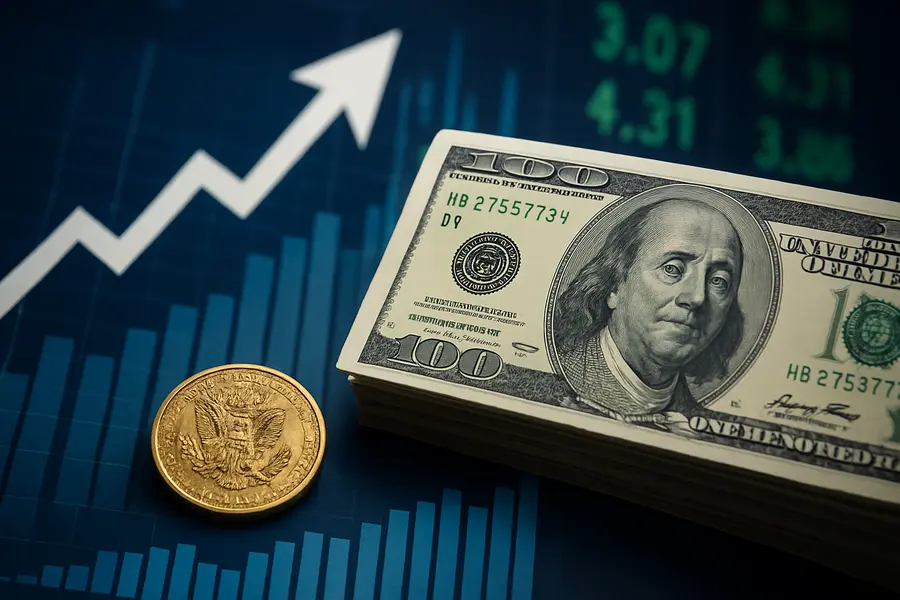
The U.S. dollar index surges above 101.7, its strongest reading since March 2025, as Treasury yields 2026 push to multi-year highs and markets brace for a pivotal inflation report that could lock in a September rate hike.
- The DXY rose above 101.7 Thursday, gaining roughly 1.5% on the week, its highest level since March 2025.
- The 2-year Treasury yield hit 4.232%, a 16-month high, while the 10-year climbed to 4.509% ahead of the PCE inflation report.
- Nine of 18 Fed officials now project at least one 2026 rate hike; markets price a 63.4% probability of a September move.
Lead
The U.S. dollar index (DXY) extended gains above 101.7 on Thursday, June 26, touching its strongest level in 15 months as Treasury yields surged across the curve and investors positioned ahead of the personal consumption expenditures (PCE) price index release — the Federal Reserve's preferred inflation gauge. The DXY has climbed approximately 1.5% since Monday's open, driven by a hawkish turn at the Federal Reserve's June 17 meeting and accumulating evidence that U.S. inflation is re-accelerating well above the central bank's 2% target.
What Happened
U.S. Treasury yields climbed sharply overnight, with the 2-year note rising more than 5 basis points to 4.232% — its highest since February 21, 2025 — while the benchmark 10-year yield advanced more than 5 basis points to 4.509% and the 30-year bond yield gained 4 basis points to 4.946%. Rising yields, by widening the interest-rate differential in favor of dollar-denominated assets, amplified demand for the greenback throughout the session.
The dollar's advance follows Federal Reserve Chair Kevin Warsh's first policy meeting, where the Fed held the federal funds target rate steady at 3.50%–3.75% but delivered materially more aggressive economic projections. Nine of 18 officials signaled support for at least one rate increase this year, with six of those calling for two quarter-point hikes — a significant shift from the easing posture that defined much of 2025. The Fed's updated Summary of Economic Projections raised the median PCE inflation forecast for year-end 2026 to 3.6%, up 0.9 percentage points from the March projection, while trimming the 2026 GDP growth estimate by 20 basis points to 2.2%.
Inflation Data in Focus
May's inflation readings set the stage for Thursday's report. Core PCE inflation — the Fed's primary price benchmark — accelerated to 3.4% year-over-year in May, up from 3.3% in April and the highest annual reading since October 2023. Headline PCE jumped to 4.1% from 3.3% the prior month. The May consumer price index told a parallel story: headline CPI climbed to 4.2% year-over-year from 3.8%, while core CPI edged up to 2.9%.
Thursday's PCE print carries outsized significance as the first full inflation reading since Warsh's hawkish pivot. The inflation data impact on Fed expectations is already visible in futures markets, where the probability of a rate hike at the September 15–16 FOMC meeting is priced at 63.4%. A reading that matches or exceeds May's core rate is likely to push that probability higher, sustaining the dollar's advance. A downside surprise could trigger a brief pullback, though the structural rate-differential backdrop remains supportive of the greenback.
Market Reaction
Currency markets responded swiftly to the yield surge and the DXY news. EUR/USD slid toward multi-month lows as the eurozone's more subdued inflation picture and a comparatively dovish European Central Bank leave the rate gap widening in the dollar's favor. USD/JPY pushed higher as the Bank of Japan's accommodative stance contrasts sharply with the Fed's newly hawkish posture. Emerging-market currencies broadly weakened, with dollar strength raising the cost of servicing dollar-denominated debt across developing economies.
Gold declined under the weight of the stronger dollar and rising real yields, reinforcing the breadth of the repricing under way across rate-sensitive assets. Rate-sensitive U.S. equity sectors — utilities, real estate investment trusts, and high-multiple technology names — lagged the broader market, while financials found support from the steeper yield curve.
Strategic Context
The dollar index rally reverses a consensus narrative that entered 2026 forecasting continued Fed easing. The DXY broke back above 100 in early June after spending much of the preceding period below that psychological threshold, and it has now extended those gains to a 15-month high, representing a decisive shift in the macro backdrop. The re-acceleration of Treasury yields 2026 across maturities reflects the market's recalibration of the entire rate path, not merely near-term policy expectations.
Warsh, who assumed the chairmanship earlier this year, has signaled a willingness to prioritize inflation credibility over growth considerations. The June dot plot's hawkish revision — the most material shift since the tightening cycle of 2022–2023 — has credibly reshaped market expectations in a way that few anticipated entering the second quarter. A secondary contributor to the dollar's strength is the easing of geopolitical risk. The U.S.-Iran interim peace agreement that took effect June 19 reduced broad risk-premium, strengthening confidence in the U.S. economic outlook while oil price moderation provides some offset to inflationary pressures.
What Comes Next
Thursday's PCE report is the immediate catalyst. A core reading above 3.4% will reinforce the case for a September hike and likely push the DXY toward 102 — a level traders have identified as near-term resistance. The next significant inflation checkpoint arrives with the June CPI report on July 14, 2026. Consecutive upside inflation surprises would place September's FOMC meeting firmly in live-hike territory and position the dollar as the best-performing G10 currency of the year.
The Fed's updated growth-inflation trade-off — lower GDP projections alongside higher inflation forecasts — signals that Warsh's Fed is prepared to accept some growth softening to restore price stability, a posture that historically supports sustained dollar strength.
Outlook
The U.S. dollar index's move above 101.7 reflects a fundamental repricing of U.S. monetary policy expectations as persistent inflation data force the Fed's hand under Chair Warsh. Treasury yields 2026 at 4.5% on the 10-year and 4.23% on the 2-year provide a substantial yield advantage over most developed-market peers, anchoring dollar demand. With September's FOMC meeting increasingly viewed as a live opportunity for the first rate hike of the cycle, the technical and fundamental backdrop for the DXY remains constructive heading into the second half of 2026.
Mentioned tickers: DXY, TLT, GLD, UUP, UDN