Pomegra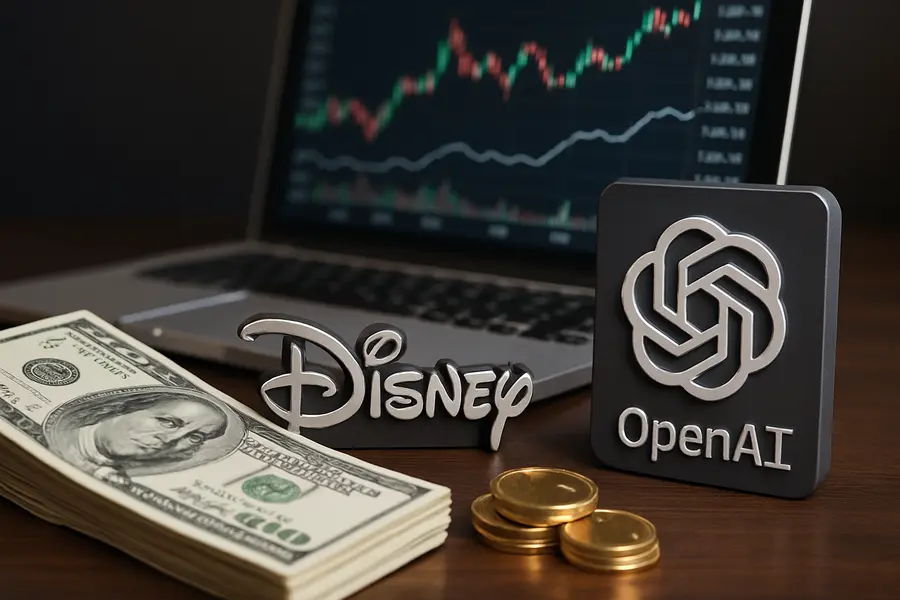
https://upload.wikimedia.org/wikipedia/commons/thumb/a/a9/Mickey_Mouse_head_and_ears.svg/1200px-Mickey_Mouse_head_and_ears.svg.png
- Disney committed $1 billion in equity to OpenAI plus warrants in December 2025, becoming Sora's first and exclusive major content licensing partner.
- The three-year agreement covered 200+ characters from Disney, Marvel, Pixar, and Star Wars, with one year of exclusivity barring OpenAI from rival content deals.
- OpenAI discontinued Sora in April 2026, citing unsustainable compute costs and declining engagement, ending the partnership before a dollar was deployed.
Disney pledged $1 billion to OpenAI in December 2025 and licensed 200+ characters for Sora AI video generation — a landmark deal that unraveled within four months.
Lead
The Walt Disney Company and OpenAI announced a $1 billion equity investment and three-year licensing agreement on December 11, 2025, making Disney the first major content partner on Sora, OpenAI's AI video generation platform. The deal included warrants for additional equity and encompassed more than 200 animated, masked, and creature characters spanning Disney, Marvel, Pixar, and Star Wars — from Mickey Mouse and Minnie Mouse to Darth Vader, Iron Man, and Simba. A curated stream of fan-created Sora AI videos was set to appear on Disney+. Less than four months later, the partnership was void.What Was Planned
Under the Disney OpenAI agreement, Sora users would generate short, user-prompted AI video clips drawing on one of entertainment's most commercially potent intellectual property catalogs. Characters cleared for use included Ariel, Belle, Baymax, Captain America, Black Panther, Han Solo, Luke Skywalker, and dozens of others from Frozen, Encanto, Toy Story, Moana, Inside Out, Zootopia, and Monsters Inc. The deal explicitly excluded talent likenesses and voices, confining Sora to visual character representations.
Disney also secured a one-year exclusivity window prohibiting OpenAI from signing equivalent content deals with competing AI platforms before December 2026 — a structural provision designed to preserve Disney's early-mover advantage in generative video.
Selected Sora-generated, fan-inspired clips were to stream directly on Disney+, giving the platform a low-cost AI-native content category aimed at younger audiences already comfortable consuming algorithmically produced media.
Strategic Rationale
CEO Bob Iger framed the $1 billion equity commitment as a deliberate posture toward disruption rather than away from it. "We'd rather participate than be disrupted by it," Iger said the day of the announcement, describing the deal as an "opportunity, not a threat." His formulation — "creativity is the new productivity" — positioned Disney's IP portfolio as the productive asset that AI needed access to, rather than a liability to be defended.
The investment also reflected a broader thesis: that premium character rights, rather than raw compute or model capability, would determine which AI video platforms gained mainstream cultural legitimacy. Disney's roster was the most valuable proof of that hypothesis.
The Collapse
OpenAI announced on March 24, 2026, that the standalone Sora platform would shut down on April 26, 2026, with the Sora API sunset following on September 24, 2026. High compute costs, declining user engagement, copyright litigation risk, and a decision to redirect engineering resources toward enterprise productivity tools drove the discontinuation. Disney learned of the shutdown less than one hour before OpenAI's public announcement. The $1 billion equity commitment was never formally executed; no capital changed hands and no character licensing fees were paid. The three-year Disney OpenAI partnership ended before generating any material content or revenue.Market Reaction
DIS shares retreated modestly following the Sora shutdown announcement in late March 2026. The retreat was limited in scope — no capital had been deployed — though the episode sharpened investor attention to execution risk in early-stage AI video platform bets. The deal's collapse also renewed scrutiny of how entertainment studios should structure AI partnerships, particularly regarding platform viability clauses and capital staging.Outlook
Disney's exit from the Sora arrangement leaves the company's IP assets available and its AI video strategy unanchored. The one-year exclusivity provision it negotiated — now moot — demonstrated negotiating sophistication that will carry into whatever deal comes next. With AI video generation advancing rapidly at Google DeepMind, Meta, Runway, and a reconstituted field of foundation-model rivals, Disney's portfolio of franchise characters remains among the most commercially attractive assets any generative video platform could seek access to. Which platform earns that access, and on what terms, is the next chapter.