Pomegra
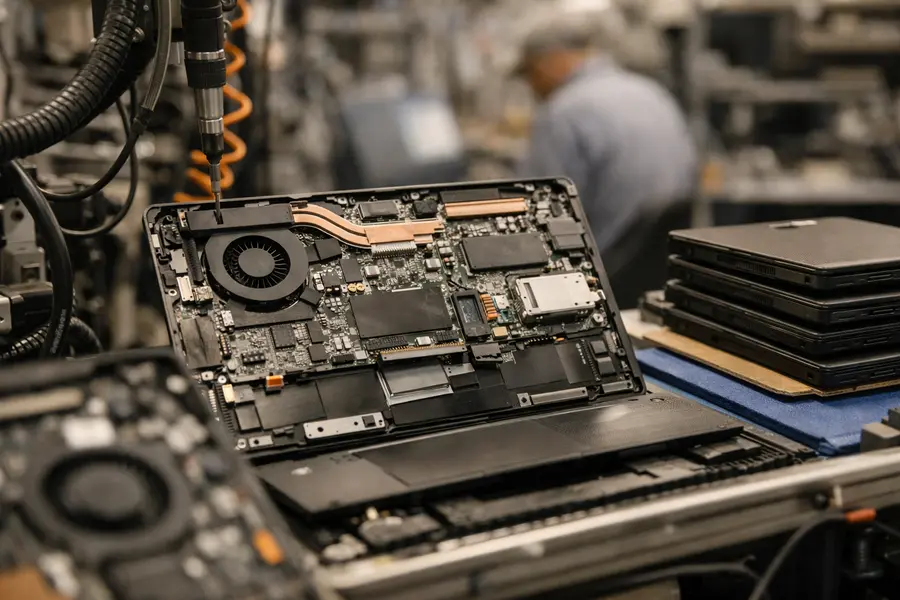
Dell (DELL) fell 11% after Barclays cut it to equal weight, saying server growth reflects memory costs, not enterprise AI demand, and hitting AI stocks broadly.
- Dell closed down 11.4% at $507.43 on Wednesday, Oct. 14, after a Barclays downgrade to Equal Weight from Overweight.
- Barclays attributes recent server revenue growth to higher memory prices passed on to customers, not a surge in enterprise AI adoption.
- Hewlett Packard Enterprise fell 8.3% and NetApp 7.0%, while Oracle and Super Micro also dropped.
Lead
Dell Technologies (DELL) shares fell 11.4% to $507.43 on Wednesday, Oct. 14, after Barclays lowered its rating on the stock to Equal Weight from Overweight. The move led a broad sell-off in server, storage and data-center equipment names. Barclays also cut Hewlett Packard Enterprise (HPE) and NetApp (NTAP) to the equivalent of a hold rating. The downgrades land after a steep rally in ai stocks tied to infrastructure spending. Dell had gained more than 300% this year before the drop.What Happened to Dell Stock?
Dell suffered its sharpest one-day decline of the year as the downgrade reset expectations for how durable its AI server growth is. HPE fell 8.3% and NetApp 7.0% on the same session. Oracle (ORCL) dropped about 9%, and Super Micro Computer (SMCI) also slid. The sell-off reached memory suppliers over the following days, with Micron (MU) down roughly 11% over the week.
The moves reversed part of a run in which Dell rose more than 300% this year, HPE about 160%, and NetApp nearly doubled.
Why Did Barclays Downgrade Dell?
Barclays downgraded Dell because it concluded that recent enterprise server growth is driven more by memory pricing than by organic AI demand. In its view, higher memory-chip prices have allowed hardware makers to pass costs through to customers, lifting revenue without a matching rise in enterprise AI deployments. The bank wrote that strong enterprise revenue is "more of a function of memory costs than a move to enterprise AI at this time."
Valuation was the second pillar. The seven enterprise-exposed stocks in Barclays' coverage have averaged gains of about 140% this year, against roughly 14% for the S&P 500. The group trades near 21 times estimated 2027 earnings, versus a five-year average of about 15 times.
Barclays does not dispute the size of the AI business. Its model has Dell's AI server revenue tripling to $75 billion in the current fiscal year, with room toward $100 billion in fiscal 2028. But it expects a meaningful deceleration in growth over the next two years as memory prices normalize, and expects the size of earnings beats to shrink.
How Does Memory Pricing Affect Server Makers?
Memory pricing affects server makers by raising the cost of every system they build, which they can recover through higher selling prices while supply stays tight. Servers carry large amounts of high-bandwidth and conventional memory, so a price spike inflates revenue per unit. AI servers run at operating margins of about 5%, so extra revenue from pass-through pricing adds little profit. It also makes year-over-year growth look stronger than unit demand would justify.
When memory prices ease, that revenue tailwind reverses. The downgrade argues that the strongest growth comparisons are close to peak. Enterprises, as distinct from hyperscalers, devote only about 5% of IT budgets to AI, and roughly a quarter of that goes to hardware. That leaves enterprise demand well short of the scale implied by the share-price gains.
How Far Did the Sell-Off Spread?
The sell-off spread from server makers to storage vendors, cloud-infrastructure names and memory suppliers within a week. Oracle fell about 9% on the session, and CoreWeave dropped sharply as investors questioned whether enterprise AI spending can justify the buildout. SK Hynix lost roughly 13% over the week. By Friday, the Invesco QQQ Trust (QQQ) had lost 1.3% and the iShares U.S. Technology ETF had lost 2% in that session.
The reaction shows how crowded positioning in AI hardware had become. A single rating change moved companies with different customer mixes together, reflecting how much of the group's valuation rests on the same assumption: that AI demand will keep broadening beyond hyperscale buyers.
What Comes Next for AI Server Demand?
AI server demand remains large, but the next phase depends on enterprise adoption rather than memory-driven pricing. Dell guided to revenue growth of just over 100% for enterprise servers, against mid-teens growth for storage and consumer devices. Hitting those targets as memory costs fall would require genuine volume gains.
Three variables now matter for the sector. The first is the trajectory of memory prices, which determines how much pass-through revenue persists. The second is whether enterprise AI projects move from pilots into production at scale. The third is hyperscaler capital spending, which still anchors most AI server orders. Upcoming earnings from Dell, HPE and NetApp will test each of them.
Outlook
Dell's 11% decline marked a shift in the debate over AI hardware from how fast demand is growing to how much of the growth is real. Barclays still sees AI server revenue reaching $75 billion this fiscal year, but expects slower growth over the next two years as memory prices normalize. Valuations near 21 times 2027 earnings leave the group exposed to any sign of that slowdown. The next set of quarterly results will show whether enterprise volumes are catching up with pricing.
Mentioned tickers: DELL, HPE, NTAP, ORCL, SMCI, MU, QQQ