Pomegra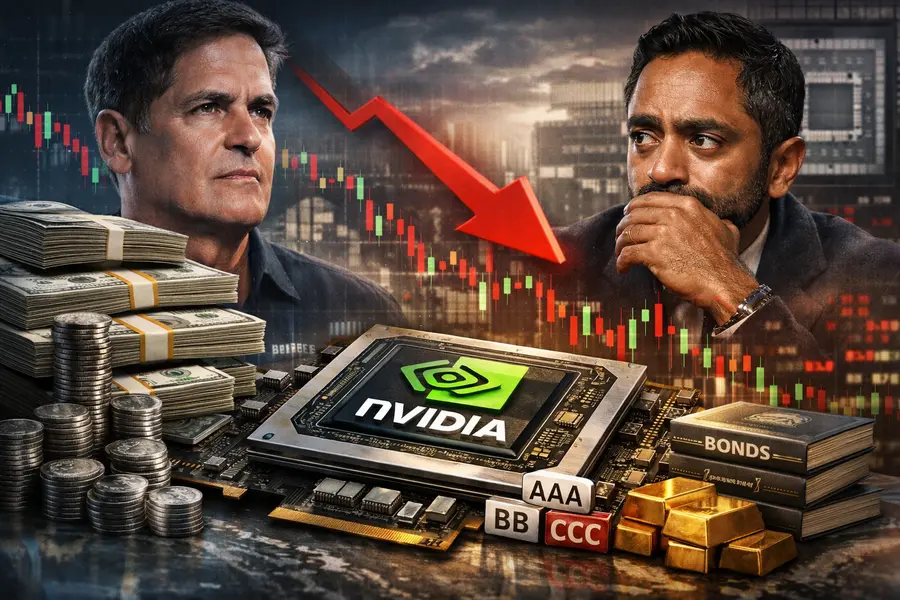
Mark Cuban and Michael Burry both warn that Nvidia's $750 billion circular financing machine underpins the AI boom and poses a systemic risk if it cracks.
- Nvidia has arranged more than $540 billion in circular financing deals in 2026 alone, with total commitments potentially exceeding $750 billion.
- Mark Cuban warned on X that Nvidia plays the role dot-com IPOs once played, and that a single misstep "could crumble" the entire AI market.
- Michael Burry flagged that Nvidia's 5-year credit default swaps have surged nearly 90% year-to-date, signaling rising stress in credit markets even as equities hold firm.
Lead
Two of Wall Street's most prominent contrarian voices converged on the same warning in late July 2026: the artificial intelligence trade is growing dangerously dependent on Nvidia (NVDA) as both the dominant chip supplier and the primary financier of the sector it serves. Mark Cuban, the entrepreneur and investor, posted on X on July 28 that Nvidia had become the AI economy's de facto funding engine — filling the role that initial public offerings played during the dot-com era. Michael Burry, whose Scion Asset Management rose to prominence by betting against mortgage-backed securities in 2007, published a separate warning the same week, pointing to a near-90% rise in Nvidia's 5-year credit default swaps as evidence of mounting systemic fragility.
What Happened
Bloomberg reported on July 28 that Nvidia had already announced more than $540 billion in circular financing commitments in 2026, before accounting for a potential new deal to guarantee up to $250 billion of OpenAI's lease on a 10-gigawatt data center campus in Ohio, plus $350 billion in additional chip purchase financing for OpenAI. Combined with earlier commitments tied to an SK Hynix infrastructure buildout, total AI infrastructure guarantees attributed to Nvidia could exceed $750 billion.
The mechanism is circular by design: Nvidia provides equity stakes or debt guarantees to AI customers — including hyperscalers, cloud startups, and large language model developers — who then deploy that capital to purchase Nvidia's own chips. The arrangement amplifies apparent demand for Nvidia's hardware while layering credit obligations onto the company's balance sheet.
Mark Cuban, responding to a post describing Nvidia as a "backstop" for the AI economy, wrote that "instead of IPOs, Nvidia is the 'ipo,' funding everyone and anyone." He called it "truly scary," adding that a breakthrough by a rival chipmaker or any Nvidia misstep "could crumble it." Michael Burry published his warning separately, characterizing Nvidia's financial reach as "overreaching" and warning that circular spending had reached "biblical proportions." His indicator of choice was Nvidia's 5-year credit default swaps — instruments that function as insurance against a company defaulting on its debt — which he said had gone "parabolic."Market Reaction
Nvidia shares were trading at approximately $211.94 as of August 4, 2026, roughly 10% below their 52-week high of $236.54 and up more than 7% over the prior seven trading sessions, reflecting continued investor confidence in near-term earnings momentum. The stock has climbed roughly 12-fold since ChatGPT's launch in late 2022, pushing Nvidia's market capitalization above $5 trillion at its October 2025 peak.The credit market, however, told a different story. Nvidia's 5-year CDS spread has risen nearly 90% year-to-date, becoming what traders on Wall Street described as the dominant fixed-income conversation of the summer. Higher CDS spreads indicate that bond and derivatives markets are pricing in a rising probability of credit stress — a signal that diverges sharply from equity market buoyancy and reinforces the core concern raised by both Cuban and Burry.
The Circular Financing Model
The practice of a supplier financing its own customers has historical precedent in technology downturns. During the dot-com era, hardware vendors extended vendor financing to internet startups that used those funds to buy the same vendor's equipment. When the cycle broke, customer defaults cascaded back onto suppliers.
In the current AI buildout, Nvidia has taken equity positions in companies including CoreWeave, provided debt backstops for data center construction projects, and entered into multi-party financing arrangements that bind its financial health directly to the capital cycles of the AI industry. The concern is not that any single deal is imprudent, but that the aggregate exposure has grown large enough to constitute a systemic linkage.
Both the International Monetary Fund and the Bank for International Settlements have formally flagged AI circular financing as a potential systemic risk, noting that concentrated financial interdependence between AI infrastructure suppliers and their customers could amplify any sector-wide demand correction.
Burry's Broader Bearish Thesis
Burry's warning on Nvidia extends from a broader conviction that AI equity markets have entered bubble territory. His fund held approximately $186.6 million in Nvidia put options as of the third quarter of 2025, alongside bearish positions on Palantir Technologies (PLTR), Oracle (ORCL), and the iShares Semiconductor ETF (SOXX). He has argued the AI-driven equity rally is being sustained by "fear of missing out, the greater fool theory, and public commitment bias" rather than by durable demand fundamentals. Bank of America's Bubble Risk Indicator placed the semiconductor sector at 0.91 — the highest reading short of a confirmed bubble designation.Outlook
The warnings from Mark Cuban and Michael Burry arrive as Nvidia approaches an inflection point in its capital-allocation strategy. With total AI financing commitments potentially exceeding $750 billion, the company's role has shifted materially from chip designer to something closer to a sector-wide lender of last resort. If AI infrastructure investment decelerates — whether from model efficiency gains, geopolitical disruption to supply chains, or a slowdown in enterprise AI adoption — the circular structure means demand, revenue, and credit risk could all reverse simultaneously. Equity markets remain constructive on Nvidia for now, but the widening gap between stock performance and CDS signals indicates that different corners of the capital markets are already arriving at different conclusions.