 Pomegra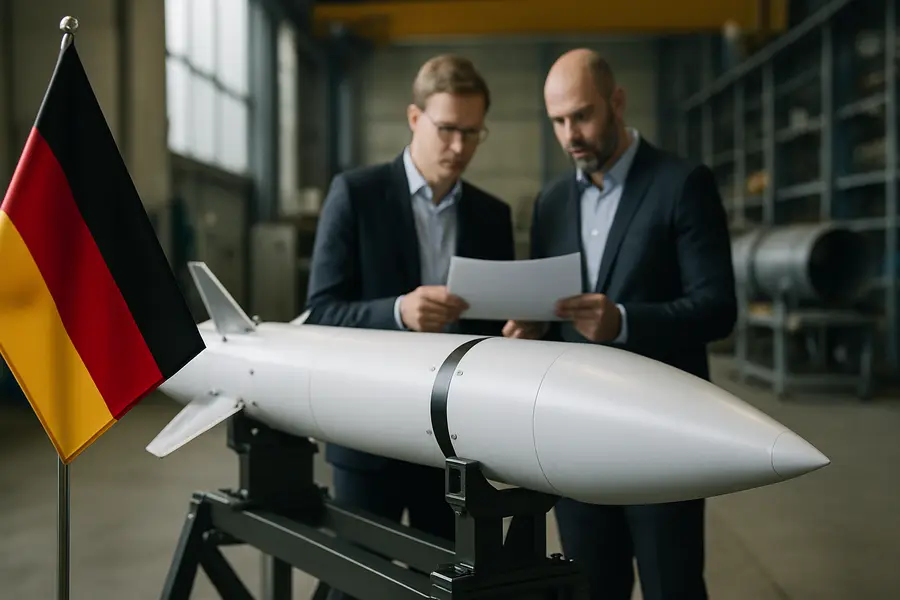
Germany's missile search has elevated Covenant Technologies, a two-year-old Israeli-American defense startup, into a live contender for one of Europe's most strategically consequential procurement contracts of 2026.
- Germany formally solicited proposals from Covenant after Washington scrapped a planned Tomahawk transfer amid acute U.S. missile shortages.
- Covenant's Anthem cruise missile targets a unit cost of several hundred thousand dollars versus the Tomahawk's several million, with live-fire tests observed by German officials in June 2026.
- Backed by Founders Fund and Andreessen Horowitz, the company plans European production lines in Germany and the United Kingdom to create a sovereign supply chain.
Lead
Berlin, June 2026 — Germany's defense ministry formally requested proposals from Covenant Technologies, a secretive Israeli-American startup employing roughly 50 people, for a long-range cruise missile system capable of filling the strike gap left by Washington's decision to cancel a planned transfer of up to 400 Tomahawk Block V missiles. The move has thrust one of the defense industry's most closely guarded ventures into the spotlight at a moment when European governments are scrambling for credible, affordable alternatives to U.S.-controlled precision-strike inventory.What Happened
The collapse of Germany's Tomahawk deal was precipitated by a combination of political and operational pressures. The Trump administration withdrew roughly 5,000 troops from Germany in early 2026, and the Pentagon simultaneously declined to issue a Letter of Offer and Acceptance on Berlin's three-launcher, 400-missile request — a package valued at more than €1 billion — despite the inquiry having been submitted ten months prior.
Compounding the problem, U.S. cruise missile stocks are under acute strain. American forces expended an estimated 850-plus Tomahawk missiles during Operation Epic Fury, the strikes campaign against Iran, while additional inventories were drawn down in Yemen and other theaters. The Center for Strategic and International Studies estimated total war-related expenditure exceeded 1,000 rounds, with U.S. stockpiles not expected to recover until late 2030 or early 2031. A seven-year production agreement between the Pentagon and RTX to push annual Tomahawk output beyond 1,000 missiles, signed in February 2026, eases the long-term supply picture but does nothing for Berlin's near-term shortfall.
Covenant's Anthem System
Founded in 2024 by American-Israeli entrepreneur Michael Kaufman, Covenant operates from Tel Aviv with subsidiaries registered in Germany and the United Kingdom. The company has raised hundreds of millions of dollars — placing it among the most heavily capitalized defense startups of its generation — with Founders Fund and Andreessen Horowitz among its prominent backers.
The centerpiece of its pitch to Berlin is Anthem, a cruise missile designed to deliver Tomahawk-class range and precision at a unit cost of several hundred thousand dollars, compared with several million for the American weapon. Covenant conducted live-fire testing of Anthem during the third week of June 2026, with German defense ministry officials invited to observe the demonstration in Israel.
The cost argument is not merely commercial. European defense planners have grown acutely aware that reliance on high-unit-cost weapons limits the depth of magazine capacity. A cheaper, domestically produced alternative addresses both the fiscal and the sovereignty dimensions simultaneously.
Strategic Context
Germany's defense minister publicly lamented a long-range strike "gap" in May 2026, following confirmation that Washington had rescinded deployment plans for a U.S. Army Long-Range Fires Battalion assigned to German territory. For Berlin, the episode accelerated an existing strategic calculation: sovereign strike capability is no longer a political option but an operational necessity.
The defense-tech ecosystem surrounding Israel's startup sector has expanded rapidly since October 2023, with capital, talent, and procurement interest converging on firms that blend Israeli engineering traditions with U.S.-style venture financing. Covenant represents the leading edge of that trend — a company simultaneously leveraging Israeli defense expertise, Silicon Valley capital, and European geopolitical urgency.
Germany is not evaluating Covenant in isolation. Ukrainian missile systems entered European procurement discussions for the first time in 2026, and established European programs from MBDA and Saab remain in the competitive field. Berlin's 2027 target for achieving an initial long-range strike capability means procurement decisions must be finalized within the next twelve months.
Production and Sovereignty
A critical element of Covenant's proposal is its commitment to establish production lines in Germany and the United Kingdom, creating a supply chain that would not depend on U.S. export-control decisions. For a European government that has just seen a €1 billion American arms deal evaporate, that guarantee carries significant political weight.
A German production facility would also align with Berlin's broader industrial policy objective: ensuring that defense spending translates into domestic manufacturing capacity, jobs, and supply-chain resilience. The UK element potentially positions Covenant within a broader Anglo-German defense-industrial framework that has grown in importance as European NATO members accelerate rearmament.
Geopolitical Dimension
Germany's interest in Covenant is inseparable from the reordering of trans-Atlantic security arrangements underway in 2026. The withdrawal of U.S. troops and the collapse of the Tomahawk agreement have catalyzed a debate across Europe about the durability of American extended deterrence. Several NATO members — including the Netherlands, whose planned U.S. missile deliveries face delays linked to Iran war consumption — are watching Berlin's procurement choices closely.
For Israel, the emergence of Covenant as a serious European defense supplier represents a shift in the country's strategic posture. Israeli defense firms — IAI, Rafael, Elbit — have long been significant exporters, but the rise of venture-backed startups pitching directly to European defense ministries marks a structural change in how Israeli defense technology reaches international markets.
Outlook
Germany's search for a long-range strike capability has moved from a medium-term planning exercise to an urgent operational requirement. Covenant Technologies enters the final procurement phase with a compelling cost argument, a live-fire demonstration completed, a commitment to local production, and backing from two of Silicon Valley's most prominent venture funds. Whether Anthem clears the technical and regulatory thresholds required by the Bundeswehr will determine whether the company transitions from high-profile startup to major transatlantic defense contractor. Berlin's 2027 initial-capability deadline leaves little margin for prolonged deliberation.