Pomegra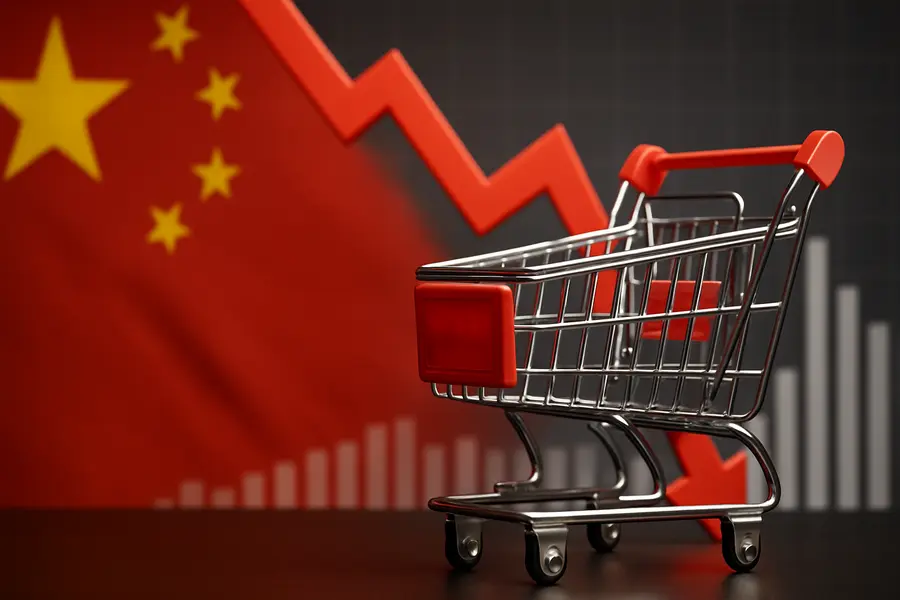
China retail sales fell 0.6% in May 2026, the first contraction since December 2022, as weak household demand deepens the gulf with robust industrial output and compounds Beijing's demand woes.
- China retail sales contracted 0.6% year-on-year in May, reversing April's 0.2% gain and missing the flat reading economists forecast.
- Auto sales plunged 16.1% while home appliances fell 15.6%, dragging broad discretionary spending sharply lower.
- Urban fixed-asset investment contracted 4.1% in January–May, nearly double the 2% decline analysts expected.
Lead
China's economy registered its most troubling consumer signal in more than three years on June 16, when the National Bureau of Statistics reported that China retail sales fell 0.6% year-on-year in May 2026. The result reversed April's modest 0.2% gain, came in below the flat consensus estimate, and ended an uninterrupted run of annual consumption gains stretching back to December 2022 — deepening anxiety about the durability of domestic demand even as first-quarter GDP growth held at 5%.What Happened
The May reading cut across a broad range of discretionary categories, reinforcing what the statistics bureau described as an "acute" domestic imbalance between strong supply and weak demand — an unusually direct acknowledgment of structural pressures building inside the world's second-largest economy.
Consumer confidence remained constrained by a still-depressed property market, a pullback in government trade-in subsidy programs introduced earlier in 2026, and persistent employment uncertainty. Even China's Labor Day Golden Week at the start of May — a period traditionally associated with elevated household spending — failed to lift aggregate demand in any meaningful way.
Sector Breakdown
The steepest contractions were concentrated in big-ticket and interest-rate-sensitive categories. Auto sales posted the sharpest decline, falling 16.1% year-on-year, reflecting both reduced subsidy support and saturation in urban markets. Home appliances and audiovisual equipment fell 15.6%, while building and decoration materials declined 13.6% — a direct transmission from the prolonged real estate correction.
Gold and silver jewelry dropped 8.9% as households dialed back discretionary outlays. Furniture fell 8.7% and sports and entertainment products declined 8.0%.A handful of categories managed gains. Beverage sales rose 6.1%, tobacco and alcohol increased 4.8%, pharmaceuticals grew 4.0%, clothing and textiles advanced 3.8%, and cosmetics climbed 2.5% — sectors linked to everyday necessities or modest premiumization behavior insulated from the property downturn.
The Supply-Demand Divide
The retail contraction sits in sharp contrast with China's economy on the industrial side. Industrial output expanded 4.5% year-on-year in May, beating the 4.2% consensus and accelerating from April's near three-year low. High-tech manufacturing surged 15.1% and equipment manufacturing grew 9.5%. Production of lithium-ion batteries rose 40% and industrial robots climbed 27.9%.
The divergence sharpens a structural concern that has defined China's post-pandemic trajectory: factories are producing at pace while households are not absorbing the output. The consequence is persistent deflationary pressure in goods prices and mounting reliance on foreign markets to clear domestic surpluses.
Urban fixed-asset investment contracted 4.1% in the January–May period from a year earlier — nearly double the 2% decline projected. Real estate development investment dropped 16.2%, extending a multi-year correction with no clear floor in sight. Manufacturing investment contracted for the first time since December 2020, falling 0.4%, even as high-tech segments held up. Infrastructure investment rose a modest 0.6%, providing minimal offset.Policy and Geopolitical Context
Beijing faces a narrow policy window. China's export apparatus has proven resilient against bilateral trade friction: shipments to the United States fell 16% in the first quarter, but exports to Southeast Asia grew 20% and to Africa rose 32%, partially compensating for the bilateral drag. That external buffer has allowed policymakers to maintain restraint on domestic stimulus.
The government is expected to deploy interest rate and reserve requirement ratio reductions to preserve liquidity, alongside expanded consumer subsidies and special bond issuance. A return to the broad-based fiscal stimulus deployed in earlier downturns is not anticipated; Beijing appears committed to its manufacturing-led growth framework rather than engineering a consumption-driven rebalancing.
The curtailment of trade-in subsidy programs earlier in 2026 directly contributed to the May weakness in autos and appliances — two categories that benefited most from those transfers. Whether Beijing restores or expands those programs in direct response to the May data will be a near-term policy signal worth watching.
Outlook
The May retail contraction sharpens the argument for additional demand-side support but also exposes the limits of supply-oriented policy frameworks. With real estate investment falling at double-digit rates, household balance sheets under pressure, and China retail sales recording their first annual decline in over three years, incremental subsidy adjustments may prove insufficient to close the demand gap. Industrial output growth, while encouraging, cannot substitute for household consumption in an economy targeting sustained 5% annual expansion. How aggressively Beijing responds — and how quickly — will determine whether May marks an inflection point or the beginning of a deeper consumption contraction.
Mentioned tickers: N/A