Pomegra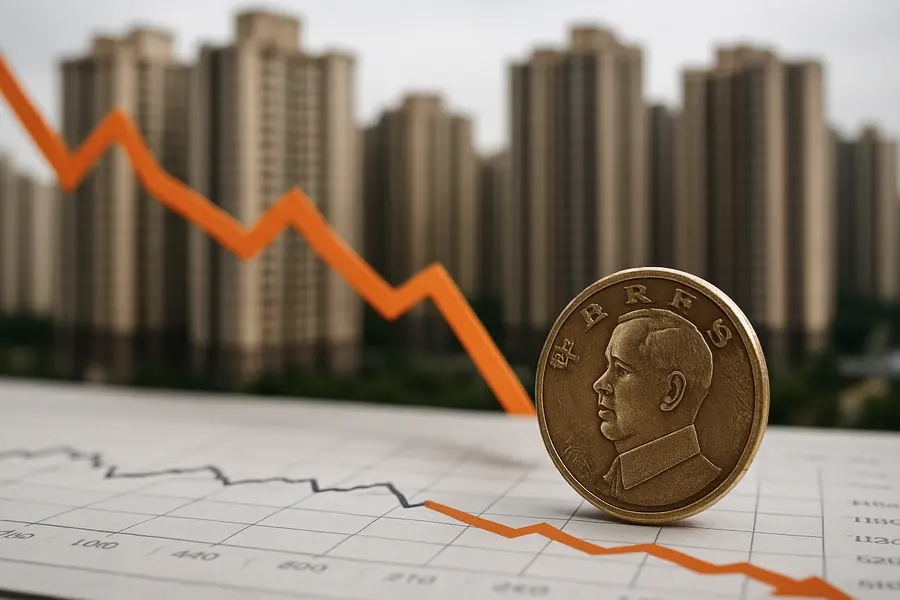
China real estate investment fell 16.2% in January–May 2026, deepening a five-year China property crisis that continues to drag on fixed-asset investment.
- Real estate development investment totaled 3,035.6 billion yuan in Jan–May 2026, down 16.2% YoY, worsening from a 13.7% decline in Jan–Apr.
- Funds received by real estate enterprises fell 19.0% YoY; residential sales value dropped 14.1% over the same period.
- Beijing's whitelist financing mechanism approved over 7 trillion yuan in developer loans by late 2025, yet structural headwinds persist.
Lead
National Bureau of Statistics (NBS) data for January through May 2026 shows China's real estate development investment contracting 16.2% year-on-year, with the pace of decline accelerating from the 13.7% fall reported for the first four months. Total sector investment reached 3,035.6 billion yuan (approximately $418 billion), extending what has become the fifth consecutive year of the China property crisis dragging on national output and fixed-asset investment aggregates.What Happened
Residential investment — the largest component of real estate development spending — fell 15.6% in January–May, reaching 2,342.6 billion yuan. Commercial building sales deteriorated in parallel: floor space of newly built commercial buildings sold declined 10.8% year-on-year to 313.2 million square meters, while residential floor space sold dropped 12.1%.
The corresponding sales value of newly built commercial buildings fell 13.5% to 2,936.6 billion yuan. The residential sub-segment recorded a steeper 14.1% decline to 2,936.6 billion yuan. Financing conditions for developers remained severely constrained: funds received by real estate development enterprises totaled 3,275.6 billion yuan in the January–May period, down 19.0% year-on-year — a rate of contraction that outpaced investment itself.
Drag on Fixed-Asset Investment
The property downturn is the primary driver behind a broader deterioration in China's fixed-asset investment. The overall FAI aggregate fell 4.1% year-on-year for January through May 2026, a marked deceleration from the 1.6% decline reported for January through April.
Real estate development investment, which accounted for 25% to 30% of total fixed-asset investment before the sector peaked in 2021, had seen its share erode to 16.9% by 2025. Manufacturing and infrastructure spending — directed by state policy toward industrial upgrading and transport projects — have offered a partial offset, but not enough to counter the scale of the property crisis.
Developer Stress and Credit Risks
Persistent revenue shortfalls and collapsed land sales are compounding financial stress across the developer universe. Vanke, the state-backed homebuilder, formally requested an extension on bond repayments — a new threshold in the China property crisis following the earlier debt restructurings of Evergrande and Country Garden. Credit rating agencies have flagged rising default risks for homebuilders, construction firms, and regional banks most exposed to real estate collateral.
Full-year 2025 real estate investment finished down 17.2%, following a 14.7% year-on-year drop through October of that year. The January–May 2026 reading of 16.2% indicates only marginal moderation. Since peaking in 2021, cumulative real estate investment has declined by nearly half in nominal terms, and property investment's drag on annual GDP growth has been estimated at roughly two percentage points per year since 2024.
Policy Response
Beijing has pursued a containment-oriented posture rather than returning to the debt-driven stimulus cycles that characterized earlier property boom periods. Its "new property development model" repositions real estate as a source of stable baseline construction demand rather than a primary growth engine.
The flagship instrument — a project financing "whitelist" mechanism introduced in early 2024 — had channeled over 7 trillion yuan in commercial bank loans to qualifying projects by September 2025. The 2026 Government Work Report broadened the framework, mandating city-specific measures to control new project starts, reduce inventory, and expand use of existing housing stock. Demand-side support has included tax relief for homebuyers, selective relaxation of purchase restrictions, mortgage rate cuts, and provident fund adjustments.
Outlook
The trajectory through mid-2026 provides limited evidence that a floor in the China property crisis is imminent. S&P Global Ratings projects primary home prices to fall 1.5%–2.5% over full-year 2026, with secondary market prices declining 4%–5%. With funds received by developers contracting at 19.0% year-on-year — faster than investment itself — the pipeline of new project starts is likely to remain compressed through year-end.
The structural reorientation of Chinese real estate away from a primary growth engine represents a generational economic shift. Until inventory in lower-tier cities clears and household income confidence recovers, fixed-asset investment is unlikely to return to pre-downturn growth rates. Near-term policy focus centers on absorbing existing supply, containing developer credit risk, and preventing further contagion into the broader banking system.
Mentioned tickers: 2202.HK, 2007.HK, 3333.HK