Pomegra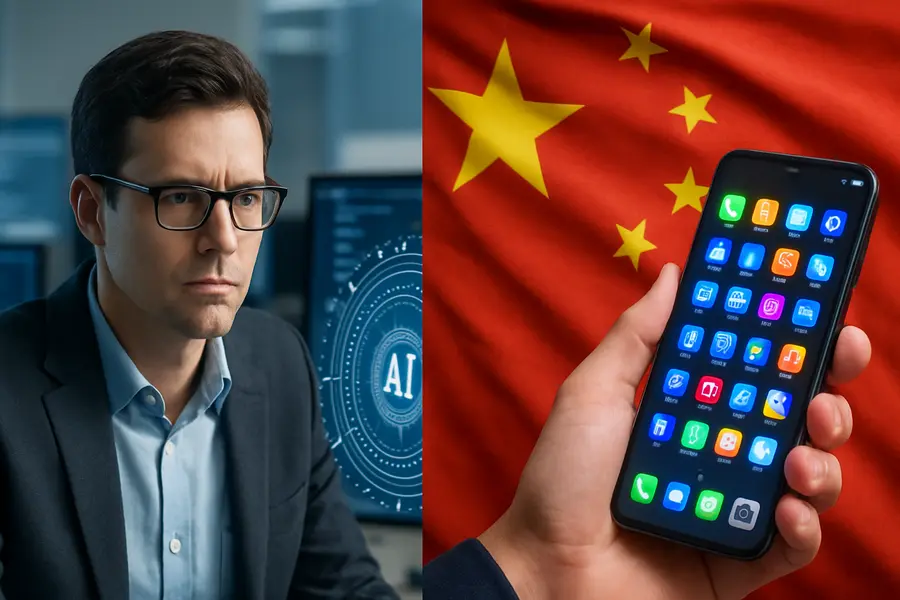
https://upload.wikimedia.org/wikipedia/commons/thumb/4/47/Tencent_Binhai_Mansion.jpg/1280px-Tencent_Binhai_Mansion.jpg
- Tencent hired former OpenAI researcher Yao Shunyu as chief AI scientist and plans to double AI spending to RMB 36 billion in 2026.
- Stanford's 2026 AI Index shows the flow of AI scholars to the US dropped 89% since 2017, accelerating 80% in the past year alone.
- ByteDance's Doubao reached 345 million monthly active users in March 2026 as China's super-app ecosystem absorbs agentic AI at scale.
Chinese tech giants are accelerating recruitment of US-trained artificial intelligence researchers while deploying AI agents across billion-user platforms, narrowing the performance gap with American models to just 2.7%.
Lead
China's largest technology conglomerates are mounting the most aggressive push yet to recruit artificial intelligence researchers from US institutions and Silicon Valley firms, while simultaneously racing to embed autonomous AI agents into existing super-app platforms that collectively serve more than a billion users. The campaign, documented in Stanford University's 2026 AI Index published in April, has helped shrink the performance gap between the leading American and Chinese AI models to 2.7%, from a substantially wider margin just eighteen months earlier.Talent Moves at the Top
The most visible sign of China's AI talent strategy is Tencent Holdings' December 2025 appointment of Yao Shunyu as chief AI scientist. Yao, a former researcher at OpenAI, reports directly to Tencent President Liu Chiping and oversees both the AI Infrastructure Department and the large-language model division. His stated objective is artificial general intelligence — a goal once associated almost exclusively with US frontier labs.
The Yao hire is not isolated. In February 2025, Wu Yonghui, then vice president of research at Google DeepMind, left to lead research at ByteDance Seed, the company's foundational AI unit, operating from California. Moonshot AI, the Chinese startup behind the Kimi model, was founded by Yang Zhilin, a researcher who trained at Meta AI and Google Brain before returning to China.
The financial incentives underwriting these moves are substantial. ByteDance expanded its year-end bonus pool by 35% and increased its budget for salary adjustments by 150%. Compensation packages at Tencent (TCEHY), Baidu (BIDU), and ByteDance now match or exceed those offered by their US counterparts for senior researchers, according to industry benchmarks.
The Structural Shift in US-China AI Talent
For two decades, China's AI ecosystem benefited from researchers trained at American universities returning to Chinese companies and universities. The Stanford 2026 AI Index reveals that pattern has now accelerated into a net reversal. The number of AI scholars relocating to the United States dropped 89% compared with 2017 levels, with the rate of decline quickening 80% in the most recent twelve-month period.
More striking is DeepSeek's composition: more than half the researchers behind its five foundational papers never left China for schooling or work, upending the core assumption that US research institutions are the primary forge of frontier AI talent.
China has simultaneously surpassed the United States in AI publication citations, accounting for 20.6% of the global total against the US figure of 12.6% in 2024. The US-China tech competition for human capital, long weighted heavily toward America, is now genuinely contested.
The Super-App Advantage
Where China AI diverges most sharply from the US model is in deployment architecture. Chinese firms entered the AI era with mature super-apps already embedded in daily life — platforms that did not need to discover users for new AI products. The strategic logic, articulated internally at several major firms, is to make AI invisible inside an application that already has a billion users, rather than launch a standalone product.
ByteDance's Doubao AI chatbot reached 345 million monthly active users in March 2026. Alibaba's Qwen assistant, integrated across Taobao, Tmall, and Alipay, claimed approximately 300 million monthly active users by early 2026. Tencent's WeChat, with 1.3 billion monthly active users, is building equivalent agentic capabilities directly into its messaging and payments layer.By early 2026, more than 600 million individuals in China were using agentic AI systems capable of autonomous task execution — booking tickets, executing financial transactions, and handling procurement with minimal human input. Meituan's Xiaomei agent, described internally as an orchestrator-plus-execution system rather than a chatbot, exemplifies the approach: a domain-specific AI agent layered on top of an existing commercial platform with 700 million registered users.
Washington's Policy Dilemma
Tencent's recruitment of Yao from OpenAI's ranks has drawn attention in Washington, where policymakers have debated restricting the movement of AI expertise to Chinese firms. The US-China tech rivalry has already produced successive rounds of semiconductor export controls, but computing power represents only one dimension of the competition.
Stanford's researchers concluded that talent patterns represent a challenge that export controls and capital investment alone cannot resolve. The compute advantage remains significant: absent advanced chip exports to China, US capacity would exceed Chinese capacity by more than ten times in 2026. With chip exports continuing under existing licensing frameworks, that margin could compress sharply.
Meanwhile, China holds thirty of the top AI models by international benchmarks, compared with fifty held by the US — but China's citation dominance in research literature signals that the foundational knowledge gap is closing faster than model counts alone suggest.
Outlook
China's AI talent recruitment from US firms and universities is no longer a marginal phenomenon — it is a deliberate, well-funded national strategy. The combination of competitive compensation, frontier research goals framed around AGI, and the structural advantage of deploying AI into pre-existing super-apps with hundreds of millions of active users gives Chinese technology firms a compounding edge in the race to build the next dominant AI platform. The Stanford 2026 AI Index's 2.7% performance gap figure is likely to feature prominently in upcoming congressional hearings and National Security Council discussions. Whether the response focuses on talent retention, accelerated model development, or both will shape the trajectory of the US-China tech competition through the decade.Geopolitics