Pomegra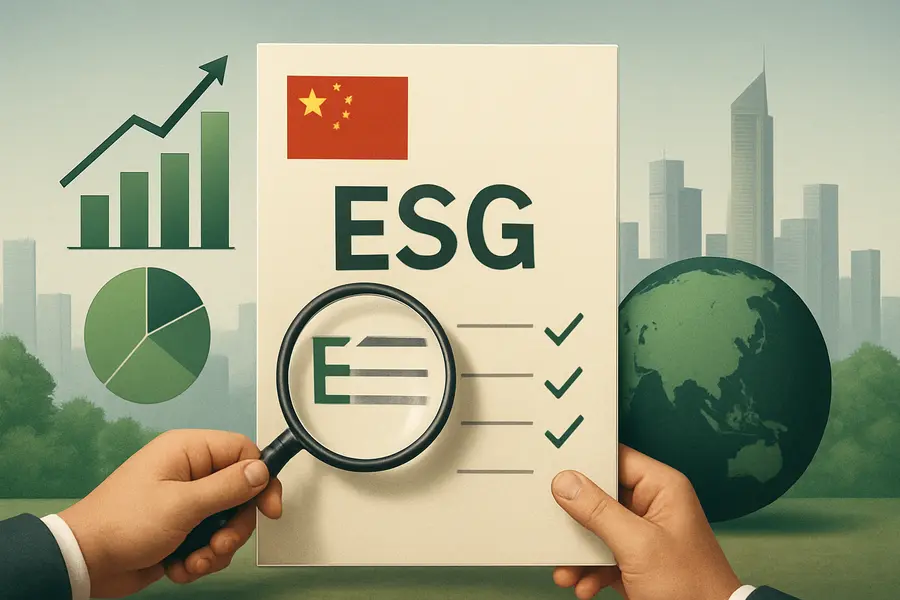
China's landmark ESG disclosure framework, aligned with ISSB and IFRS standards, introduces mandatory sustainability fund rules covering 59% of the country's listed market value beginning April 2026.
- First mandatory sustainability reports covering fiscal year 2025 are due by 30 April 2026, applying to large listed companies representing 59% of China's stock market value.
- The Asset Management Association of China launched SFDR-style sustainability fund guidelines effective June 12, mandating an 80% ESG alignment threshold for labelled funds.
- China's China ESG rules incorporate double materiality, requiring companies to report both climate impacts on their business and their business's impact on the environment — a standard experts say goes beyond many global peers.
Lead
China is now among the world's most demanding ESG disclosure regimes. In a regulatory push spanning corporate reporting, fund labelling, and sector-specific guidance, Beijing has rolled out a suite of China ESG rules designed to match and in several respects exceed the benchmarks set by the International Sustainability Standards Board. The first mandatory reporting standards filings — covering the 2025 fiscal year — are due by 30 April 2026, marking a decisive shift from voluntary to enforceable sustainability disclosure for the country's largest listed companies.
What Happened
China's Ministry of Finance, together with the People's Bank of China and several other regulators, finalized the Corporate Sustainable Disclosure Standard No. 1 – Climate (Trial), commonly referred to as CSDS-1. The standard mirrors the IFRS Foundation's IFRS S1 and S2 frameworks, ensuring cross-border comparability for the international investors and multinationals that interact with China's capital markets.
The standard requires companies to disclose climate-related risks, opportunities, and material impacts across both financial and environmental dimensions — a structure known as double materiality. That requirement places China's reporting standards ahead of the ISSB baseline, which mandates only financial materiality, and in closer alignment with the European Union's Corporate Sustainability Reporting Directive.
Scope 1 direct emissions and supply chain emissions are both within scope, creating significant data collection obligations for companies and their upstream partners. Sector-specific application guidelines are being developed for electricity, steel, coal, fertiliser, aluminium, hydrogen, cement, and automobiles — industries that together account for the bulk of China's industrial carbon footprint.
The Sustainability Fund Layer
Running parallel to the corporate disclosure regime, the Asset Management Association of China introduced SFDR-style fund disclosure guidelines that took effect on 12 June 2026, with a one-year transition period for existing products. The rules represent a direct analogue to the EU's Sustainable Finance Disclosure Regulation and establish a clear pass-fail structure for sustainability fund labelling.
Under the guidelines, any fund carrying an ESG or sustainability label must allocate at least 80% of its portfolio to assets that satisfy defined ESG criteria. Fund managers are required to maintain dedicated ESG research teams, construct measurable indicator frameworks, and review those criteria at least annually.
The rules recognize three permitted investment strategies: negative screening, which excludes assets causing environmental or social harm; positive screening, which selects companies with above-peer ESG ratings; and integrated investment, which embeds ESG factors throughout the portfolio construction process. Unlike the EU's SFDR, China's framework does not yet require disclosure of principal adverse impacts, but the 80% threshold creates a harder, more enforceable standard than SFDR's categorization-based approach.
Going Beyond Global Standards
The breadth and stringency of China's evolving framework have drawn attention from international sustainability experts. The CSDS framework's double materiality requirement — mandating that companies account not only for how climate change affects them financially, but how their activities affect the climate — represents a higher bar than the ISSB's baseline. Combined with mandatory Scope 3 supply-chain emission disclosures, analysts describe the regime as "very ambitious" and note that it "goes beyond many global standards in terms of its rigour."
The Ministry of Finance has signalled that sector-specific supplementary guidelines will be finalized progressively through 2027, with mandatory reporting for key non-listed entities — including large state-owned enterprises — expected to be phased in before 2030. China's overall China green finance strategy integrates the CSDS framework with green bond taxonomy rules and the broader dual-carbon targets of peak emissions by 2030 and carbon neutrality by 2060.
Who Is Affected
The initial mandatory cohort covers large listed companies included in the CSI 300, SSE 50, and related domestic indices, as well as Chinese companies with overseas listings including Hong Kong. Together, these entities represent approximately 59% of China's total listed market capitalization. Beijing and Shanghai and Shenzhen stock exchanges have published detailed guidance requiring the first batch of sustainability reports by April 30.
Foreign-invested enterprises with Chinese listed subsidiaries fall within scope as of the 2025 reporting year. Multinationals with Chinese operations but without directly listed Chinese entities will face indirect pressure through supply-chain disclosure requirements imposed on their listed Chinese counterparts.
Outlook
China's ESG disclosure regime now sits alongside the EU and the UK as one of the world's most comprehensive frameworks for mandatory sustainability reporting. The convergence with ISSB standards eases cross-border reporting burdens for dual-listed companies and global investors, while the addition of double materiality and the SFDR-style sustainability fund rules push the overall framework into territory few major markets have yet reached. With sector-specific guidelines rolling through 2027 and mandatory coverage extending to non-listed entities by 2030, China ESG rules are set to deepen in scope and enforceability, reinforcing China's position as a structural force in global reporting standards and China green finance policy.
Mentioned tickers: N/A