Pomegra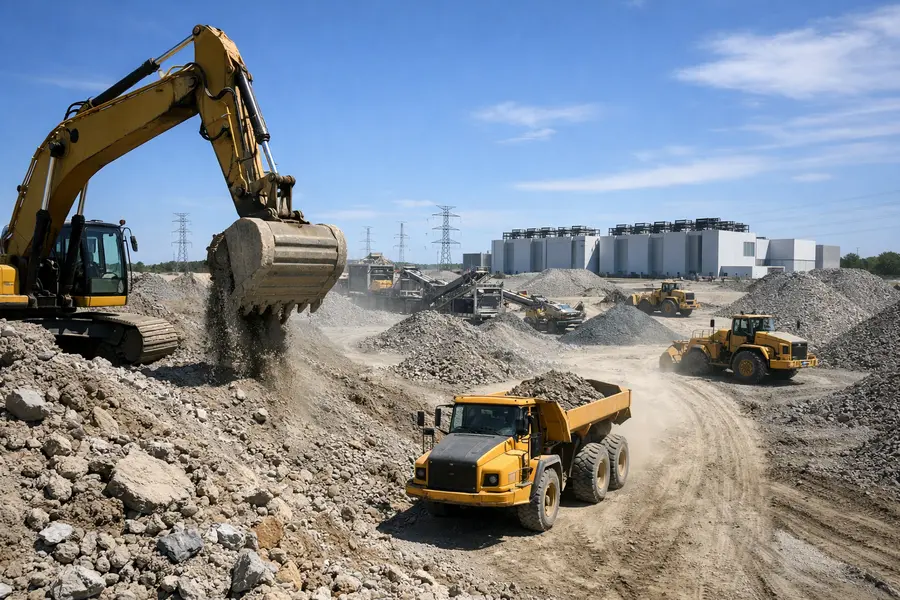
Caterpillar (CAT) gained 1.65% Monday to top the Dow as AI data center construction and power grid buildout drove its order backlog to a record $2 billion, with customers booking equipment through 2030.
- CAT rose 1.65% Monday to rank as the session's top performer in the dow industrials average, outpacing all 29 other blue-chip components
- The company's order backlog reached a record $2 billion, with customers locking in equipment deliveries through 2030
- AI data center construction and power grid expansion are converting Caterpillar into an unexpected blue-chip beneficiary of America's AI capital expenditure wave
Lead
Caterpillar Inc. (CAT) climbed 1.65% on Monday to post the largest single-session advance among all 30 components of the dow industrials average, as accelerating demand for construction equipment and power generation systems tied to the artificial intelligence infrastructure cycle drove its order backlog to a record $2 billion. Customers across the data center and energy infrastructure sectors are now booking Caterpillar equipment for delivery through 2030, signaling a structural shift in who captures the most value from America's AI capital expenditure wave.
Why Is Caterpillar Gaining From the AI Boom?
The answer lies in concrete and steel. Every AI data center campus requires tens of thousands of tons of excavation, foundation work, and structural build-out before a single server rack is installed - work that runs through Caterpillar's core lineup of excavators, dozers, and motor graders. Beyond site preparation, the power demands of AI computing are generating equally large orders for Caterpillar's power generation division, which supplies large-scale diesel and gas-powered generators used as primary backup systems and bridging capacity while permanent utility connections are completed.
Hyperscale operators including Microsoft (MSFT), Amazon (AMZN), and Alphabet (GOOG) have each announced multi-year AI infrastructure programs measured in the hundreds of billions of dollars, translating directly into extended equipment procurement cycles. Nvidia (NVDA) GPU clusters at the center of these facilities require uninterrupted power, and the redundant generation systems that guarantee uptime are increasingly specified with CAT-branded hardware.
The AI capital spending cycle has also pushed utilities and independent power developers to accelerate grid upgrades and new generating capacity - a second track of demand that runs parallel to, and reinforces, data center construction orders. For Caterpillar, these two demand streams are arriving simultaneously, compressing the usual lag between project announcement and equipment ordering.
What Does a Record $2 Billion Backlog Signal?
A record backlog is revenue visibility, not just a pipeline. Caterpillar's $2 billion order position - with contracts stretching to 2030 - locks in a multi-year revenue runway that insulates the company from the cyclical construction downturns that have historically compressed its valuation multiple. For institutional investors, bookings extending four-plus years forward represent a qualitative shift in Caterpillar's earnings profile, moving it closer to the predictable cash-flow characteristics more often associated with aerospace and defense primes than with heavy equipment cyclicals.
The booking horizon also reflects customer conviction. Infrastructure operators do not commit capital years in advance unless they are confident in their own expansion plans. The fact that data center and grid developers are locking equipment slots through the end of the decade confirms that AI infrastructure spending is not a one- or two-quarter surge but a sustained buildout that has taken on the character of a long-cycle capital program.
Market Reaction
CAT's 1.65% advance set it apart from most Dow components, which registered muted moves in a session dominated by rotation into industrial and infrastructure-adjacent names. The stock's outperformance reflects a broader reassessment of its growth category: Caterpillar is increasingly priced not purely as a late-cycle heavy machinery maker but as an infrastructure enabler whose revenues are structurally tied to the AI capital expenditure cycle.
Trading volume confirmed conviction behind the move, with turnover running meaningfully above the 30-day average - a pattern more consistent with institutional accumulation than short-term momentum.
What Comes Next for Caterpillar?
The company's next major data point will be its quarterly earnings release, where investors will scrutinize backlog figures, order intake rates, and management commentary on pricing discipline within the data center and power generation segments. Any upward revision to forward backlog or extension of the booking window beyond 2030 would likely function as a positive catalyst.
Longer term, Caterpillar's exposure to the AI infrastructure theme broadens as the grid buildout scales. Legislative frameworks supporting domestic energy infrastructure have extended favorable treatment to large-scale power projects, widening the addressable market for Caterpillar's power systems division beyond data centers to utility-scale generation, transmission upgrades, and distributed energy assets.
Near-shoring also adds a parallel demand channel: as AI-related manufacturing facilities - chip fabrication plants, advanced packaging operations - come onshore to the United States, the construction equipment requirements of those projects feed into the same backlog dynamic driving Monday's gains.
Outlook
Caterpillar's record $2 billion order backlog, running with visibility through 2030, reflects a durable realignment of demand anchored in AI data center construction and power grid investment. Monday's 1.65% gain to the top of the dow industrials average is consistent with that structural reassessment. Absent a broad reversal in AI capital spending commitments - which the multi-year booking horizon makes unlikely in the near term - Caterpillar enters the next earnings cycle with the strongest revenue visibility in its recent history, cementing its position as one of the more grounded blue-chip plays on the AI infrastructure buildout.