Pomegra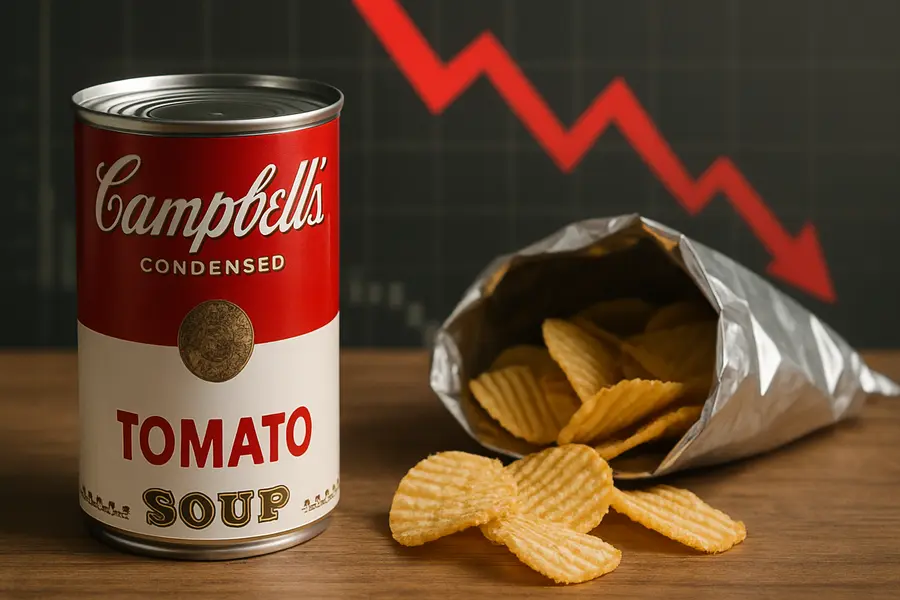
https://moneycheck.com/wp-content/uploads/2026/06/shutterstock_2093388007-1.webp
- Campbell's stock rose 3.3% after Q3 adjusted EPS of $0.50 beat estimates, even as revenue missed by $15M and snacks operating earnings fell 32%.
- The snacks segment declined 4% in Q3, extending a streak of losses in salty snacks, crackers, and fresh bakery products.
- Full-year adjusted EPS guidance of $2.15–$2.25 represents a roughly 25% decline from fiscal 2025's $2.91.
Campbell's Q3 revenue slid 4% to $2.37B as persistent snack demand weakness and rising input costs dragged the consumer staples giant's outlook.
Lead
The Campbell's Company (Nasdaq: CPB) reported third-quarter fiscal 2026 net sales of $2.366 billion on June 8, down 4% year-over-year and short of the $2.381 billion Wall Street consensus, as snack demand remained depressed across its salty portfolio, crackers, and fresh bakery lines for the third consecutive quarter. Adjusted earnings per share of $0.50 edged past the $0.48 estimate, while Campbell's stock climbed 3.3% in premarket trading — a relief bounce for a name that has lost 22% year-to-date and 37% over the trailing twelve months.What Happened
The snacks segment posted a 4% net sales decline in Q3, matching the prior-quarter pace of deterioration, as consumers continued to trade down to store-brand alternatives or skip discretionary consumer staples purchases outright. Operating earnings in the snacks division fell a steeper 32%, pressured by higher input costs, rising tariffs, and an unfavorable product mix. Brands including Goldfish, Snyder's of Hanover, and Cape Cod were among those most affected by the volume softness.
The Meals & Beverages segment also contracted 4%, with U.S. soup sales down 8%, though the division provided the quarter's clearest bright spot: Rao's pasta sauce surpassed $1 billion in trailing twelve-month net sales, validating the $2.7 billion Sovos Brands acquisition completed in fiscal 2024.
On profitability, adjusted gross profit fell 12% to $656 million, compressing adjusted gross margin by 240 basis points to 27.7%. Adjusted EBIT declined 24% to $274 million. Net income nonetheless improved to $124 million from $66 million a year earlier, partly reflecting reduced restructuring charges.
Snack Demand: A Persistent Drag
The sustained weakness in snack demand is not idiosyncratic to Campbell's. Across consumer staples, households have been rationalizing pantry spending as cumulative food inflation erodes real purchasing power, and salty snacks — perceived as the least essential category — are bearing a disproportionate share of trade-down behavior. Private-label alternatives in the cracker and chip aisles have taken incremental shelf share, while supply disruptions in the fresh bakery segment compounded the volume shortfall.
CEO Mick Beekhuizen acknowledged that the recovery in snacks is taking longer than the company originally modeled but cited "emerging positive signals in the salty snacks product line" and described quarterly performance as "aligned with internal projections." CFO Todd Cunfer was more candid on costs, warning that "first half inflation will be pretty high" for fiscal 2027, with the company projecting input-cost inflation of 5–6% in the coming year. A tariff-related refund is expected to contribute 3–4 cents per share in the fiscal fourth quarter, a partial but limited offset.
Market Reaction
Campbell's stock traded near $21.60 heading into the release, against a consensus twelve-month analyst price target of $20 — itself a signal of cautious sentiment on the Street. The 3.3% premarket gain reflected relief that the EPS beat and full-year guidance hold, rather than any acceleration in the underlying business. Year-to-date, CPB remains one of the worst performers in large-cap consumer staples, down roughly 22% even after the post-earnings bounce.The company's balance sheet carries elevated leverage from the Sovos acquisition, limiting financial flexibility. Capital expenditures reached $297 million through the first nine months of fiscal 2026, while nine-month operating cash flow of $839 million compared with $872 million a year earlier. Cash on hand stood at $402 million. Shareholder returns of $380 million in the period were driven almost entirely by dividends rather than buybacks.
Cost Reduction and Strategic Context
Campbell's is executing a $375 million cost-savings program targeting fiscal 2028, with cumulative savings reaching $200 million after roughly $20 million generated in the third quarter. Management is leaning on efficiency gains and the growing Rao's franchise to offset snacks-segment headwinds and restore margin trajectory, rather than pursuing additional large-scale M&A.
The at-home cooking trend has provided modest tailwinds for soups and sauces, with Rao's, Swanson, and the core Campbell's soup brand cited as beneficiaries. However, an 8% decline in domestic soup sales in Q3 indicates that even the traditionally resilient soup category is not immune to consumer belt-tightening.
Outlook
Campbell's reaffirmed its fiscal 2026 full-year guidance: organic net sales to fall 1–2% and adjusted EPS of $2.15–$2.25, in line with the $2.17 FactSet consensus. The range implies roughly a 25% earnings decline relative to fiscal 2025's $2.91, making this one of the most significant guidance compressions the company has executed in nearly two decades. With snack demand recovery slower than anticipated, tariff-related headwinds persisting into fiscal 2027, and Wall Street's twelve-month price target sitting below the current share price, the near-term path for Campbell's stock depends heavily on whether early green shoots in salty snacks translate into measurable volume recovery in the fiscal fourth quarter and into the following year.
Mentioned tickers: CPBEarnings