Pomegra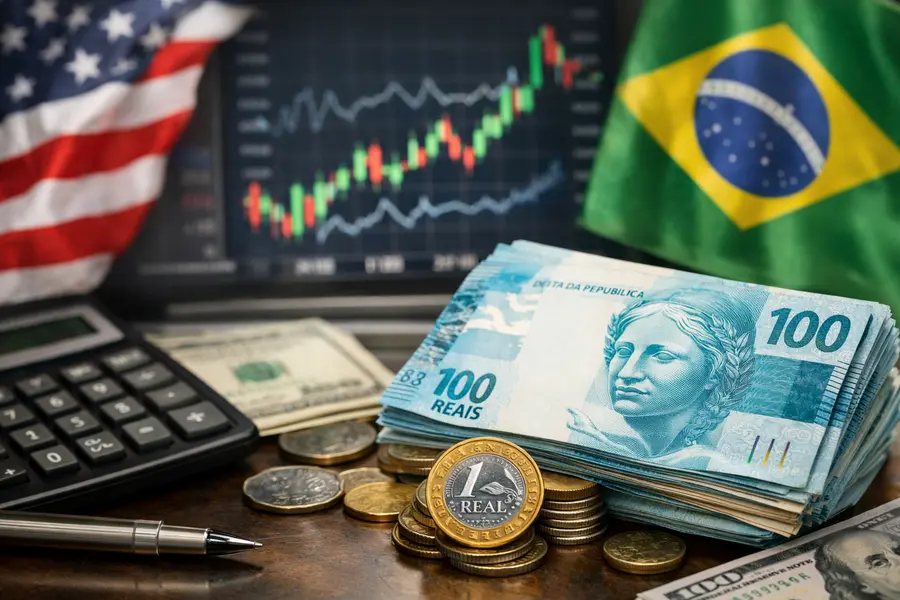
The Brazilian real stabilized near R$5.21 after June's weak US jobs report eased dollar pressure and highlighted Brazil's 10.5-percentage-point yield advantage over US rates.
- US nonfarm payrolls added just 57,000 jobs in June, less than half the 115,000 consensus forecast, pulling the dollar broadly lower.
- Brazil's Selic rate at 14.25% versus the US policy band of 3.50%–3.75% sustains a yield differential that continues drawing foreign capital into BRL-denominated assets.
- The real gained 0.99% on July 3 to 5.1702 per dollar, recovering from a three-month trough of 5.22 struck the previous session.
Lead
The Brazilian real rebounded to 5.1702 per dollar on July 3, 2026, clawing back losses after striking a three-month low of 5.22 a session earlier, as a sharply weaker-than-forecast US employment report for June diminished the dollar outlook and reinforced the carry advantage embedded in Brazil forex positions over dollar-denominated holdings.
What Happened
The US Bureau of Labor Statistics released June nonfarm payroll data on July 2 showing the economy added just 57,000 jobs — the softest monthly gain in four months, less than half the 115,000 projected by economists, and well below a downwardly revised May reading of 129,000. The unemployment rate edged to 4.2%, but largely because the labor force participation rate dropped 0.3 percentage point to 61.5%, its lowest since March 2021, masking the breadth of the slowdown.
The miss triggered a swift retreat in the US dollar as traders recalibrated Federal Reserve rate-cut expectations. Easing dollar pressure lifted currencies across LatAm investment markets, with the real's 0.99% intraday swing from 5.22 to 5.17 underscoring how acutely Brazil forex responds to shifts in US rate dynamics.
Market Reaction
The BRL posted one of the stronger single-session gains among major emerging-market currencies on July 3. The recovery trimmed the real's month-to-date loss to approximately 2.10%, while its twelve-month performance remained firmly positive at roughly 4.64% against the dollar — notable resilience for an emerging-market currency navigating elevated global uncertainty.
Domestic fixed-income instruments extended gains alongside the currency. Softer US labor data reinforced the view that the Fed will ease policy sooner than its guidance had implied, compressing the discount applied to higher-yielding LatAm investment assets and drawing fresh demand into Brazilian sovereign paper.
Strategic Context: The Yield Gap
The structural anchor for the Brazil real is a yield differential that remains extraordinary by historical benchmarks. The Banco Central do Brasil (BCB) cut its benchmark Selic rate by 25 basis points to 14.25% at its June 17 monetary policy meeting — a third consecutive quarter-point reduction — yet the gap between Brazilian and US borrowing costs still exceeds 10.5 percentage points against the US policy band of 3.50%–3.75%.
That differential continues to channel foreign capital into Brazil forex markets through carry trades, providing a structural floor under the currency even as the BCB loosens. The central bank has framed its calibration cycle cautiously, flagging that domestic inflation risks remain elevated. Annual inflation reached 4.72% in May, above the BCB's 4.5% upper tolerance band, prompting the bank to raise its full-year 2026 headline forecast to 4.6%. That inflation overshoot limits the pace of future Selic reductions and, by extension, helps preserve the yield advantage that underpins the real.
US Economic Briefing: Broader Picture
The June employment figures amplified a mounting debate about the durability of the US expansion. While private payroll growth surged earlier in 2026 to more than double its 2025 monthly average, the pace has decelerated through the spring. Professional and business services led June hiring with 36,000 additions, followed by social assistance at 25,000 and healthcare at 22,000 — a narrow roster of sectors carrying the bulk of the labor market's forward motion.
The Federal Open Market Committee projects US policy rates ending 2026 in the 3.50%–3.75% range. Should the labor market soften further through the summer, markets are pricing an earlier pivot, a scenario that would extend favorable carry conditions for high-yielding Brazil forex positions and sustain LatAm investment inflows into the second half of the year.
Geopolitical Dimension
Global headwinds complicate the macro backdrop. World Bank projections place global growth at 2.5% for 2026, with emerging-market and developing economies facing the weakest per capita income expansion since the pandemic. Renewed inflation stemming from the Middle East conflict has weighed on consumer purchasing power across the region, though partial normalization of energy markets following preliminary steps toward an Iran-US accord has helped contain noncore price pressures in Brazil — a development the BCB cited as a mitigating factor in its June easing decision.
Within LatAm investment allocation, Brazil has demonstrated relative resilience. Regional peers face a tighter combination of fiscal consolidation requirements, trade uncertainty, and more limited monetary flexibility, reinforcing selective positioning in Brazilian assets among institutional investors seeking yield alongside a measure of macro stability.
Outlook
The Brazil real enters the remainder of July with the June US jobs print absorbed and attention shifting to the next American employment reading, due August 7. A continuation of below-trend US hiring would sustain dollar headwinds and keep carry demand for BRL positions intact near current levels. Domestically, the BCB's capacity to extend its Selic reduction cycle without re-anchoring inflation expectations above target will determine how much of the yield buffer the real can hold through year-end.
Inflation running above the 4.5% ceiling constrains the pace of easing and, in doing so, protects the structural pillar supporting the currency. The real's consolidation near R$5.21 reflects precisely that balance: pressured by decelerating domestic growth, yet anchored by a yield advantage that few LatAm currencies can replicate.
Mentioned tickers: BRL, EWZ, ITUB, BBD, BRFS