Pomegra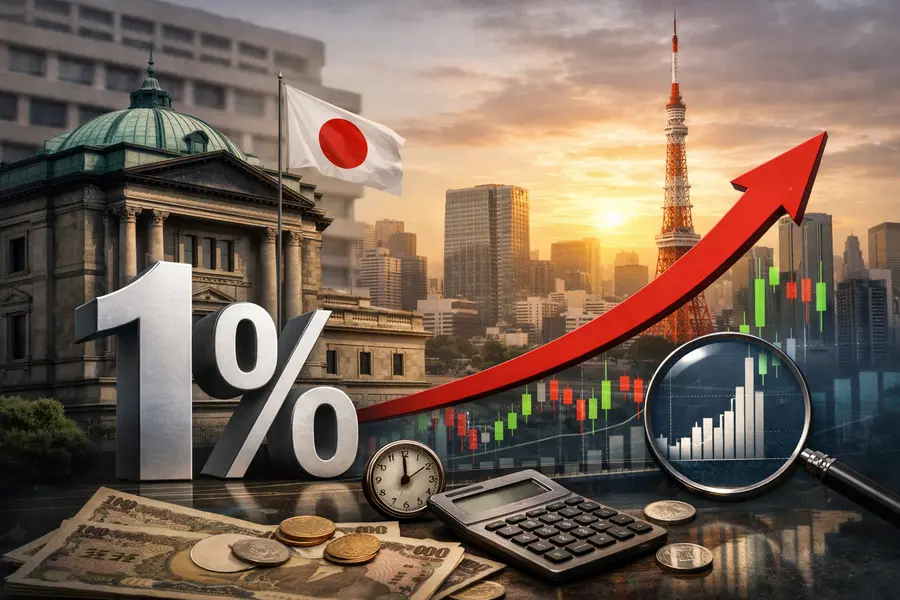
The Bank of Japan kept its benchmark rate unchanged at 1.00% on July 31, 2026, but upgraded its economic forecasts and signaled a potential move as soon as September as Tokyo inflation hit a two-month high.
- BoJ voted 8-1 to hold rates at 1.00%, the highest level since September 1995, with one dissenter seeking an immediate hike to 1.25%.
- Tokyo's headline CPI rose 2.0% year-on-year in July, up from 1.7% in June, while core inflation quickened to 1.9%.
- Governor Kazuo Ueda signaled a rate increase could come as soon as September; 70% of economists in a Reuters poll see rates reaching at least 1.50% by Q2 2027.
Lead
The Bank of Japan held its short-term policy rate at 1.00% on Friday, July 31, following an 8-1 board vote, as policymakers assembled at the bank of japan building in tokyo weighed a resilient labor market and quickening consumer prices against a weakening yen and global trade uncertainty. The decision left borrowing costs at their highest since 1995 and came alongside the central bank's quarterly Outlook Report, which nudged up growth projections and retained a hawkish bias on inflation, setting the stage for a potential autumn hike.
What Happened
The hold was widely anticipated — all 52 economists surveyed by Bloomberg had forecast no change — but the vote count underscored internal pressure. Board member Hajime Takata cast the sole dissent, arguing for an immediate 25-basis-point increase to 1.25%.
The BoJ last raised rates in June 2026, marking a steady climb from decades of near-zero policy. In its Quarterly Outlook, the bank revised its fiscal 2026 real GDP growth forecast upward to 0.6% from 0.5%, and lifted the fiscal 2027 projection to 0.8% from 0.7%, citing resilient domestic demand.
On inflation, the BoJ trimmed its fiscal 2026 core CPI forecast to 2.5% from 2.8%, reflecting government steps to ease household energy bills over the summer. For fiscal 2027, it raised the inflation outlook to 2.4% from 2.3%. The report emphasized that underlying inflation carries a risk of deviating above the 2% target, citing firms' increasing willingness to raise wages and prices.
Tokyo CPI: Inflation Data Firms
The Tokyo consumer price data released alongside Friday's decision provided concrete support for the BoJ's hawkish tilt. The capital's headline CPI rose 2.0% year-on-year in July, accelerating from 1.7% in June — the fastest pace in two months. Core inflation, which strips out fresh food, climbed to 1.9% from 1.6%, while the narrower measure excluding food and energy rose to 1.3% from 1.1%.
The tokyo metropolitan area serves as a leading indicator for national inflation figures released later in the month. The broad-based firming across all three measures reflects two compounding forces: elevated global energy prices, exacerbated by a resurgence in U.S.-Iran hostilities that disrupted Middle East oil and gas flows, and a sharply weaker yen that inflates the cost of Japan's heavily imported food and energy supplies.
Market Reaction
Currency markets were volatile heading into the decision. The yen had hit a 40-year low against the dollar, briefly trading above 163, prompting the Ministry of Finance to intervene in the foreign exchange market on Thursday. The intervention drove USD/JPY down roughly 3%, pulling the pair briefly below 158. After the BoJ held and Governor Ueda's press conference concluded, the yen gave back some of those gains, with USD/JPY recovering toward 160.37.
Japanese government bonds were little moved, as the rate hold had been fully priced in. Equity markets responded positively to the upgraded growth forecasts, with the Nikkei 225 tracking broader risk sentiment.Strategic Context
The BoJ's cautious pace reflects a balancing act that has defined Governor Ueda's tenure: normalizing policy after decades of ultra-loose settings without triggering a disorderly rise in the yen or derailing Japan's consumption-led recovery. Wage growth — the central bank's key precondition for sustained inflation — has remained above trend, with this year's spring wage negotiations delivering some of the strongest pay gains in three decades.
The quarterly outlook's forecast that core inflation will accelerate "clearly above" 2% from the second half of fiscal 2026 — the period running from September to March — amounts to an implicit acknowledgment that the current rate is still below neutral. The BoJ cited wage pass-through into retail prices, elevated crude oil costs, and yen weakness as the primary drivers.
A Reuters poll conducted July 23 found 70% of economists expect rates to reach at least 1.50% by the second quarter of 2027, with 51% treating that level as a terminal rate. The timing debate has narrowed to October versus December 2026, though Ueda's post-meeting remarks pointed to September as a live possibility.
Outlook
The Bank of Japan has positioned itself for a deliberate but near-term resumption of its tightening cycle. With Tokyo CPI back above the 2% threshold, the Quarterly Outlook projecting inflation persistence into fiscal 2027, and a dissenting board member already pushing for action, the conditions for a September hike are solidifying. Currency intervention has bought time, but the yen's structural weakness — driven by the still-wide differential with U.S. rates — will remain a pressure point until the policy gap narrows further. The next pivotal data will be the national CPI release in mid-August and any further wage data, which will shape whether the bank moves in September or delays until the final quarter of the year.