Pomegra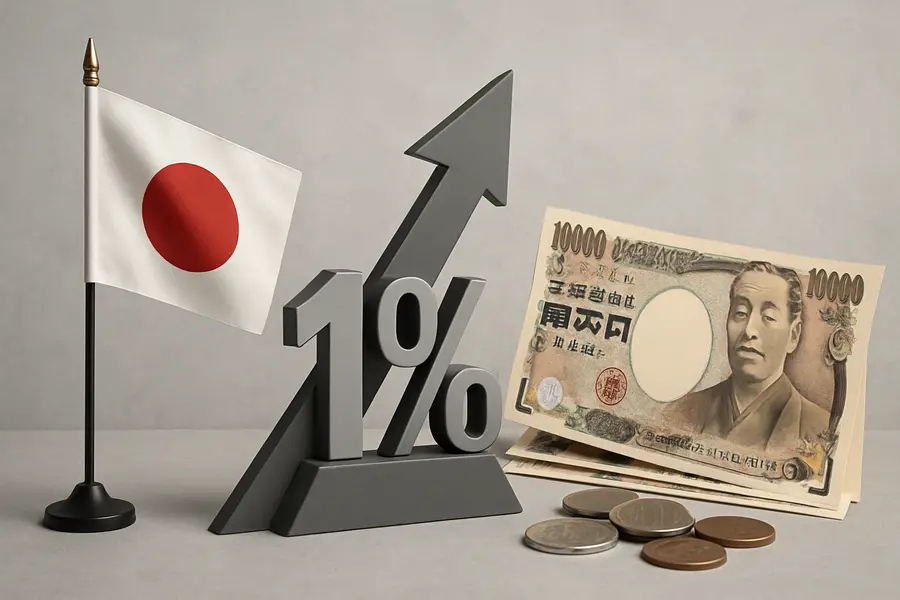
The Bank of Japan raised its policy rate to 1% on June 16—its highest since 1995—as persistent inflation driven by energy shocks and a battered yen push Tokyo toward its most sustained monetary tightening in a generation.
- The BOJ voted 7-1 on June 16 to raise its short-term rate 25 basis points to 1.0%, the highest level since September 1995.
- USD/JPY held near 160 post-decision as the BOJ rate hike was fully priced in; yen short positions reached their highest level since 2017.
- The Bank raised its core CPI forecast for fiscal 2025 to 2.7%, up from the 2.2% projected in April, signaling rate risk remains skewed higher.
Lead
The Bank of Japan raised its benchmark short-term interest rate by 25 basis points to 1.0% on June 16, 2026, delivering Japan's highest policy rate in 31 years. The decision, approved by a 7-1 vote with board member Toichiro Asada dissenting, marks the second consecutive hike in six months and reflects the central bank's accelerating concern that energy-driven inflation and sustained yen weakness are becoming self-reinforcing. It follows December 2025's unanimous move to 0.75% and cements what is now the BOJ's most aggressive tightening cycle since the mid-1990s.
What Happened
In its policy statement, the board said underlying inflation could accelerate above the 2% target if energy-cost pressures are left unaddressed. The BOJ upgraded its core consumer price index forecast for fiscal year 2025 to 2.7%, a 50-basis-point revision above the April projection. FY2026 inflation is now seen easing to around 1.8%, with a return to approximately 2% targeted for FY2027.
The trigger is familiar: a weak yen amplifies imported energy and food costs, and conflict-driven oil price volatility has kept those inputs elevated. After the Bank of Japan reportedly deployed 11.7 trillion yen — roughly $73.5 billion — in foreign-exchange intervention operations in May 2026, the currency drifted back toward the 160 level against the dollar in June, effectively erasing the intervention's gains. With the currency tool visibly losing potency, the rate lever became unavoidable.
Market Reaction
The immediate market response was muted. USD/JPY traded around 160.10 during Asian hours, with the yen firming only marginally — a sign that the BOJ rate hike had been fully absorbed by markets in the days leading up to the announcement. The Nikkei 225 climbed modestly following the decision, as investors took the absence of a hawkish surprise as reassurance against an abrupt tightening shock. Japanese government bond yields edged higher across the curve.
Notably, the BOJ simultaneously softened its Japanese government bond purchase-taper schedule — a yen-negative move at the margin — which helped cap any sharp currency appreciation. A parallel development, a U.S.-Iran framework agreement that pushed crude oil prices lower, also eased imported-inflation pressure and reduced the urgency of further yen strengthening.
The Yen Carry Trade Under Scrutiny
No structural consequence looms larger over global markets from this decision than the yen carry trade. For more than a decade, ultra-low Japanese rates made yen-denominated borrowing effectively free, financing leveraged positions in higher-yielding U.S. Treasuries, equities, and emerging-market assets. Net yen short positions heading into the June meeting reached their highest level since 2017 — a concentration of carry-trade exposure that leaves global portfolios exposed to a rapid unwind if the yen were to spike.
At 1%, the cost of borrowing yen has risen meaningfully, but the U.S. Federal Reserve's benchmark rate remains at 3.50%–3.75%, leaving a rate differential of roughly 275–300 basis points. That gap still makes the yen carry trade economically viable, which explains why the unwind feared by markets did not materialize on June 16. The math shifts materially only if the BOJ accelerates its hiking pace or the Fed cuts substantially — or both simultaneously.
Strategic Context
The BOJ's current trajectory represents a deliberate dismantling of three decades of deflationary bias. Governor Kazuo Ueda has moved the institution from negative rates — abandoned in March 2024 — through 0.25%, 0.5%, 0.75%, and now 1.0%, each step taken with care not to destabilize the world's largest carry-trade funding currency. The 7-1 vote reflects an unusual degree of consensus; the dissent came not from opposition to tightening in principle but from concern about the pace.
Tokyo's fiscal dynamics add pressure. With public debt exceeding 260% of GDP, rising yields increase the government's debt-servicing costs — a constraint that limits how aggressively the BOJ can move without triggering sovereign stress. The bond-taper softening signals that the BOJ is managing this tension actively.
What Comes Next
Market expectations have converged around a terminal rate of 1.25%, implying one additional 25-basis-point hike in 2026 and another in 2027, before the cycle plateaus. That path assumes inflation cools gradually toward 2% by FY2027 and that the yen stabilizes without requiring further intervention. If Middle East energy risks re-escalate and oil prices climb back toward previous peaks, the pace could quicken. Conversely, a stronger dollar driven by U.S. fiscal uncertainty could reignite yen weakness and present the BOJ with an uncomfortable choice between currency defense and growth caution.
The immediate test is whether global yen carry trade holders begin to reduce positions as the rate gap narrows incrementally and the BOJ's resolve becomes undeniable.
Outlook
The BOJ's move to 1.0% is less a destination than a way-marker on a longer normalization road. Inflation above target, a yen near multi-decade lows despite historic intervention, and geopolitically elevated energy costs have narrowed the bank's room to pause. The absence of a carry-trade unwind on June 16 reflects how carefully the BOJ engineered its communication — but the structural vulnerability remains intact. Each successive hike compresses the yen-carry premium that has underpinned trillions in global positioning, and the cumulative pressure on that trade will only grow as Tokyo continues reclaiming monetary ground it ceded 30 years ago.
Mentioned tickers: USD/JPY, NKY