Pomegra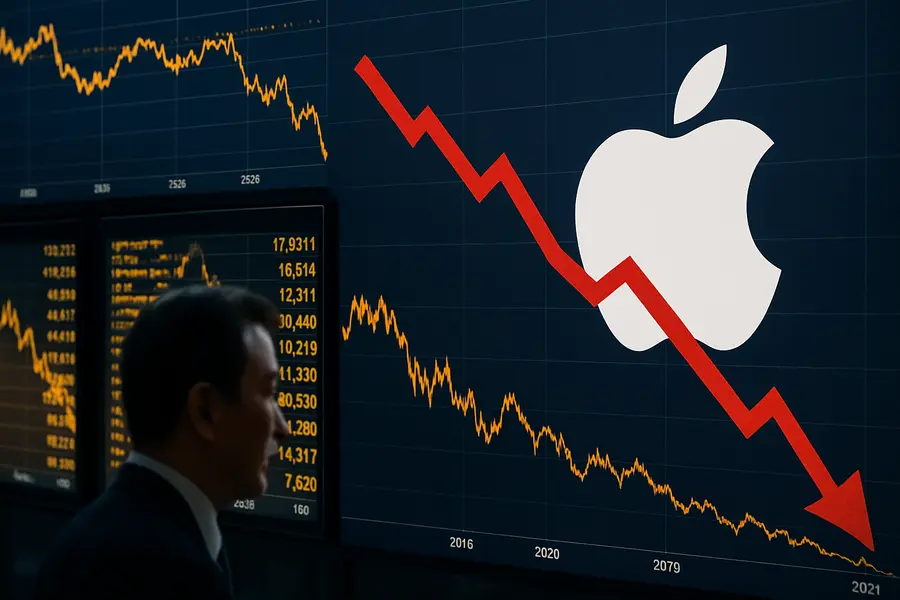
Asian market news: A renewed tech stocks decline drove the Nikkei index and regional benchmarks to two-week lows as Apple's price hikes ignited a global equity selloff across semiconductor and AI names.
- Apple erased ~$250 billion in market cap after raising prices on Macs and iPads, sending a cost-inflation warning through Asia's chip supply chain.
- SoftBank Group plunged 13%, SK Hynix fell 10%, and Samsung slid 9% as the Nikkei index deepened its weekly tech stocks decline.
- Reports that OpenAI may delay its IPO compounded selling pressure, unsettling AI-focused investors across the region.
Lead
Asian equities fell to their lowest level in two weeks on Friday, June 26, as a fresh wave of selling swept through technology shares after Apple Inc. raised prices on its Mac, iPad, and home device lines — a move that stripped roughly $250 billion from the company's market value in a single U.S. session and transmitted anxiety from Silicon Valley to Seoul, Tokyo, and Taipei. The MSCI Asia Pacific Index declined 3.2% in the session, extending a punishing week for regional technology stocks and marking the sharpest multi-day retreat for the sector in 2026.
What Happened
The tech stocks decline spread broadly across Asia, with Japan, South Korea, and Taiwan bearing the heaviest losses. SoftBank Group Corp. led the carnage in Tokyo, plunging as much as 13% — its steepest single-day fall in months — while chip-equipment maker Advantest Corp. shed 6.2%, memory materials supplier Taiyo Yuden Co. lost 8.3%, and wafer-fabrication toolmaker Tokyo Electron Ltd. declined 2.3%.
Japan's Nikkei index fell 4.15% to 69,360.88 on the week's sharpest down day, with the broader Topix shedding 1.32% to 3,963.36. Earlier in the week, the benchmark had lost 3.6% in a single session on June 23, underscoring the persistence of the selling pressure.
In South Korea, Samsung Electronics Co. lost 9.2% and SK Hynix Inc. declined 10%, extending a week in which both names had already surrendered double digits. In Taiwan, Taiwan Semiconductor Manufacturing Co. (TSMC) fell more than 5%, pulling the broader Taiex Index sharply lower.
The Apple Catalyst
Apple's decision to raise prices on its flagship hardware products — citing unsustainable costs for memory and storage components — sent an immediate shockwave through Asia's semiconductor supply chain. The price hike effectively signalled that the relentless demand for advanced memory chips, which had underpinned a months-long rally across Asian technology equities, is now generating consumer-level inflationary pressure.
SK Hynix and Samsung, the world's two dominant producers of DRAM and NAND flash memory, absorbed the steepest losses as investors reassessed whether surging chip demand was approaching an inflection point. The concern is structural: if Apple — the single largest consumer of mobile memory — is compelled to pass costs to consumers, margin compression or volume softness in device markets may follow. Microsoft Corp. reinforced the narrative by announcing higher prices for Xbox gaming consoles, attributing the move to rising component costs. Together, the two disclosures transformed what might have been a company-specific story into a sector-wide alarm about the economics of hardware in the AI era.OpenAI IPO Delay Weighs on SoftBank
Reports that OpenAI may defer its initial public offering into 2027, as the company struggles to attract sufficient investor demand at a $1 trillion valuation, added a second layer of selling to Friday's session. SoftBank Group, whose Vision Fund holds a significant stake in OpenAI, saw its losses accelerate following the reports. The Japanese conglomerate's AI-focused investment thesis — a central driver of its year-to-date stock appreciation — came under pointed scrutiny.
SoftBank's listed affiliate, Arm Holdings Ltd., also fell 3.2% in the prior U.S. session, underperforming the broader semiconductor peer group even as some AI-related names attempted a partial rebound.
Global Equity Selloff Context
The Asian market news selloff extended a global equity selloff that began on Wall Street earlier in the week. The Nasdaq Composite fell for a fourth consecutive session on Thursday, declining 0.46%, as Apple's 6.1% single-day drop overshadowed stronger-than-expected earnings from Micron Technology Inc. — results that would ordinarily have lifted the chip sector.
European markets also retreated, with the STOXX 600 Index slipping 0.51%, led by semiconductor and chip-equipment producers. The breadth of the decline made clear that the repricing was not confined to Apple's direct supply chain but reflected a wider reassessment of technology valuations after an extended AI-driven run-up.
South Korea Under Strain
South Korea bore disproportionate damage during the global equity selloff, a direct consequence of index concentration. Samsung Electronics and SK Hynix together represent roughly half of the KOSPI's total market capitalisation, meaning their combined double-digit weekly losses were sufficient to move the entire market materially.
On June 23, the KOSPI triggered a 20-minute circuit-breaker halt after plunging as much as 10%, its worst session in several years. The South Korean financial regulator separately raised concerns about leveraged single-stock exchange-traded funds tied to Samsung and SK Hynix that had only entered the market weeks earlier — instruments that amplified selling pressure as margin calls forced rapid liquidations.
AI Infrastructure Costs: A Structural Shift
The underlying fault line in the tech stocks decline is a reassessment of artificial intelligence economics. For most of 2025 and the early months of 2026, AI infrastructure demand for semiconductors — high-bandwidth memory, advanced logic chips, GPU accelerators — fuelled outsized gains across Asian technology names. The prevailing assumption was that institutional capital flows into AI buildout would insulate the sector from broader cost pressures.
Apple's price announcement challenged that assumption directly: rising memory costs are migrating downstream to device makers, introducing a new inflationary dynamic into the supply chain. Compounding the repricing, the Federal Reserve's hawkish tone at its June 17 policy meeting — signalling fewer rate reductions than markets had anticipated — has elevated the discount rate applied to growth-heavy technology stocks, reducing the present value of projected earnings.
Outlook
Asian technology stocks remain exposed to further volatility as the market digests the implications of hardware inflation spreading through the AI supply chain. The Nikkei index faces headwinds as semiconductor-adjacent names recalibrate; South Korea's KOSPI will watch closely for any stabilisation in Samsung and SK Hynix, whose combined weight makes a sustained recovery difficult without broad sector participation. Key near-term variables include any further guidance from major chip buyers on procurement volumes, the Federal Reserve's next policy signal, and clarity on OpenAI's financing and IPO timeline. Until those datapoints emerge, the global equity selloff appears unlikely to find a firm floor.
Mentioned tickers: AAPL, MSFT, 9984.T, 000660.KS, 005930.KS, TSM, 6857.T, 6976.T, 8035.T, MU, ARMH