Pomegra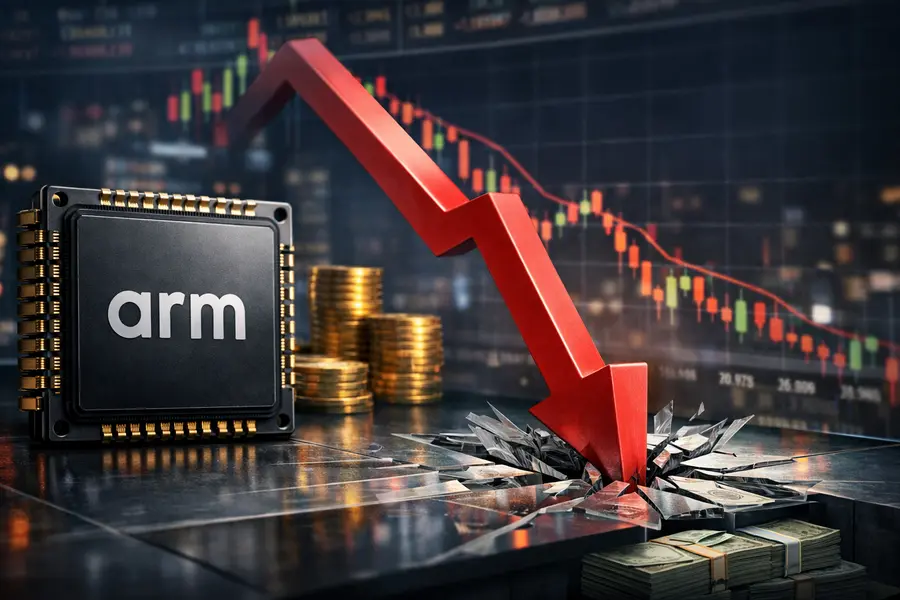
Arm Holdings shed 29% in a month, cracking $240 support as a near-290x trailing P/E and China's accelerating RISC-V pivot force a hard reset on the chip architecture giant's growth premium.
- ARM dropped ~29% over four weeks, breaching $240 support before Q1 FY2027 earnings on July 29, 2026, then falling an additional 8% on results day.
- Trailing P/E approaching 290x leaves no margin for error as full-year royalty growth guidance was trimmed to the high-teens, below the 20% threshold priced in.
- China, which generates 19% of Arm's revenue and grew only 7.5% last fiscal year, is executing a government-mandated pivot to open-source RISC-V chip architecture.
Lead
Arm Holdings (NASDAQ: ARM) suffered one of the sharpest sustained declines in its post-IPO history through late July 2026, shedding roughly 29% over a single month and violating the $240 technical support zone that institutional traders had treated as a structural floor. From a June intraday peak above $450, the stock had lost more than 40% of its value by the close of July 27, arriving at Q1 fiscal 2027 earnings with momentum firmly negative and questions about the durability of its AI-driven valuation premium reaching a crescendo.What Happened
Arm reported record first-quarter revenue of $1.29 billion for the period ended June 2026 — a 22% year-over-year increase that topped the high end of management guidance. Non-GAAP earnings per share of $0.45 also beat consensus. The headline numbers were not the problem. Data center royalty revenue more than doubled year-over-year, and demand for the Arm AGI CPU surpassed $2 billion against approximately $1 billion in secured supply, pointing to genuine structural appetite in the AI compute buildout.
The market sold the report regardless. Management disclosed that memory-driven price inflation is compressing volumes in mid-tier and premium handsets, pulling full-year royalty revenue growth guidance toward the high-teens percentage — a meaningful step down from the roughly 20% trajectory that had been embedded in analyst models and, by extension, in the stock's multiple. Capacity bottlenecks at TSMC's 3nm foundry node add a further supply-side constraint on Arm's ability to capitalize on the backlog it has accumulated. HSBC had preemptively downgraded ARM to Hold on July 14, citing precisely those foundry limitations alongside a valuation it described as pricing in years of near-perfect execution.
Market Reaction
The technical breakdown preceded the fundamental disappointment. ARM sliced through $240 — a key support anchored by the 100-day simple moving average — in the sessions immediately ahead of earnings, triggering automated sell programs and institutional de-risking. Volume on the decline days ran well above the three-month daily average, characteristic of genuine distribution. After the July 29 print, the stock settled near $225, leaving it down more than 50% from its cycle high.
At those levels, Arm Holdings still carries a trailing price-to-earnings multiple approaching 290x — among the loftiest valuations in the global semiconductor sector. The forward P/E, using fiscal 2027 consensus estimates, remains above 100x. Both figures encode assumptions of sustained, uninterrupted revenue compounding over the next five to seven years, leaving the stock acutely exposed to any deceleration in the licensing and royalty pipeline.
The China Dimension
Simultaneously, a structural threat is materializing in Arm's second-largest market. China accounted for 19% of total Arm revenue in fiscal 2025, but that exposure grew only 7.5% year-over-year — a sharp deceleration against Arm's overall growth rate and one that now draws direct attention from investors.
The proximate cause is an accelerating government-directed pivot toward RISC-V, an open-source chip architecture that carries no licensing fees and no dependency on Western intellectual property. In March 2025, eight Chinese government bodies issued a coordinated policy framework mandating RISC-V integration across critical infrastructure sectors — energy, finance, and telecommunications. Major domestic technology firms, including Alibaba Cloud, Huawei, Tencent, and ZTE, have become premier members of RISC-V International, and domestic designers such as Alibaba's XuanTie and Nuclei System Technology are supplying production silicon at scale.
RISC-V has reached roughly 25% market penetration in China's specialized AI and IoT chip segments, up from negligible share three years ago, with momentum spreading into cloud and high-performance computing applications. Companies migrating to RISC-V eliminate not only annual licensing fees — often running into tens of millions of dollars for large-volume chipmakers — but also the risk of license revocation in a deteriorating bilateral environment. For Arm's licensing model, that combination of cost economics and geopolitical risk mitigation represents a structurally adverse competitive dynamic, not a cyclical one.
Strategic Context
The long-term investment case for Arm Holdings remains anchored in AI infrastructure. CEO Rene Haas has articulated a roadmap to $15 billion in revenue from the Arm AGI CPU line and $25 billion in total revenue by fiscal year 2030, a roughly tenfold increase from current annualized levels. The doubling of data center royalty revenue in a single quarter demonstrates that demand for Arm's chip architecture in AI workloads is genuine and accelerating. The company retains more than 95% share in smartphone processors and is extending into cloud servers and automotive.
The issue is valuation arithmetic. A near-290x trailing multiple encodes the optimistic scenario as the base case. The combination of trimmed royalty guidance, TSMC capacity constraints, China's RISC-V transition, and HSBC's downgrade introduces variance that such a multiple cannot readily absorb.
Outlook
ARM enters the second half of fiscal 2027 with record quarterly revenues, a credible long-cycle AI narrative, and a stock down 50% from its peak. The $240 support failure and the earnings-day selloff confirm that institutional investors are actively recalibrating the risk premium in Arm Holdings' valuation. Whether the AGI CPU demand backlog and expanding data center royalties can sustain 20%-plus compound revenue growth — the implicit requirement to justify current earnings multiples — will determine the stock's medium-term trajectory. The China revenue deceleration adds a dimension that no near-term product cycle can reverse. Resolution will come from guidance revisions, foundry capacity expansion timelines, and whether the RISC-V encroachment remains contained to government mandates or broadens into commercial Chinese handset and mobile chip markets.
Mentioned tickers: ARM, TSMC