Pomegra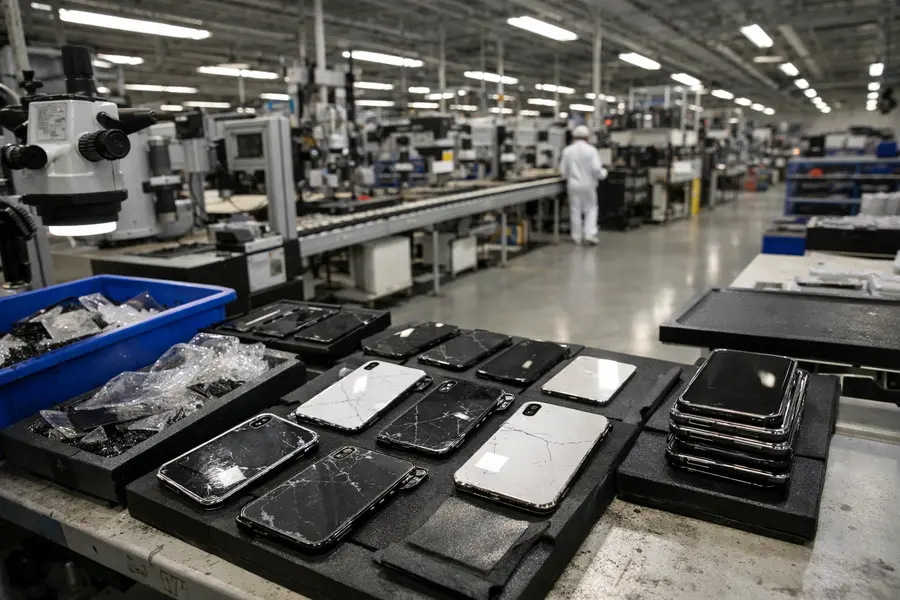
Apple's plan to mark the iPhone's 20th anniversary with a revolutionary all-glass design has collapsed under the weight of insurmountable manufacturing yields, prompting a sharp Wall Street downgrade.
- Apple canceled its 20th-anniversary all-glass iPhone concept after suppliers failed to achieve production-viable yields on the structural glass design.
- Jefferies downgraded AAPL to Underperform, setting a $63.66 price target that implies roughly 16% downside from current levels.
- The cancellation removes Apple's most anticipated hardware catalyst from its 2027 roadmap, weakening the upgrade cycle narrative.
Lead
Apple (AAPL) has abandoned a fully glass-encased flagship iPhone planned for the product's 20th anniversary after manufacturing partners could not achieve acceptable yields on the technically demanding design. The decision eliminates a marquee product moment expected to anchor Apple's 2027 lineup, and Jefferies responded with a downgrade to Underperform, setting a price target of $63.66 — implying roughly 16% downside from current levels.What Happened
The all-glass iPhone concept — a design that would have replaced aluminum and titanium frames with load-bearing structural glass across every surface — was conceived as the centerpiece of Apple's commemoration of the iPhone's two-decade milestone. Production trials with casing and display suppliers exposed yield rates on the curved, multi-surface glass components that fell materially below the thresholds required for mass production at Apple's volume and quality standards.
Unlike the Ceramic Shield panels sold in Apple Store locations as front-display protection, the anniversary design required glass to bear structural stress on all six faces simultaneously. Fabrication processes proved incapable of consistently meeting the tolerances that specification demanded. Breakage during assembly and stress-testing exceeded acceptable limits, rendering the 2027 launch timeline unworkable.
The all-glass iPhone concept was widely regarded as the most visually radical iPhone redesign since the introduction of the glass-and-stainless-steel iPhone 4 in 2010, and its cancellation closes a design chapter before it opened.
Market Reaction
Jefferies moved promptly to Underperform following disclosure of the cancellation, citing the removal of a major product catalyst and the risk it poses to a stalling upgrade cycle. The $63.66 price target places the firm among the more bearish voices on the stock.
AAPL came under pressure in the wake of the news. The Jefferies call stands as a contrarian marker against a broader analyst community that has, until recently, maintained broadly constructive ratings on the stock. The downgrade surfaces at a moment when Apple's premium valuation multiples are increasingly dependent on the services growth story rather than hardware breakthroughs.
Strategic Context
The 20th anniversary of the iPhone carries exceptional symbolic weight for Apple. The original device, unveiled in January 2007, transformed consumer technology and ultimately propelled Apple to become the first U.S. company to surpass $3 trillion in market capitalization. A 20th-anniversary flagship was positioned as a declaration of continued hardware leadership.
Without the all-glass iPhone concept, Apple enters 2027 without an obvious anchor product. Hardware iterations since the iPhone X have remained incremental — titanium frames, thinner form factors, iterative camera advances — and the absence of a supercycle-level redesign reinforces a structural challenge: hardware differentiation alone no longer reliably drives the mass upgrade behavior seen in earlier generations.
Artificial intelligence capabilities embedded in iOS and custom silicon have become central to Apple's upgrade pitch, but AI features are increasingly table stakes across premium Android competitors. A compelling physical redesign, the kind uniquely suited to the high-touch environment of the Apple Store, would have given the AI story a tangible hardware container. That opportunity is now gone.Retail and Apple Store Implications
Blockbuster iPhone launches historically drive significant Apple Store foot traffic, lifting accessory attachment and drawing consumers deeper into the services ecosystem. A visually distinctive all-glass iPhone concept — designed for exactly the kind of in-hand, in-store reveal that Apple's retail format was built around — would have been a natural magnet for that dynamic. The 2027 cycle, absent that anchor, faces a more subdued retail moment.
Services revenue growth, while still robust, is beginning to decelerate in mature Western markets. That makes a strong hardware year more consequential to near-term revenue trajectory than it might otherwise be.
What Comes Next
Apple's engineering teams are expected to redirect efforts toward materials already within production capability — next-generation titanium alloys, advanced ceramic composites, and improved display glass — for the anniversary cycle, while leaning harder on silicon performance and on-device AI as differentiators. Structural glass research is likely to continue with a longer development horizon in view.
The Jefferies downgrade will face scrutiny at Apple's next earnings call. Any pipeline commentary from management could materially reprice expectations across the analyst community.
Outlook
The cancellation of the all-glass iPhone concept leaves Apple navigating its 20th-anniversary year without a hardware centerpiece capable of driving broad consumer excitement. The Jefferies downgrade to Underperform, with a $63.66 target implying roughly 16% downside, marks a significant reassessment of the product risk embedded in current valuation. The degree to which Apple can sustain premium multiples through AI execution and services momentum — without a marquee physical redesign — is now the central question for investors heading into 2027.
Mentioned tickers: AAPL