Pomegra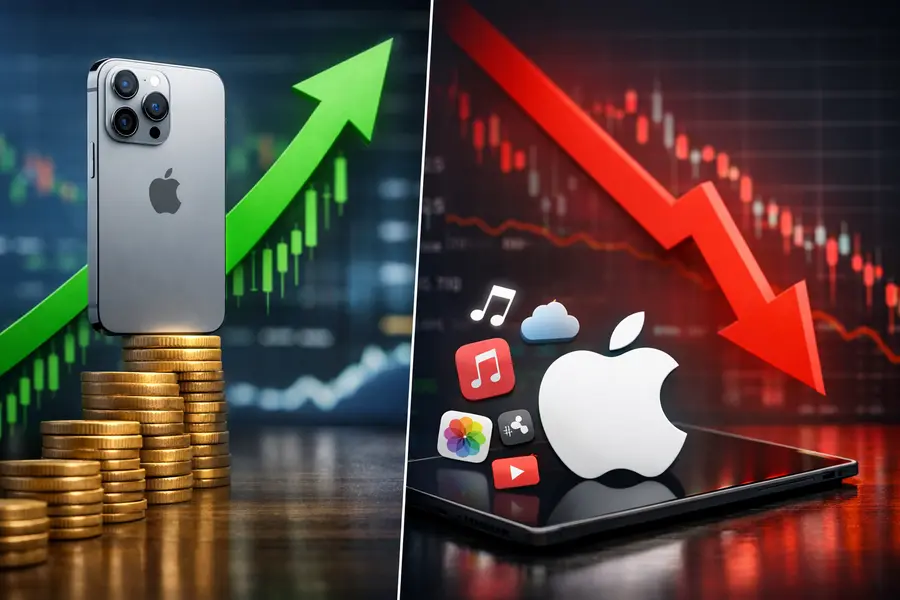
Apple's Q3 2026 revenue of $109.4B topped estimates as iPhone sales surged 22%, but a services miss and weak Q4 guidance sent AAPL shares down 7% pre-market.
- Apple Q3 revenue rose 16% to $109.4B, beating the $108.65B estimate; EPS of $2.02 topped the $1.89 consensus by 7%.
- iPhone revenue surged 22% to $54.3B, but Services revenue of $30.7B missed the $31.2B analyst estimate.
- Q4 revenue guidance of ~$113B at midpoint fell below the $114.9B consensus, triggering a 7% pre-market stock slide.
Lead
Apple reported its strongest June quarter on record Thursday, posting fiscal third-quarter revenue of $109.4 billion — up 16 percent year over year and above Wall Street's $108.65 billion consensus. Despite the headline beat and a 29 percent jump in diluted earnings per share to $2.02, shares fell more than 7 percent in pre-market trading Friday, sliding from Thursday's close of $333.43 to roughly $309.50 and erasing approximately $390 billion in market capitalization. The sell-off reflected investor concern over a shortfall in Services revenue and a below-consensus fiscal fourth-quarter outlook.iPhone Drives the Quarter
The iPhone lineup delivered the quarter's standout result, generating $54.25 billion in revenue — a 22 percent increase from the year-earlier period and above the $53.86 billion analyst estimate. The performance reflected sustained consumer demand across Apple's flagship product family, with double-digit growth reported across every geographic segment. Mac revenue of $10.35 billion also surpassed the $8.74 billion estimate, and Wearables, Home & Accessories contributed $7.9 billion. iPad was the sole hardware laggard, at $6.19 billion against a $6.92 billion projection.
Net income rose to $29.79 billion from $23.43 billion a year earlier. Gross margin reached 50.1 percent.
Services and China Disappoint
Services — Apple's second-largest segment and the long-run growth engine of its Apple Store ecosystem — generated $30.74 billion, below the $31.22 billion analyst consensus. The miss stalled the narrative of accelerating subscription, digital commerce, and licensing growth that investors had priced into the stock following several consecutive quarters of record results. Greater China revenue came in at $18.8 billion, short of the $19.6 billion projection, extending a pattern of regional softness in a market that accounts for a meaningful share of both iPhone assembly and end demand.The EPS Asterisk
Apple's headline EPS figure carried an important qualifier: the $2.02 result included an approximately $0.11-per-share benefit from tariff refunds, which also inflated the reported gross margin by roughly two percentage points. Stripping out the one-time item moderates the apparent profitability outperformance, a distinction that weighed on sentiment after the initial results.
Guidance and Supply Concerns
For the fiscal fourth quarter, Apple guided for revenue growth of 9 to 11 percent year over year, placing the midpoint near $113 billion — below the $114.9 billion analyst consensus and the primary driver of the after-hours and pre-market decline. CEO Tim Cook cited industrywide memory chip supply constraints — spanning both DRAM and NAND — as a factor limiting Mac and iPad availability ahead of the autumn product cycle, a window that typically encompasses a refresh of the iPhone lineup and associated demand peaks for Apple Store retail and digital channels.
The guidance miss comes as Apple recently reclaimed the title of world's most valuable company, with a market capitalization approaching $5 trillion, surpassing Nvidia in a closely watched race for the top position.
Leadership Transition
Thursday's call was also Tim Cook's final quarterly earnings presentation as chief executive. Cook, who has led Apple since 2011, is set to hand the CEO role to John Ternus on September 1. Ternus, currently head of hardware engineering and credited with overseeing Apple's silicon transition, will inherit a business generating more than $400 billion in annual revenue and an installed base at all-time highs across every product category.
Outlook
Apple's June quarter demonstrated durable hardware momentum, with the iPhone lineup posting 22 percent growth and Mac revenue well ahead of estimates. However, the Services shortfall and a below-consensus Q4 revenue guide have reset near-term expectations, pulling shares sharply lower before Friday's open. Memory supply constraints add operational risk heading into the critical September launch window, while the upcoming leadership change introduces a new variable as investors calibrate the strategic path ahead under John Ternus.
Mentioned tickers: AAPL, NVDA