Pomegra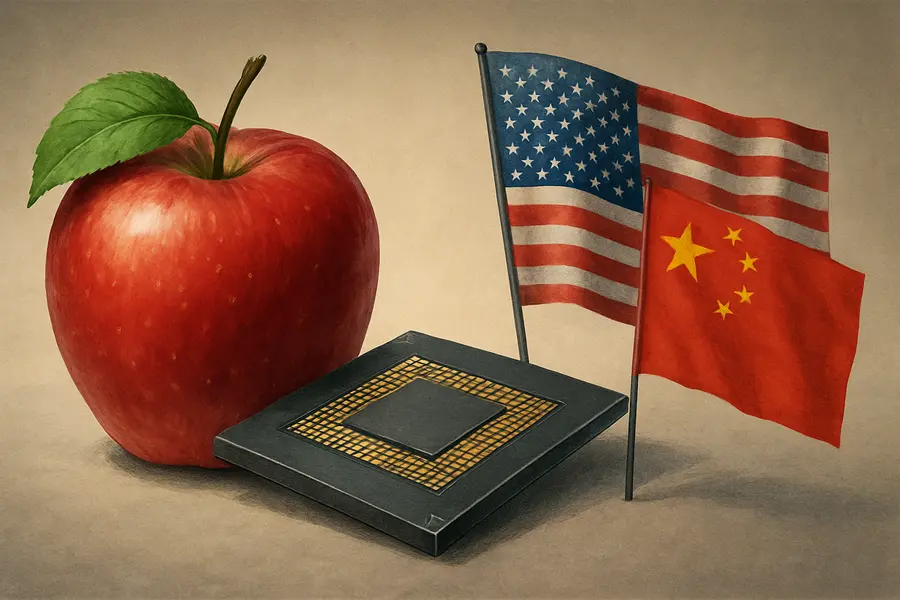
Apple is in talks to source DRAM and NAND flash from Pentagon-blacklisted Chinese makers CXMT and YMTC as a 55-60% memory price surge driven by AI data center demand threatens iPhone 18 margins.
- Apple is negotiating with CXMT and YMTC — both on the Pentagon's military-linked entity list — for DRAM and NAND flash memory supply.
- DRAM contract prices have risen 55-60% in early 2026 as AI infrastructure absorbs an estimated 15-20% of global consumer chip capacity.
- CEO Tim Cook has personally appealed to Treasury Secretary Scott Bessent to reduce political exposure from any deal with Chinese chip suppliers.
Lead
Apple Inc. entered active negotiations in late June 2026 to purchase memory chips from Chinese manufacturers ChangXin Memory Technologies (CXMT) and Yangtze Memory Technologies Co. (YMTC), both named on the U.S. Department of Defense's list of firms suspected of ties to the People's Liberation Army. The company is pursuing the Apple Chinese chips arrangement to address a widening memory supply deficit that has sent DRAM contract prices up an estimated 55-60% in the first half of 2026 and caused iPhone 18 Pro memory component costs to spike 271.79%, according to Counterpoint Research data. Apple stock (AAPL) rose 4.84% to close at $308.63 on July 2.What Happened
Apple is seeking to add CXMT-produced DRAM and YMTC-produced NAND flash to the Apple supply chain, initially scoped to devices sold in China. The two companies represent the leading edge of China's domestic semiconductor ambitions, but their inclusion on the Pentagon's 1260H list makes any commercial relationship politically costly for a U.S.-headquartered corporation.
YMTC carries an additional layer of complexity: it is also named on the Commerce Department's Entity List, which restricts U.S. companies from exporting to it. Apple's proposed arrangement involves purchasing chips rather than supplying technology, which falls outside the export control framework — but it does not eliminate the political risk.
Apple does not require formal U.S. government authorization to buy from either company. What it needs is political tolerance, and it is actively seeking that from the White House.
The Memory Crunch Behind the Push
The pressure on the Apple supply chain originates in a structural demand shift. AI data center expansion is projected to absorb 15-20% of global memory capacity that would otherwise serve consumer electronics by 2027. Memory prices across the market have quadrupled over three consecutive quarters, with DRAM contract prices up an estimated 55-60% in 2026 alone.
The strain is already visible in Apple's product pricing. The company has raised MacBook prices by $100 to $300 and iPad prices by $100 to $200, citing surging component costs. iPhone 18 parts planning has been complicated further by the refusal of incumbent suppliers — Samsung Electronics, SK Hynix, and Kioxia — to negotiate material price concessions despite Apple's scale.
CXMT and YMTC are expanding capacity specifically targeting the consumer segment vacated by AI-driven demand, offering technically competitive chips at prices incumbent suppliers are no longer willing to match. Both have achieved process nodes sufficient for Apple's specifications, removing product quality as a barrier.Geopolitical Dimension
Tim Cook's lobbying effort reflects how seriously Apple is treating the supply threat. His appeals to Treasury Secretary Scott Bessent signal that the company is not relying solely on commercial channels but is seeking political insurance at the cabinet level before any deal is concluded.
The strategy echoes Apple's practice of managing geopolitical risk through direct executive engagement — but the ask is more exposed than prior episodes. Apple Chinese chips discussions arrived in public view at a moment of elevated U.S.-China technology tensions, with both CXMT and YMTC having recently been added to or retained on Pentagon monitoring lists.
Congressional opposition has surfaced swiftly. National security-aligned legislators have framed the talks as a threat to U.S. technology competitiveness. Senator Bernie Sanders characterized the move as corporate greed, arguing that Apple's profit margins provide ample room to absorb cost increases without resorting to military-linked Chinese suppliers. Other lawmakers have warned that any arrangement with CXMT or YMTC would serve as an implicit endorsement of Chinese chip quality at a moment when Washington is attempting to contain Beijing's semiconductor progress.
Apple attempted a similar arrangement with YMTC in 2022 for iPhone memory supply. Congressional backlash caused the company to exit those talks before a contract was signed. The renewed discussions arrive under heavier commercial pressure and with fewer alternative supply options.Market Reaction
Apple stock (AAPL) gained 4.84% on July 2, closing at $308.63 and recovering toward the $300 level the stock had struggled to sustain in recent weeks. The move reflected investor relief that Apple is taking active steps to address memory cost inflation heading into the iPhone 18 production ramp.Citi analysts described a potential Apple agreement with CXMT and YMTC as a global endorsement of Chinese memory capability — a signal that carries implications far beyond Apple's cost structure. If the world's largest consumer electronics company validates Chinese chips at scale, it changes the competitive dynamics for South Korean and Japanese incumbents that have dominated Apple's memory supply for over a decade.
Strategic Context
The episode illustrates the structural contradiction in Apple's post-pandemic supply chain strategy. Years of effort to shift iPhone assembly toward India and Vietnam have reduced but not eliminated manufacturing concentration in China. Advanced semiconductor sourcing, however, has remained tethered to a narrow cluster of East Asian producers — and that cluster is now applying pricing power that Apple is not willing to absorb indefinitely.
CXMT and YMTC represent the first credible volume alternative to emerge outside that cluster in the memory category. The risk to Apple is not technical but legislative: whether Washington's tolerance for the arrangement holds through the political cycle around the iPhone 18 parts ramp later in 2026.Outlook
Apple's pursuit of Apple Chinese chips puts commercial necessity and geopolitical constraint in direct conflict. Memory supply pressure is structural and tied to AI infrastructure investment, which is not slowing. Whether the Trump administration extends Apple the political cover Cook is seeking — or whether the 2022 congressional playbook repeats — will determine whether the talks translate into supply agreements before the iPhone 18 launch window.
Apple stock AAPL's 4.84% single-session gain reflects markets pricing in cost mitigation momentum. The geopolitical resolution remains open, and with both CXMT and YMTC on Pentagon watch lists, the path from negotiations to finalized supply contracts runs through Washington as much as through Cupertino or Shenzhen. Mentioned tickers: AAPL