Pomegra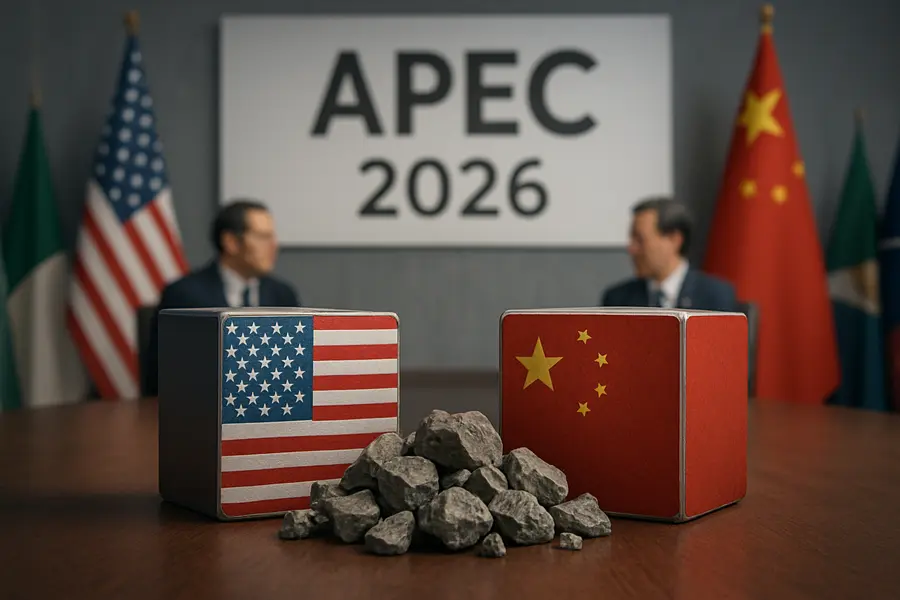
With Shenzhen's APEC summit 2026 months away, China's rare earth export controls on US firms are forcing a market redefinition of bilateral trade dynamics and critical supply chains.
- China added MP Materials and USA Rare Earth to its export control list on June 22, targeting the firms at the core of Washington's supply-diversification strategy.
- A US-China tariff truce extended through November 10, 2026, faces its stiffest test ahead of the Shenzhen leaders' summit.
- China holds approximately 70% of global rare earth production and 90% of refining capacity, giving Beijing structural leverage across defense, EV, and semiconductor supply chains.
Lead
With the APEC summit 2026 — scheduled for November in Shenzhen — now less than five months away, the fault lines in US-China news have sharpened around a single commodity class: rare earths. On June 22, 2026, China's Ministry of Commerce added ten US companies to its export control list, including MP Materials (NYSE: MP) and USA Rare Earth, the two domestically focused producers Washington has relied on to reduce a decades-long dependence on Chinese supply. The move injected fresh urgency into a bilateral trade framework already operating on a narrow margin of stability and placed rare earth supply squarely at the center of the APEC agenda.
What Happened
China's June 22 action is entity-specific rather than a sector-wide restriction. The designation bars Chinese firms from supplying dual-use items to the named companies and prohibits any organization or individual worldwide from transferring Chinese-origin dual-use products to them. Beijing framed the measure as a direct response to Washington expanding its own list of Chinese military-linked entities earlier in June.
MP Materials, which operates the Mountain Pass facility in California — the only large-scale rare earth mining and processing complex in the United States — and USA Rare Earth, building a mine-to-magnet supply chain in Texas, are central pillars of US industrial policy aimed at supply-chain autonomy. Targeting them signals that China views the companies not merely as commercial competitors but as instruments of US strategic policy.Market reaction was contained at the announcement. MP Materials shares were roughly flat; USA Rare Earth traded modestly higher. Both have climbed sharply in 2026 — USA Rare Earth is up approximately 107% year-to-date, while MP Materials has gained around 20% — reflecting investor bets on accelerating Western demand for non-Chinese supply. The muted immediate sell-off reflects a structural reality: the June 22 controls restrict what the named firms can receive from China, not what they can sell, leaving near-term revenue forecasts intact.
The Rare Earth Leverage Problem
The deeper concern is structural. China controls approximately 70% of global rare earth supply and close to 90% of global refining and processing capacity. Any foreign-made product containing 0.1% or more of Chinese-origin rare earths — or manufactured using Chinese processing technologies — now requires a license under rules Beijing put in place through 2025 and 2026, effectively extending Chinese regulatory reach across international supply chains regardless of where final assembly occurs.
The consequences extend well beyond EV batteries and consumer electronics. Aerospace manufacturers relying on yttrium-coated turbine components have flagged material rationing and the potential for production pauses. Defense procurement pipelines for permanent magnets — critical for precision-guided munitions and advanced avionics — face bottlenecks that analysts forecast will persist through 2027 as alternative processing capacity comes online.
This vulnerability defines what is increasingly described as a market redefinition: the repricing of rare earth and critical mineral assets not merely on supply-demand fundamentals but on geopolitical risk premiums embedded into valuations, procurement contracts, and national industrial strategies alike.
The Trade Truce and Its Boundaries
The June 22 controls occurred against the backdrop of a fragile, carefully constructed US-China trade framework. Following a Trump-Xi meeting in October 2025, the two governments agreed to extend reciprocal tariff reductions to 10% — supplemented by a 20% fentanyl-related tariff — through November 10, 2026. The arrangement encompasses the creation of a bilateral Board of Trade to manage non-sensitive commerce, mutual tariff reductions across selected sectors, Chinese commitments to purchase US aircraft, and pledges from Beijing to "address US concerns" about critical mineral supply access.
The effective tariff rate on the broadest category of Chinese goods entering the US remains near 30% — the highest applied to any single trading partner — reflecting the depth of structural divergence that the truce has papered over rather than resolved.
On diversification, Washington has moved on parallel tracks. In October 2025, the US and Australia signed a Critical Minerals Framework targeting expanded mining and processing capacity. Ahead of the APEC forum, the Trump administration signed a series of bilateral mineral agreements with Indo-Pacific partners designed to broaden alternative sourcing. These agreements acknowledge what policy planners increasingly accept: China's processing dominance cannot be displaced quickly, making diplomatic management of the relationship a near-term necessity.
Shenzhen: A Summit Defined by Minerals
China assumed the APEC chairmanship at the start of 2026, announcing the Shenzhen summit under the theme "Building an Asia-Pacific Community to Prosper Together," with openness, innovation, and cooperation as its three stated priorities. Beijing has used the chairmanship to position itself as the region's anchor of multilateral economic engagement — a contrast drawn explicitly against US unilateralism on tariffs and export controls.
The APEC summit 2026 is expected to include a bilateral Trump-Xi meeting, their second since October 2025. Critical mineral supply chains, bilateral trade commitments, and technology transfer rules are likely to dominate the margins of that encounter. Whether China's June 22 entity listings are reversed, suspended, or expanded before November will shape the summit's tone and determine whether the managed-trade framework survives its self-imposed November 10 deadline intact.
Any escalation — broader rare earth restrictions, retaliatory technology sanctions, or a breakdown in Board of Trade negotiations — risks unraveling the truce before Shenzhen, with compounding effects on global industrial supply chains already operating under elevated geopolitical stress.
Outlook
The Shenzhen meeting in November is the most consequential near-term checkpoint for the US-China news cycle on trade and supply chains. Verifiable commitments on rare earth licensing, tariff trajectories, and Board of Trade mechanics could stabilize the managed-trade framework into 2027 and compress the geopolitical risk premium embedded in critical mineral markets. Visible drift or escalation ahead of the summit is likely to accelerate supply-chain bifurcation and direct capital into Western alternative-supply projects at a faster pace. Rare earths have moved from a niche materials market to a primary lever of geopolitical statecraft, and the terms negotiated — or left unresolved — in Shenzhen will echo through defense, clean energy, and advanced manufacturing investment decisions well into the next decade.
Mentioned tickers: MP