Pomegra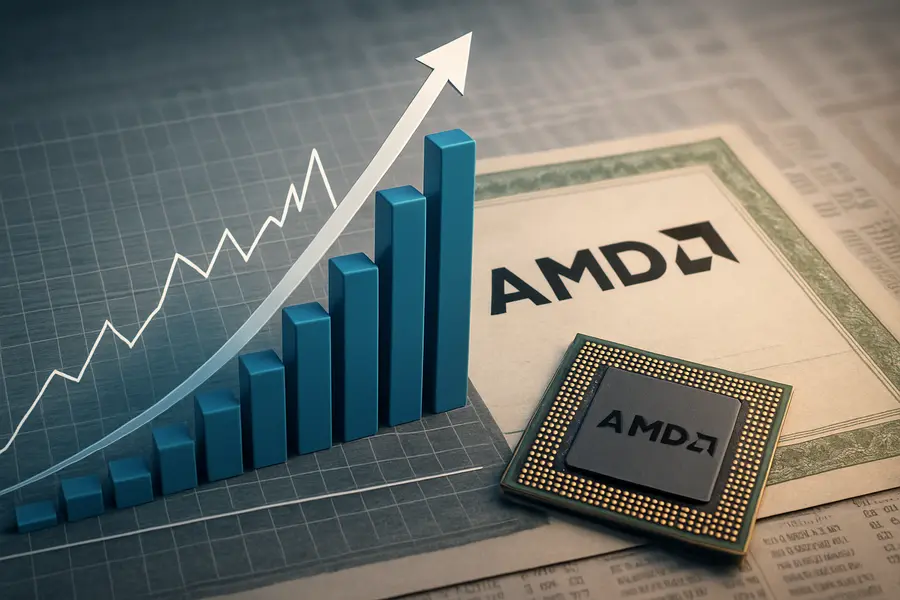
Advanced Micro Devices has become the standout performer of the 2026 tech rally, with shares up 153% year-to-date as insatiable demand for AI compute reshapes the semiconductor landscape.
- AMD shares hit an all-time high of $584.73 on June 30, 2026, up 153% YTD, far outpacing Nvidia's 13% advance.
- Q1 2026 data center revenue surged 57% to $5.8B; Q2 guidance of $11.2B topped consensus by roughly $700M.
- AMD's MI350X competes directly with Nvidia's B200 as Microsoft, Meta, and OpenAI expand Instinct deployments.
Lead
Advanced Micro Devices (AMD) shares climbed to an all-time high of $584.73 on June 30, 2026, capping a year-to-date gain of approximately 153% on the Nasdaq — the strongest run among large-cap semiconductor names in a year defined by AI infrastructure spending. The stock dipped 6.89% on July 1 amid a broad chip-sector pullback but has retained most of its extraordinary advance, with the company's market narrative firmly anchored to surging AMD AI GPU sales and a rapidly expanding server CPU business.What Happened
AMD's first-quarter 2026 results, reported May 5, crystallized the bull case. Total revenue reached $10.25 billion, up 37.85% year-over-year and above the top end of the company's own guidance range of $9.8 billion. Non-GAAP earnings per share of $1.37 rose 43% from a year earlier, beating consensus by roughly 6%. Free cash flow more than tripled to $2.57 billion. Shares jumped 16% in the session after the release — the largest single-day gain since the AI trade accelerated in late 2024.
The data center segment was the engine. Revenue there hit $5.8 billion in the quarter, up 57% year-over-year from $3.67 billion, driven by simultaneous gains in Instinct AI accelerators and EPYC server processors. The result erased lingering investor doubt about whether AMD stock 2026 momentum could survive broader market volatility.
AI and Technology Angle
The hardware underpinning the rally is AMD's Instinct MI350X, a next-generation AI accelerator launched in mid-2025. Equipped with 288 gigabytes of HBM3E memory and a reported 35-times improvement in inference throughput over its predecessor, the MI350X has drawn deployment commitments from Microsoft, Meta, and OpenAI — hyperscalers that had previously relied almost exclusively on Nvidia silicon.
The competitive dynamic matters in the context of semiconductor trends: Nvidia still commands roughly 80% of the AI accelerator market by revenue, with fiscal 2026 data-center sales reaching $193.7 billion. But AMD's MI350X is the first Instinct-generation chip that independent technical reviews position as a credible alternative to Nvidia's B200 on total cost of ownership — particularly for inference workloads where memory bandwidth is the binding constraint. That positioning has translated into purchase orders, and purchase orders into revenue.
AMD is already preparing the next step. The company's "Helios" rack-scale systems, featuring the MI450 series GPU, are targeted for launch in Q3 2026. If the product schedule holds, AMD will have completed two full accelerator generations within 18 months — a cadence that would have seemed implausible as recently as 2023.
Market Reaction and Competitive Context
The AMD AI GPU narrative has reshuffled the 2026 semiconductor trends leaderboard in ways the market had not priced at the start of the year. While Nvidia, Broadcom, and Marvell entered 2026 as the consensus AI-chip winners, AMD has emerged as the year's biggest outperformer in the sector. Micron, AMD, and Intel collectively added roughly $2 trillion in market capitalization in the second quarter, in what analysts broadly characterize as the most concentrated AI-driven tech rally since the initial generative-AI breakout of 2023.
AMD's outperformance over Nvidia — approximately 140 percentage points of relative return year-to-date — reflects a market repricing of competition risk. Hyperscalers have a structural incentive to dual-source AI accelerators, and AMD is now the only credible alternative at scale. That supply-chain logic, rather than any single product milestone, is what drove multiple re-ratings from the analyst community. Bank of America raised its price target to $560, Citi to $575, and Bernstein to $600, all citing AI GPU demand and server CPU market share expansion.
Strategic Context
The CPU business reinforces the data-center story. AMD revised its server CPU total addressable market forecast upward from 18% annualized growth to 35%, projecting the market will exceed $120 billion by 2030. EPYC processors continued to gain share against Intel's Xeon line in Q1, and the combination of CPU and GPU wins within the same data-center accounts gives AMD a cross-sell advantage that is increasingly visible in contract structures and forward booking.
For the second quarter, AMD guided revenue of approximately $11.2 billion, plus or minus $300 million — roughly 46% higher than a year earlier and about $700 million above the analyst consensus of $10.5 billion at the time of reporting. That guidance beat was the single largest contributor to the re-acceleration in AMD stock 2026 momentum following the Q1 report.
Risks
Export controls remain the principal uncertainty. Restrictions on high-performance AI chip sales to China have constrained accessible revenue and create ongoing policy risk. AMD has not provided granular disclosure on China exposure for its Instinct line, and any tightening of existing rules — or new country-specific restrictions — could reduce near-term revenue visibility. Additionally, the July 1 pullback in chip stocks as a group illustrates how crowded the AI trade has become; positioning risk is elevated after a 153% move.
Outlook
AMD enters the second half of 2026 with the strongest product lineup in its history, a data-center revenue run rate that annualizes above $23 billion, and Q2 guidance that implies the top line has not yet peaked. The MI450 launch and continued EPYC adoption are the two variables most likely to determine whether the tech rally in AMD shares extends or consolidates. With 51 sell-side analysts holding an average "Strong Buy" rating, institutional consensus remains firmly constructive — even after one of the largest year-to-date gains among large-cap technology equities.
Mentioned tickers: AMD, NVDA, INTC, MRVL, AVGO, MU