Pomegra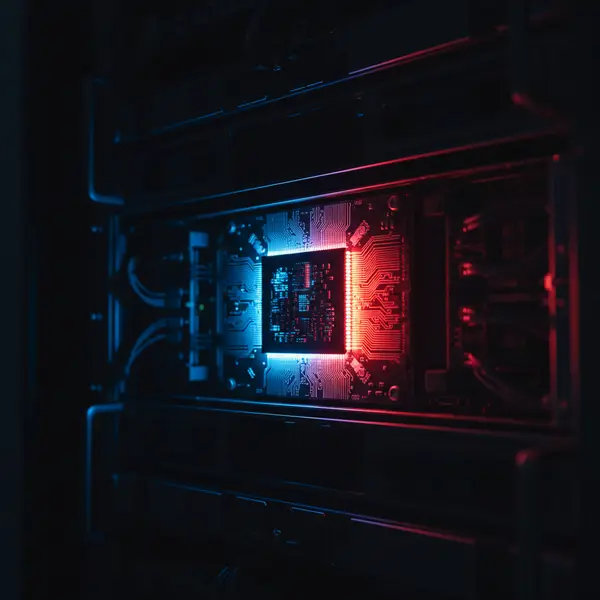
Advanced Micro Devices (NASDAQ: AMD) delivered its strongest quarterly performance in the company's history on May 5, 2026, posting first-quarter revenue of $10.25 billion — a 38% jump from $7.44 billion in the same period a year earlier — as accelerating AI infrastructure spending propelled the Santa Clara chipmaker past every major consensus estimate. The stock surged approximately 15% in after-hours trading following the announcement, marking one of the largest single-session moves in AMD's recent history.
- AMD Q1 2026 non-GAAP EPS of $1.37 beat the $1.29 consensus; revenue of $10.25B topped the $9.89B estimate.
- Data Center segment revenue surged 57% year-over-year to $5.8 billion, now the company's primary profit engine.
- Q2 2026 revenue guidance of approximately $11.2 billion significantly exceeded Wall Street's $10.52 billion forecast.
Data Center Becomes AMD's Dominant Revenue Engine
The Data Center segment delivered $5.775 billion in revenue during Q1 2026, up 57% year-over-year from $3.674 billion, cementing its position as the company's most critical growth driver. Operating income from the segment reached $1.599 billion, underscoring the high-margin nature of AMD Instinct GPU and EPYC server CPU sales.
CEO and Chair Dr. Lisa Su credited the performance to the intersection of AI infrastructure build-outs and the rising compute demands of inferencing and agentic AI workloads. "Data Center is now the primary driver of our revenue and earnings growth," Su said, adding that "server growth is expected to accelerate meaningfully as we scale supply to meet demand."
Demand for 5th Generation AMD EPYC processors remained particularly robust, with AWS, Google Cloud, Microsoft Azure, and Tencent all expanding EPYC-powered cloud instances during the quarter. AMD's Instinct MI355X also posted leadership inference results across multiple categories in the latest MLPerf benchmark suite, signaling competitive parity in the AI accelerator race where Nvidia has long dominated.
Client, Gaming, and Embedded Segments Hold Firm
Beyond the headline data center beat, AMD's Client and Gaming segment contributed $3.605 billion in Q1 2026 revenue, a 23% year-over-year increase. Within that, AMD Ryzen CPU sales for notebooks and desktops drove client revenue to $2.885 billion — up 26% — fueled by continued market share gains and strong demand for Ryzen AI PRO 400 Series processors targeting AI-capable enterprise PCs. Gaming revenue reached $720 million, up 11%, as Radeon GPU demand partially offset a decline in semi-custom revenue.
The Embedded segment contributed $873 million, a 6% year-over-year gain, as demand improved across industrial and edge AI end markets.
Margins, Cash Flow, and Balance Sheet Signal Structural Strength
On a non-GAAP basis, AMD posted gross margin of 55%, operating income of $2.540 billion, and net income of $2.265 billion, representing year-over-year increases of 43% and 45% respectively. Non-GAAP diluted EPS of $1.37 rose 43% from $0.96 in Q1 2025.
Free cash flow surged to a record $2.566 billion in the quarter, up from $2.082 billion in Q4 2025 and more than tripling from $727 million in Q1 2025. Adjusted EBITDA reached $2.746 billion. AMD closed the quarter with $12.347 billion in cash, cash equivalents, and short-term investments — up from $10.552 billion at year-end 2025 — providing the company with significant firepower for R&D acceleration and strategic partnerships.Capital expenditures rose to $389 million, reflecting AMD's commitment to scaling its AI chip supply chain as packaging capacity constraints remain an industry-wide challenge.
Helios Rack System and MI450 Pipeline Build Momentum
A central theme of AMD's earnings call was the company's expanding partnership ecosystem around its upcoming Helios rack-scale AI system — a direct rival to Nvidia's Grace Blackwell and Vera Rubin platforms. Both Meta and OpenAI have committed to Helios deployments, with Meta's multi-year agreement covering up to 6 gigawatts of AMD Instinct GPU capacity, including a custom MI450-based GPU for the first 1-GW deployment. Helios shipments are expected to commence in the second half of 2026.
AMD also announced a collaboration with Samsung on next-generation AI memory, including HBM4 supply for the MI455X GPUs, and deepened ties with Tata Consultancy Services on rack-scale AI infrastructure for enterprise and sovereign AI deployments in India and Korea.
Su stated AMD has "strong and increasing confidence" in reaching tens of billions of dollars in data center AI revenue within the next year, while targeting long-term growth exceeding 80% as AI infrastructure spending continues to compound.
Q2 2026 Guidance Towers Above Estimates
For the second quarter of 2026, AMD guided revenue to approximately $11.2 billion (±$300 million), representing 46% year-over-year growth and a roughly 9% sequential increase. Non-GAAP gross margin for Q2 is expected to be approximately 56%. The midpoint of the revenue range cleared the $10.52 billion Wall Street consensus by nearly $700 million — a margin that reinforced the depth and durability of AI-driven semiconductor demand.
The x86 AI compute extension initiative jointly announced with Intel — designed to boost CPU performance density by 16x — further positions AMD's EPYC and Ryzen architectures at the center of the agentic AI era, where CPU workloads are accelerating alongside GPU demand rather than being displaced by it.
Market Reaction and Broader Sector Context
AMD shares soared roughly 15% in extended trading, building on a year-to-date gain of approximately 66% and a trailing twelve-month return of more than 200%. The outsized move reflects a market recalibrating AMD's long-term competitive position against Nvidia in AI accelerator infrastructure — a market that AMD management now frames as large enough to sustain multiple dominant players.
The broader semiconductor sector continued its exceptional run. Micron Technology surpassed a $700 billion market capitalization on the same day, driven by insatiable AI memory demand, while Intel recorded its best monthly performance in April 2026 after posting its own earnings beat.
AMD's Q1 2026 results confirm that the company has moved from an AI challenger to a structural partner for the world's largest hyperscalers. With Helios shipments imminent, EPYC market share gains accelerating, and a record cash position providing operational flexibility, AMD enters the second quarter of 2026 from a position of considerable momentum in the global AI infrastructure cycle.
Mentioned Tickers: AMD, NVDA, INTC, MU, META