Pomegra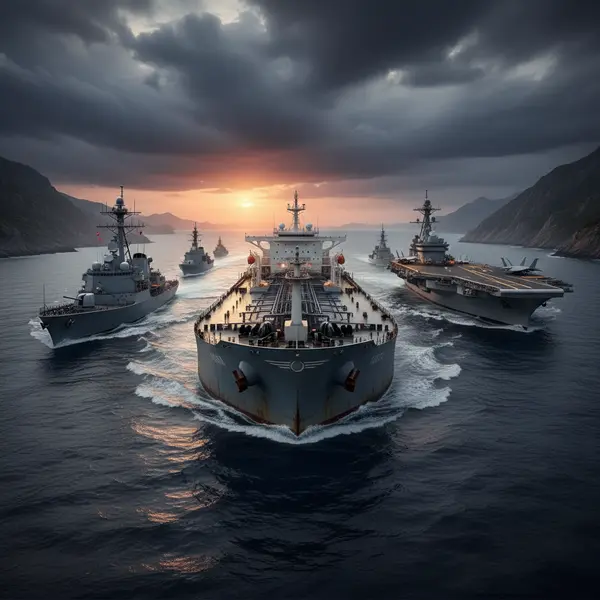
War Now in Its 10th Week as Strait Standoff Intensifies
The US-Iran war, which erupted on February 28, 2026, entered a dangerous new phase on Monday, May 4, as Iranian IRGC-affiliated media reported that Tehran's navy fired two missiles at a US warship attempting to transit the Strait of Hormuz near the port of Jask, forcing the vessel to "flee." US Central Command issued a flat denial, stating: "No U.S. Navy ships have been struck." The conflicting claims deepened an already volatile standoff at the world's most critical oil chokepoint, through which approximately 20 million barrels of crude — one-fifth of daily global production — once flowed every day.
- Iran claims to have fired missiles at a US warship near Jask; the Pentagon denied any US vessel was struck.
- Trump's "Project Freedom" deploys 15,000 troops, 100+ aircraft, and guided-missile destroyers to restore freedom of navigation.
- Brent crude surged 3.8% to $112.30/barrel; US gas prices hit $4.45/gallon, up nearly 50% since the war began February 28.
"Project Freedom" Launched, Iran Calls It a Ceasefire Violation
President Donald Trump announced "Project Freedom" on Sunday, May 3, vowing the US military would begin guiding stranded neutral ships out of the strait beginning Monday. US Central Command, led by Admiral Brad Cooper, confirmed the operation would mobilize guided-missile destroyers, more than 100 land- and sea-based aircraft, multi-domain unmanned platforms, and 15,000 service members. Trump described the initiative as a "humanitarian gesture" on behalf of nations uninvolved in the conflict, warning that any interference "will have to be dealt with forcefully."
Tehran immediately rejected the announcement. Major General Ali Abdollahi, head of Iran's unified military command, declared that "any foreign military force, especially the invading American army, will be attacked if they try to approach or enter the Strait of Hormuz." Iran's Foreign Ministry labelled the US move a violation of the April 8 ceasefire agreement, calling Washington unable to escape its "self-made quagmire." The IRGC published a map Monday declaring Iranian military control over a wide swath of the waterway, warning commercial vessels to coordinate transit through IRGC naval channels or "face serious risks."
UAE Tanker Hit by Iranian Drones; Kuwait Crude Exports Hit Zero
Compounding the chaos, the United Arab Emirates condemned what it called an "Iranian terrorist attack" on an ADNOC state-affiliated tanker targeted by two Iranian drones while passing through the strait. The UAE foreign ministry stated no injuries were recorded but decried the use of Hormuz "as a tool of economic coercion." Separately, a bulk carrier reported being attacked by multiple small craft 11 nautical miles west of Sirik, Iran; all crew were reported safe.
The economic fallout from the effective closure of the strait since February 28 has been staggering. Kuwaiti crude oil exports plummeted from more than one million barrels per day to zero in April — the first such disruption since the end of the Gulf War in 1991. The UN warned that aid delivery costs have doubled, cutting humanitarian assistance to Sudan and Lebanon by half. An estimated 20,000 seafarers remain stranded aboard hundreds of vessels inside the Persian Gulf, some rationing food, water and medical supplies.
Oil Prices Spike, US Gas Hits $4.45 a Gallon
Brent crude futures for July delivery spiked 3.8% to $112.30 per barrel as Iran's naval claims reignited fears of a direct US-Iran military confrontation inside the strait. West Texas Intermediate rose a similar margin to $105.60 a barrel. Prices had dipped briefly after Project Freedom was announced on Sunday, only to reverse sharply. SPI Asset Management's Stephen Innes captured market sentiment concisely: "Washington and Tehran are locked in a stare-down that feels less like diplomacy and more like two central banks daring each other to flinch."At the retail level, national average US gasoline prices climbed to $4.45 per gallon on Sunday — a near-50% increase since the war began. US stock futures pointed to a modestly weaker open Monday, with European markets also in the red, while South Korea's Kospi surged 5% on a semiconductor sector rally.
Diplomacy Stalled Over Nuclear Demands and Reparations
The ceasefire that began April 8 remains technically in place but has grown increasingly fragile. After a 21-hour round of face-to-face negotiations in Islamabad on April 11 failed over Iran's refusal to abandon its nuclear enrichment program, the two sides have traded proposals through Pakistani mediators. Tehran submitted a 14-point proposal that demands the US lift all sanctions, end its naval blockade of Iranian ports, withdraw forces from the region, and halt Israeli military operations in Lebanon — while deferring nuclear issues to a later stage. Trump rejected prior iterations and signaled similar skepticism about the latest text, saying on May 1 his options were to "make a deal" or "go and just blast the hell out of them."
On May 3, Tehran confirmed it was reviewing a fresh US counter-response relayed through Pakistan. Iranian Foreign Ministry spokesman Esmaeil Baghaei said authorities were prepared to discuss "nothing except for the full end to the war at this stage," and urged a more "realistic" US approach. Pakistan's Prime Minister, Foreign Minister, and Army Chief continue to act as active intermediaries between the two sides.
Iran's "Jan Fadaa" Mobilization and Missile Reconstitution
Domestically, Tehran has intensified its wartime mobilization campaign called "Jan Fadaa" — meaning "to sacrifice one's life" — through which the government claims more than 31 million Iranians have registered as potential volunteers, though independent analysts disputed the figure, with some backend data pointing to fewer than 4 million actual registrations. Iran's armed forces are simultaneously reconstituting missile and drone stockpiles, digging out bombed entrances to underground weapons storage facilities.
A near-total internet blackout affecting over 90 million Iranians, in place since the war began, continues under "security considerations." State-backed armed motorcades patrol Tehran and other cities nightly.
Global Dimensions: China, Hezbollah, and a Trump-Xi Summit Looms
The Strait of Hormuz crisis has rippled far beyond the Middle East. China, which imports roughly one-third of its oil and gas through the strait, remains highly exposed. A Trump-Xi summit scheduled for May 14-15 in Beijing has added geopolitical complexity, with Chinese officials cautiously viewing the unresolved conflict as potentially strengthening Xi's negotiating hand — though Beijing remains split on how to capitalize on the moment.
Meanwhile, Hezbollah chief Naim Qassem declared on Monday that "there is no ceasefire in Lebanon," as the Iran-backed group exchanged fire with Israeli forces despite the broader truce framework. Israeli strikes have killed 2,679 people in Lebanon since March 2, with Hezbollah claiming 11 retaliatory attacks on Sunday alone — the highest single-day tally since the ceasefire began.
Outlook: A Strait on the Knife's Edge
The Strait of Hormuz remained almost completely empty of commercial traffic on Monday morning despite Project Freedom's launch, with shipping executives expressing deep skepticism. "It takes both sides to unblock — not just one," said Bjørn Højgaard, CEO of ship manager Anglo-Eastern. "Announcements are one thing — safe and predictable passage is another."
With peace talks deadlocked, crude oil above $112, gas prices at their highest in years, and Iranian and US forces now in direct confrontation at the strait's entrance, the 2026 Hormuz crisis shows no signs of imminent resolution. The next 72 hours — as Project Freedom attempts to move its first vessels and Iran's response takes shape — will be critical in determining whether the conflict tips from a ceasefire-in-name into full-scale naval warfare.
Mentioned tickers: USO, BNO, XOM, CVX, OXY, HAL, SLB, BP, SHEL, TTE