Pomegra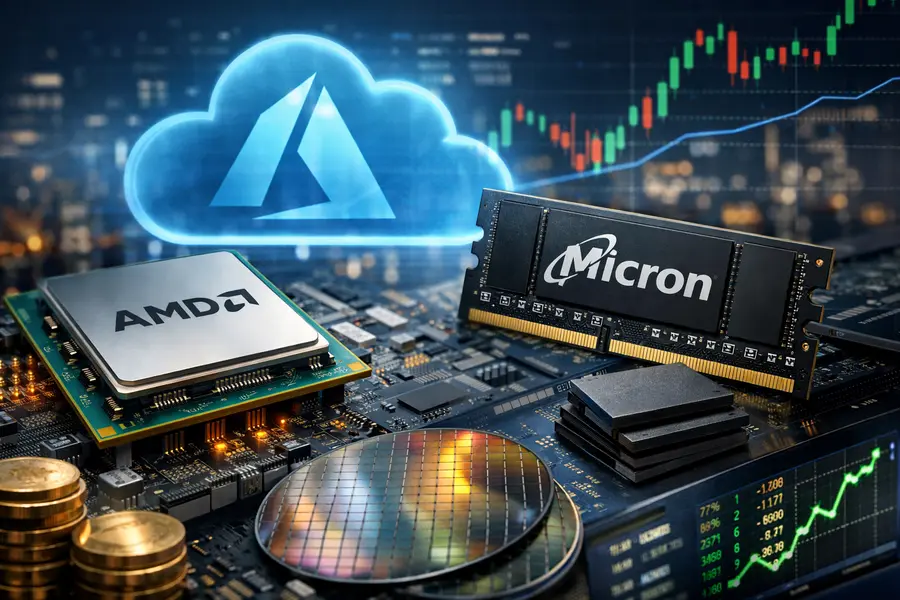
AMD stock surged more than 8% and Micron rebounded sharply as Microsoft Azure's expanded AMD AI partnership reignited confidence in the semiconductor industry's growth trajectory.
- AMD jumped 8.04% to $544.05 after Microsoft confirmed Azure will deploy AMD Helios rack-scale AI infrastructure at scale.
- Micron rose 5% to $887 as memory chip supply tightness through 2027 supports pricing power heading into Q3.
- The Philadelphia Semiconductor Index gained more than 3%, recovering from a 9% weekly decline and a 20% one-month drawdown.
Lead
Advanced Micro Devices (AMD) surged 8.04%, or $40.48, to $544.05 on Tuesday, July 22, as Microsoft confirmed it will deploy AMD's Helios rack-scale AI solution across Microsoft Azure data centers, adding the cloud giant to a customer list that already includes OpenAI and Meta. Micron Technology (MU) climbed 5% to $887, extending a rebound from a three-day losing streak, as analysts flagged tightening memory supply and projected at least a 25% sequential increase in chip prices by the third quarter. The dual advance drove a broad chip stock recovery, lifting the Philadelphia Semiconductor Index more than 3% and signaling that a weeks-long sector selloff may have run its course.What Happened
Microsoft and AMD disclosed on July 20 that Azure will integrate the AMD Helios Rackscale Solution, combining Instinct MI455 GPUs, sixth-generation EPYC "Venice" CPUs, and Pensando DPUs into a unified rack-scale system optimized for AI inference. Azure will simultaneously launch two new virtual machine series built on Venice processors: the HDv2, designed for agentic AI pipelines, and the HXv2, targeting semiconductor design workloads. Deployment is scheduled to begin in late 2026, extending AMD's multi-year data center revenue visibility.
The announcement arrived days before AMD's own Advancing AI 2026 event, compressing two catalysts into the same trading week. AMD shares had already gained 1.58% on Monday following the initial disclosure, added 3.56% in premarket trading Tuesday, then extended further through the afternoon session.
Micron's move was not tied to a single announcement. The stock, which had pulled back alongside the broader semiconductor sector, recovered as the market repriced memory dynamics. The company had previously warned that high-bandwidth memory (HBM) and DRAM supply will remain constrained beyond 2027, a signal that AI-driven demand continues to outpace production capacity. Earlier in July, Micron had surged more than 7% after announcing a $3 billion expansion of its U.S. manufacturing footprint, reclaiming the $1,000 level before giving back gains in the subsequent sector-wide retreat.Market Reaction
The chip stock recovery on Tuesday was the most significant single-day bounce for the sector in several weeks. Intel (INTC), Texas Instruments (TXN), and Taiwan Semiconductor Manufacturing (TSM) all posted gains. In the memory subsector, SanDisk rose 6% and Western Digital (WDC) climbed 4% alongside Micron.
The Philadelphia Semiconductor Index had fallen more than 9% in the prior week and approximately 20% over the preceding month, a decline that had drawn comparisons to earlier AI-driven corrections in 2024 and 2025. Tuesday's rebound stopped short of reversing the full drawdown, but the breadth of gains across the semiconductor industry — spanning logic, memory, and foundry names — reinforced the view that the selloff had been sentiment-driven rather than a reflection of deteriorating fundamentals.
AMD's year-to-date advance now exceeds 100%, trading at approximately 84 times forward earnings, a multiple that reflects sustained hyperscaler demand and a broadening customer base.
Strategic Context
The Microsoft deal represents a meaningful competitive development within the AI chip supply chain. Azure has historically relied heavily on Nvidia (NVDA) for AI training and inference infrastructure. The integration of AMD Helios racks alongside Instinct MI455 GPUs introduces a credible second-source architecture at the frontier model tier — not just for commodity inference workloads but for the most demanding AI inference tasks, including those serving enterprise AI labs and external Azure customers.
Hyperscalers collectively committed approximately $750 billion in capital expenditures for 2026, with data center AI infrastructure representing the fastest-growing line item. AMD's positioning as an alternative GPU supplier, now validated by the largest cloud platform, strengthens the company's case for a sustained share of that spending cycle. The Venice EPYC partnership for specialized VM series further deepens AMD's footprint in cloud compute, where its server CPU line has steadily gained share.
AI and Technology Angle
The Helios platform illustrates the shift in Microsoft Azure AI infrastructure strategy from discrete GPU procurement toward integrated rack-scale systems. By bundling GPUs, CPUs, and data-processing units into a validated rack configuration, AMD reduces deployment friction for hyperscalers while locking in a more durable revenue relationship than component-level sales allow.
For Micron, the AI angle is structural. High-bandwidth memory remains the binding constraint for large-scale GPU clusters; each successive generation of AI accelerators requires more HBM bandwidth, and current supply chains cannot yet meet the pace of demand growth. Micron's warning that supply tightness extends past 2027 — combined with projected Q3 price increases — positions the company as a direct beneficiary of infrastructure buildout regardless of which GPU vendor wins hyperscaler contracts.
What Comes Next
AMD's Advancing AI 2026 event, scheduled for later this week, is expected to provide additional product roadmap detail on Helios deployments and next-generation Instinct architectures. Investors will also watch for guidance on the timing and scale of the Azure rollout, which has so far been confirmed for late 2026 but not quantified.
For Micron, the next inflection point is the fiscal Q3 earnings report, where management guidance on HBM pricing and volume will test the optimistic supply-constraint thesis laid out by sell-side analysts.
Outlook
The Microsoft Azure commitment to AMD's Helios platform marks a structural shift in the AI chip supply chain, reducing hyperscaler dependence on a single GPU supplier and broadening AMD's addressable market at the highest-margin tier of data center infrastructure. Micron's recovery reflects durable memory demand from AI workloads and constrained supply through at least 2027. The semiconductor industry's single-day rebound — across logic, memory, and foundry segments — suggests that the recent drawdown reflected positioning rather than a fundamental reassessment of the AI infrastructure cycle, though valuations across the sector remain elevated relative to historical norms.
Mentioned tickers: AMD, MU, MSFT, NVDA, INTC, TXN, TSM, WDC