Pomegra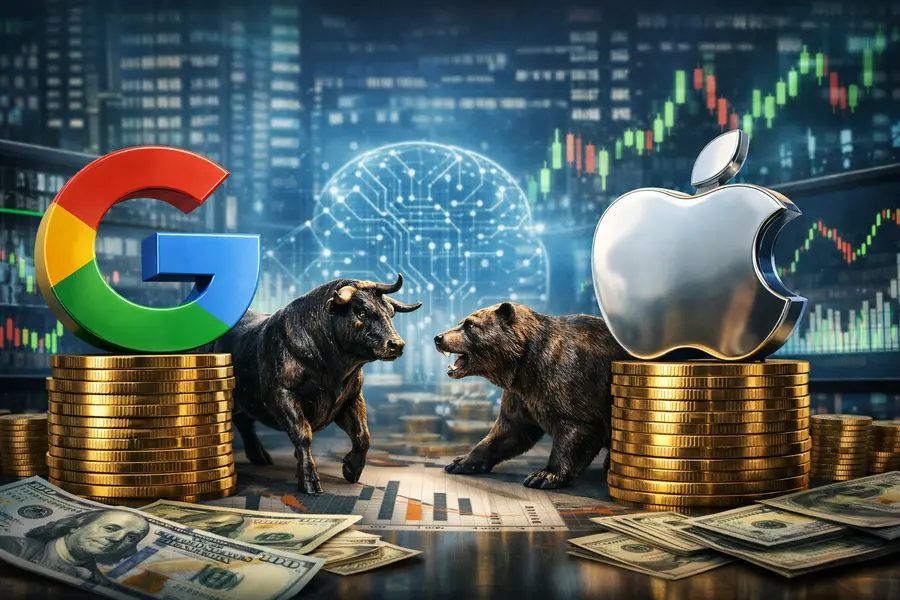
Two of the most scrutinized portfolios on Wall Street — Berkshire Hathaway's holdings in Alphabet and Apple — illuminate a broader debate in technology investing: infrastructure bet versus ecosystem hold, and which model generates more durable value in an economy reshaped by artificial intelligence.
- Berkshire Hathaway holds ~$57.8B in Apple and ~$31B in Alphabet, together nearly 30% of its $343B portfolio.
- Alphabet posted 24% revenue growth in Q2 2026 to $119.8B; Apple grew 17% to $111.2B in the same period.
- GOOG trades at 24.49x forward earnings versus AAPL at 36.29x, with Alphabet expanding cloud and AI revenue at a far faster pace.
---
Lead
As of late July 2026, Berkshire Hathaway holds roughly $57.8 billion in Apple (AAPL) and approximately $31 billion in Alphabet (GOOG/GOOGL), with the two positions together accounting for nearly 30% of the conglomerate's $343 billion equity portfolio. The pairing sets up one of the most consequential GOOG vs AAPL comparisons in public markets — a clash between a capital-intensive AI infrastructure builder and a cash-generative consumer franchise navigating a slower pivot to the same technology.
---
Berkshire's Evolving Position
Warren Buffett, who stepped down as Berkshire's chief executive at the start of 2026 but remains chairman, has publicly acknowledged he sold Apple stock too soon. As of March 31, 2026, Berkshire retained 227.92 million Apple shares — a 1.55% stake representing 21.99% of the portfolio — after reducing a position that once totaled more than 900 million shares. Despite the trimming, Buffett said he would add to Apple if valuations become more attractive, though he noted the stock had not yet reached that threshold after retreating more than 14% from a recent peak.
The Alphabet position tells a different story. Greg Abel, Berkshire's new chief executive, directed more than $20 billion into Alphabet in the first half of 2026, including a $10 billion commitment in a private placement in which Alphabet raised $80 billion to fund AI infrastructure. The purchase was split evenly between the company's two share classes at prices modestly below prevailing market levels. Buffett later confirmed he was involved in the original Alphabet investment decision, reframing the thesis as a shared conviction rather than purely a generational handoff. Abel now holds roughly $31 billion in Alphabet, or more than 9% of Berkshire's total equity portfolio.
---
Financial Performance: Q2 2026
Alphabet's second-quarter results, reported July 22, showed consolidated revenues of $119.8 billion, up 24% year-over-year — the company's twelfth consecutive quarter of double-digit revenue expansion. Google Cloud was the standout, surging 82% to $24.8 billion as enterprise demand for AI solutions and infrastructure accelerated. Cloud operating income reached $8.8 billion, up from $2.8 billion in the year-earlier period. Google Search rose 17%, and YouTube advertising grew 13%. Adjusted earnings per share came in at $2.85, fractionally below the $2.89 consensus estimate.Despite the broad beat, GOOG shares fell 3.65% in after-hours trading to $329.43. The trigger: Alphabet raised its full-year capital expenditure guidance to a range of $195 billion to $205 billion, up from the $180 billion to $190 billion forecast issued last quarter, intensifying investor scrutiny of returns on that spending.
---
AI and Technology Angle
The two companies have arrived at artificial intelligence from opposite directions. Alphabet has built a vertically integrated AI stack: custom Tensor Processing Units (TPUs) that serve as cheaper, proprietary alternatives to third-party accelerators for training and inference workloads, a frontier model series deployed across search, cloud, and consumer products, and a cloud backlog that nearly doubled quarter-on-quarter to exceed $460 billion.
Apple Intelligence, integrated into the A19 and A19 Pro chips, takes a device-centric approach — prioritizing on-device processing, privacy, and tight hardware-software integration. The company's AI monetization flows primarily through the Services segment, which benefits from higher-margin subscription and platform revenue rather than infrastructure utilization fees. Apple largely avoided the capex surge that defined competitor strategies in 2025 and 2026, preserving free cash flow at the cost of a less visible AI footprint.---
Valuation and Strategic Context
The divergence in capital allocation is reflected in relative valuations. GOOG trades at 24.49 times forward earnings and a price-to-book ratio of approximately 9x, with a PEG ratio near 1.42. AAPL trades at 36.29 times forward earnings and a price-to-book of roughly 43x, with a PEG ratio near 2.9. By conventional growth-adjusted metrics, Alphabet screens as the cheaper stock despite reporting faster revenue growth.
Buffett has historically favored businesses that generate high returns on capital without requiring heavy reinvestment. That preference fits Apple well and has created friction with the Alphabet thesis: the company's 2026 capex guidance of up to $205 billion is the largest in its history and represents a structural shift from the asset-light model that first attracted value-oriented investors to large-cap technology. Alphabet briefly overtook Apple as the world's second-most-valuable company by market capitalization in 2026, reflecting an accelerating reassessment of which architecture — platform ecosystem or AI infrastructure — commands a higher multiple in the current cycle.
---
Outlook
The Alphabet vs Apple stock comparison has moved beyond a simple growth-versus-value framing. Both companies are deeply embedded in Berkshire's portfolio, and both carry conviction from one of history's most studied investment franchises. Alphabet's capex-heavy posture creates near-term earnings pressure but positions the company at the center of enterprise AI adoption, a market expanding rapidly. Apple's disciplined capital allocation and record Services margins sustain profitability and cash return capacity even as its AI product differentiation remains harder to quantify. The two names now represent distinct but complementary expressions of the same structural shift — and their relative trajectories through the remainder of 2026 will likely be shaped by whether AI infrastructure spending translates into cloud revenue at the pace Alphabet has projected.
Mentioned tickers: GOOG, GOOGL, AAPL, BRK.A, BRK.B