Pomegra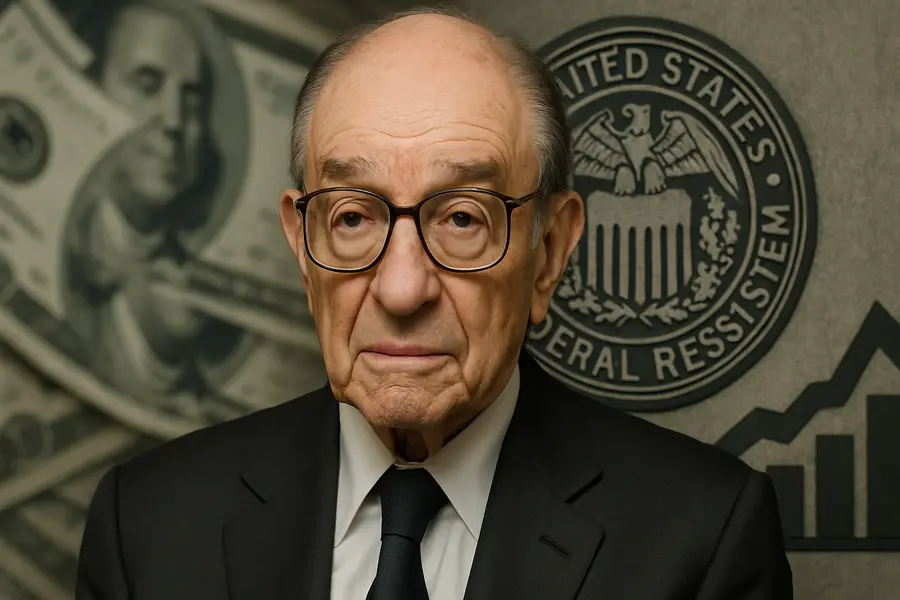
Alan Greenspan, the longest-serving Federal Reserve chairman of the modern era, has died at 100 from complications of Parkinson's disease, leaving behind a legacy defined by both historic prosperity and lasting controversy.
- Greenspan died Monday, June 22, 2026, at his Washington, D.C., home; his wife Andrea Mitchell confirmed the news.
- As Fed chair from 1987 to 2006, Greenspan presided over the longest U.S. economic expansion of the 20th century — a decade-long run from 1991 to 2001.
- His legacy remains contested: celebrated for taming inflation, criticized for policies that enabled the 2007–08 global financial crisis.
Lead
Alan Greenspan, the 13th chairman of the Federal Reserve and one of the most consequential economic policymakers in American history, died Sunday at his home in Washington, D.C. He was 100. His wife of 29 years, NBC News chief Washington correspondent Andrea Mitchell, announced his death, attributing it to complications from Parkinson's disease. Greenspan served at the helm of the Fed for 18 years — the second-longest tenure in the institution's history, falling four months short of William McChesney Martin's record — guiding the U.S. economy through market crashes, technological revolutions, and geopolitical crises across four presidencies.
A Tenure Defined by Stability and Innovation
Appointed by President Ronald Reagan in August 1987, just months before the Black Monday stock market crash of October that year, Greenspan quickly established himself as a steady hand in moments of financial stress. His Fed navigated the savings-and-loan crisis, the 1991 recession, the Mexican peso crisis of 1994–95, the Asian financial crisis of 1997–98, the collapse of Long-Term Capital Management, and the September 11, 2001, attacks without triggering a systemic breakdown of U.S. financial markets.
Under his stewardship, the Fed reduced inflation to 2% and below by the early 2000s — a transformation that anchored price expectations for a generation. Greenspan was among the first major policymakers to recognize that gains in technology-driven productivity allowed the economy to expand faster than conventional models predicted without sparking inflation, a judgment that shaped policy throughout the 1990s boom.
In 1994, the Fed's rate-setting committee issued a public statement after a policy meeting for the first time — a transparency measure that Greenspan championed and that has become standard practice. In 1996, he coined the phrase "irrational exuberance" in a Washington speech, a two-word warning about speculative excess that reverberated through global markets and entered the financial lexicon permanently.
A Legacy Shadowed by 2008
Greenspan's reputation suffered a significant blow in the aftermath of the 2007–08 global financial crisis. Critics argued that his long advocacy for financial deregulation and his reluctance to use the Fed's supervisory authority to restrain the subprime mortgage market helped inflate the housing bubble whose collapse nearly brought down the global banking system. In a notable October 2008 congressional testimony, he acknowledged a "flaw" in his ideological framework — a moment that reframed how economists and historians would assess his tenure.Tributes from the Fed and Beyond
The Federal Reserve issued a statement Monday praising Greenspan's contributions: "Under his leadership, the Federal Reserve achieved a sustained era of price stability that supported economic growth and helped anchor the public's confidence in the institution." Condolences arrived from former colleagues, Treasury officials, and market participants who came of age during his 18-year tenure.
Born March 6, 1926, in the Washington Heights neighborhood of New York City, Greenspan displayed mathematical aptitude from childhood. He studied at the Juilliard School and played jazz saxophone and clarinet before pivoting to economics at New York University and Columbia. He later became a close associate of philosopher Ayn Rand, whose ideas on markets and individualism shaped his thinking for decades.