Pomegra
Goldman Sachs projects $7.6 trillion in cumulative AI capex through 2031 as annual spending nears $1 trillion, eclipsing every prior technology buildout in recorded history.
- Goldman Sachs forecasts $765B in AI CapEx in 2026, scaling to $1.6T annually by 2031, with $7.6T cumulative through the decade.
- The five largest hyperscalers—Amazon, Alphabet, Microsoft, Meta, and Oracle—will collectively invest up to $725B this year alone.
- AI revenue hit $25B in Q1 2026, exceeding quarterly depreciation costs for the second consecutive quarter, signaling the buildout is beginning to pay.
Lead
The global AI infrastructure buildout has crossed into territory that rivals and, by several measures, surpasses every major technology investment cycle in modern economic history. Annual spending on AI compute, data centers, and supporting hardware is closing in on $1 trillion in 2026, according to Goldman Sachs projections, with the firm's baseline model pointing to $765 billion in AI capital expenditure for the year. That figure is set to more than double — to $1.6 trillion per year — by 2031, putting cumulative AI spending for the six-year stretch at roughly $7.6 trillion, or approximately one-quarter of current annual U.S. GDP.
What Happened
The scale of the current wave became impossible to ignore when the five dominant hyperscalers — Amazon (AMZN), Alphabet (GOOGL), Microsoft (MSFT), Meta (META), and Oracle (ORCL) — disclosed 2026 capital expenditure plans aggregating between $660 billion and $725 billion, nearly double their collective outlay in 2025. Microsoft alone is tracking toward roughly $190 billion in capex this calendar year, a 61% year-over-year increase. Amazon has guided for approximately $200 billion, while Alphabet has budgeted $175 billion to $185 billion and Meta between $115 billion and $135 billion.
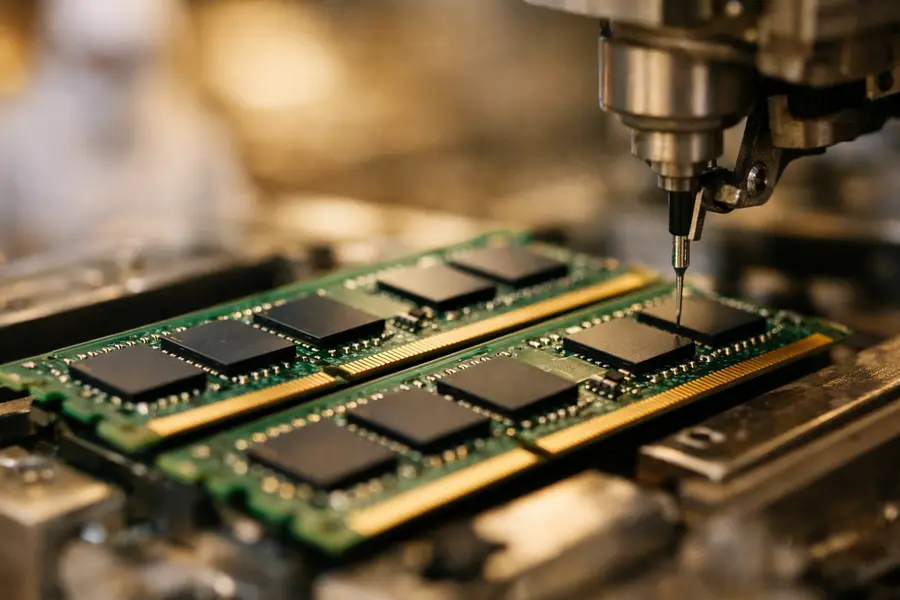
Goldman Sachs breaks the 2026 figure into two primary buckets: $494 billion for compute — AI chips, training clusters, and inference hardware — and $232 billion for data center construction and power. Nvidia (NVDA) is positioned to capture approximately 75% of the compute layer, translating to an estimated $3.8 trillion in cumulative revenue through 2031 if the projections hold.
Worldwide AI spending, which encompasses software, services, and end-user applications alongside infrastructure, is projected to reach $2.59 trillion in 2026, a 47% increase year over year, while Morgan Stanley estimates roughly $3 trillion in AI infrastructure investment will flow through the global economy by 2028.
Historical Context: Tech Boom 2026 vs. Prior Eras
The comparisons to prior tech booms are instructive but incomplete. The broadband and fiber-optic buildout that accompanied the late-1990s dot-com surge drew tens of billions annually at its peak. The mobile network rollout of the 2000s and the initial cloud computing expansion of the 2010s were likewise measured in the low hundreds of billions across multi-year cycles. The current AI infrastructure buildout is spending that amount in a single quarter.
At roughly 1.5% to 1.9% of U.S. GDP, AI-related investment in 2026 ranks alongside or above the combined capital intensity of the Apollo program, the interstate highway system, and the broadband expansion era on an annualized basis. The Federal Reserve has noted that the AI economic impact is beginning to register in aggregate demand data, with Goldman estimating that AI-related investment will add approximately 0.3 percentage points to true GDP growth in 2026 and contribute to roughly 60% of recent U.S. economic expansion.
Revenue Catching Up
For much of 2024 and 2025, a persistent question shadowed the buildout: whether demand could ever justify the capital being committed. That arithmetic has begun to shift. Global AI revenue — excluding China — reached $25 billion in the first quarter of 2026, surpassing the industry's estimated $21 billion in quarterly depreciation charges tied to data center and chip investment for the second consecutive quarter, according to Bloomberg data. Revenue coverage of depreciation costs signals that the infrastructure base is generating enough cash flow to service its asset base, a threshold the dot-com fiber boom never reliably cleared before the bust.
Depreciation still consumes more than two-thirds of AI revenue, leaving limited margin to cover power, labor, and financing costs. But the directional trend — revenue growing faster than depreciation — gives creditors and equity holders a concrete benchmark to track.
Structural Drivers
Three forces are sustaining the pace of commitment. First, AI model capability continues to scale with compute, keeping the hardware demand function open-ended. Second, enterprise adoption — from software development to drug discovery to logistics optimization — is generating contractual revenue backlogs that justify infrastructure commitments years in advance. Third, geopolitical considerations around AI sovereignty and data residency are driving governments in Europe, the Middle East, and Asia to co-invest alongside hyperscalers, broadening the capital base beyond a handful of U.S. balance sheets.
The AI economic impact is also becoming visible in commodity markets. Demand for power, copper, cooling systems, and specialized construction labor is reshaping supply chains and contributing to elevated capital goods prices across multiple sectors.
Outlook
The AI infrastructure buildout has entered a self-reinforcing cycle in which revenue growth funds the next tranche of capital expenditure, validating further commitment. Goldman Sachs' $7.6 trillion cumulative forecast through 2031 carries significant model sensitivity — a 10% shift in assumed AI adoption rates moves the figure by roughly $760 billion — but even conservative scenarios imply an infrastructure investment wave with no precedent in the history of commercial technology. The central question for markets is no longer whether the tech boom 2026 is real; it is how quickly the revenue side can grow to match the asset base being assembled.
Mentioned tickers: AMZN, GOOGL, MSFT, META, ORCL, NVDA