Pomegra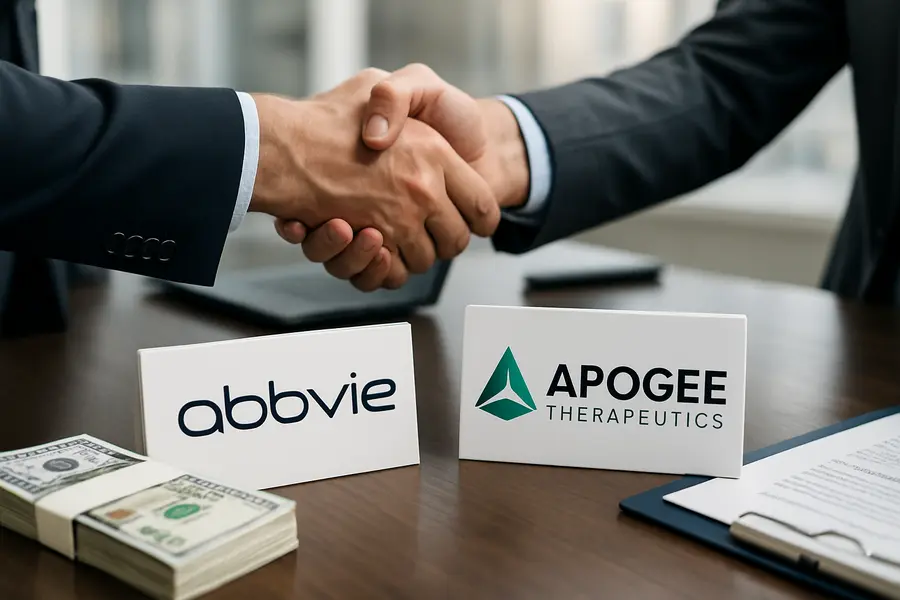
AbbVie agrees to acquire Apogee Therapeutics at $135.11 per share in an all-cash deal valued at approximately $10.9 billion, deepening its immunology pipeline with a next-generation IL-13 antibody.
- AbbVie offers $135.11 per share, a 60% premium to Apogee's June 18 closing price of $90.38
- Lead asset zumilokibart targets atopic dermatitis, asthma, and eosinophilic esophagitis with a long-acting subcutaneous dosing profile
- The deal is expected to close in Q3 2026, subject to Apogee shareholder approval and regulatory clearance
Lead
AbbVie (ABBV) announced on June 22, 2026, a definitive agreement to acquire Apogee Therapeutics (APGE) for $135.11 per share in cash, representing a total equity value of approximately $10.9 billion. The acquisition centers on Apogee's lead candidate zumilokibart (APG777), a half-life extended anti-IL-13 monoclonal antibody designed for less-frequent subcutaneous dosing, and is intended to reinforce AbbVie's position in immunology and inflammation as the company continues to rebuild its revenue base following the loss of Humira exclusivity.What Happened
The all-cash transaction was disclosed before U.S. markets opened on June 22, with AbbVie hosting an investor call at 8:00 a.m. CT. The offer price represents a 60% premium over Apogee's most recent unaffected closing price. Apogee's shares surged approximately 47% in premarket trading following the announcement, briefly reaching an intraday high of $132.61. ABBV rose 4.48% on the day, closing at $226.33, a market-cap gain of roughly $26 billion that signals investor confidence in the deal's industrial logic.
Strategic Context
Zumilokibart holds potential across multiple type 2 inflammatory diseases — a therapeutic category generating tens of billions annually and dominated by Sanofi and Regeneron's Dupixent (dupilumab). Phase 2 data in atopic dermatitis showed 65.9% of patients on the mid-dose achieving EASI-75 skin clearance at 16 weeks, a threshold competitive with existing biologics. Critically, the drug's extended half-life enables less-frequent dosing than current standard-of-care options, an attribute that could drive meaningful patient preference in a market where adherence is a persistent clinical challenge.
Apogee's pipeline extends beyond zumilokibart to APG273, a combination candidate pairing the IL-13 blocker with APG333, an anti-TSLP antibody, in development for asthma — adding a respiratory dimension to what AbbVie is acquiring.
M&A and Pipeline Context
The Apogee acquisition is the largest in a sequence of MnA moves AbbVie has executed to offset Humira's patent cliff. The company acquired Cerevel Therapeutics for $8.7 billion (neuroscience) and Aliada Therapeutics for $1.4 billion (Alzheimer's) in 2024, and has since added assets spanning CAR-T immunology, obesity, and psychiatry. The Apogee transaction extends that strategy into dermatology and respiratory immunology, areas where AbbVie already operates commercial infrastructure.
The $10.9 billion price tag — the company's largest deal since Cerevel — reflects the competitive demand for validated I&I assets and the scarcity premium attached to mechanisms capable of competing with Dupixent across multiple indications.
Outlook
Closing is targeted for Q3 2026, contingent on Apogee shareholder approval and customary regulatory review. If completed on schedule, ABBV will gain a clinical-stage asset positioned to enter pivotal trials across atopic dermatitis, asthma, and eosinophilic esophagitis — three indications with combined market opportunity in excess of $20 billion annually. The outcome of those pivotal programs, and the speed with which AbbVie can advance them through its established development infrastructure, will determine how meaningfully zumilokibart contributes to the company's post-Humira revenue trajectory.