Pomegra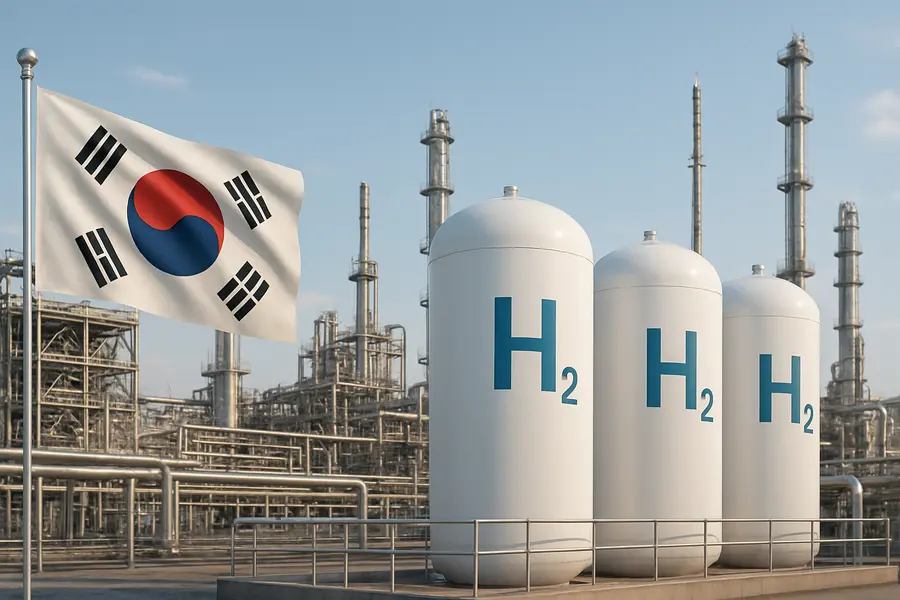
Utility Global and SAMJIN E&I sign an engineering services agreement to deploy a 3.5-ton-per-day H2Gen hydrogen plant in Daejeon, marking the first commercial project of its kind in South Korea.
- Utility Global and SAMJIN E&I signed an engineering services agreement June 9, 2026, to advance a commercial H2Gen plant in Daejeon, South Korea.
- The facility will produce 3.5 metric tons per day of fuel-cell-grade hydrogen to power a fleet of hydrogen-powered trams — a first in South Korea and Utility Global's first commercial deployment outside the United States.
- Front-end engineering and design work is now underway, with a final investment decision targeted by June 2027.
Lead
Utility Global signed its first commercial project agreement in South Korea on June 9, 2026, executing an engineering services contract with SAMJIN E&I to advance a H2Gen hydrogen production plant in Daejeon. The facility will deliver 3.5 metric tons per day of fuel-cell-grade hydrogen to a hydrogen-powered tram fleet operating in the city — establishing both the first commercial H2Gen deployment in South Korea and Utility Global's inaugural international expansion of its low-carbon fuels platform.What Happened
The engineering services agreement authorizes both companies to progress the Daejeon project through successive front-end loading stages — FEL-1 through FEL-3 — culminating in a final investment decision (FID) targeted by June 2027. Front-end engineering and design (FEED) work will be completed ahead of that milestone to enable full commercial construction.
The agreement follows a broader strategic collaboration pact between the two companies announced June 3, 2026, which established the framework for SAMJIN E&I to serve as Utility Global's engineering partner in South Korea. The Daejeon project is the first concrete commercial milestone to emerge from that arrangement.
Parker Meeks, President and CEO of Utility Global, described the deal as translating "clean energy ambition into economically viable, real-world projects," noting that the engineering partnership is "a critical step toward delivering scalable, commercially viable hydrogen solutions for hard-to-abate sectors."
Ho Young Jeong, CEO of SAMJIN E&I, said the agreement "represents meaningful progress from collaboration to execution," adding that H2Gen technology "can support the advancement of decentralized hydrogen infrastructure in South Korea" given its focus on "practical and economic decarbonization in multiple sectors, including transportation."
H2Gen Technology
H2Gen® is a proprietary electrochemical system that converts water into high-purity, fuel-cell-grade hydrogen using energy derived from industrial off-gases and biogases — without consuming grid electricity. The process generates hydrogen with low-to-negative carbon intensity on-site at the point of use, eliminating the cost penalties and logistics complexity associated with centralized hydrogen production and bulk delivery.The system simultaneously produces a high-concentration carbon dioxide stream, substantially reducing the cost and complexity of downstream carbon capture compared with conventional steam methane reforming or electrolysis pathways. This dual output positions H2Gen as commercially differentiated in markets where industrial off-gas feedstocks are available and carbon accounting is increasingly mandated.
Strategic Context
The Daejeon agreement marks a significant geographic milestone for Utility Global: the Daejeon plant will be its first commercial-scale deployment outside the United States, following a biogas-to-hydrogen project executed with MAAS Energy in California that served as proof of commercial readiness for the H2Gen platform.
Daejeon, South Korea's fifth-largest city, has positioned itself as a national hydrogen economy hub and has committed substantial infrastructure and production investment to support transport decarbonization. The tram application — the first hydrogen-fueled tram project in South Korea — provides a high-visibility proving ground for the technology and a scalable municipal model for other Korean cities.South Korea's Hydrogen Economy
South Korea's clean energy policy architecture provides a strong structural backdrop for the project. The government's Clean Hydrogen Portfolio Standard (CHPS), fully implemented in 2024, mandates clean hydrogen use in power generation and has underpinned the country's first clean hydrogen power generation auction market — the world's first of its kind. Korean conglomerates, including Samsung, Hyundai, and SK Group, have pledged over $86 billion toward domestic hydrogen-adjacent infrastructure through 2030.
Under the national Hydrogen Economy Roadmap, South Korea targets annual domestic hydrogen production exceeding 5 million metric tons by 2040, with the full development of a hydrogen value chain spanning production, distribution, transportation, power generation, and industrial use. The government has already deployed 2,000 hydrogen-powered commuter buses through agreements with 14 major companies and 12 regional governments.
Daejeon's tram project fits directly into this national mobilization — and positions the city as a recipient of both government support and internationally validated production technology.Outlook
With FEED now authorized and a June 2027 FID in view, the Daejeon H2Gen hydrogen plant is the first test of Utility Global's international growth strategy. A successful outcome would establish a replicable commercial template for H2Gen deployments across South Korea's expanding network of hydrogen hubs, and open pathways into broader Asian markets where industrial off-gas feedstocks are abundant, policy tailwinds are intensifying, and the economics of decentralized clean energy hydrogen production are increasingly compelling.
Mentioned tickers: N/A