
355 entries
Valuation
DCF, trading multiples, residual income and real options — the methods and the inputs they need.
- Revenue Multiple Valuation metric showing how many times annual revenue the market will pay for a business; useful for high-growth or unprofitable firms.
- Revenue Multiple Valuation for Private Companies How revenue multiple valuation prices early-stage and low-margin private companies when earnings are unstable or negative.
- Revenue Multiple vs EBITDA Multiple for Private Company Valuation Revenue multiples and EBITDA multiples serve different purposes in private company valuation. Learn when each metric works best and how valuers choose between them.
- Reverse DCF A valuation technique that works backward from a stock's market price to determine the implied assumptions—growth rate, terminal value, or discount rate—embedded in that price.
- Reverse DCF Valuation A reverse DCF valuation estimates the growth rate implied by a stock's current market price, revealing whether expectations are optimistic or conservative.
- Risk-Neutral Probability in Real Options: What It Means Risk-neutral probability in real options models explains why practitioners use pricing probabilities, not actual future odds, when building binomial trees for investment decisions.
- ROE Mean Reversion and Its Impact on Residual Income Valuation Learn why analysts assume ROE reverts to cost of equity in residual income models and how reversion speed affects terminal value.
- ROE Minus Cost of Equity: The Value-Creation Spread How the ROE minus cost of equity spread drives residual income valuation, when it signals value creation, and its link to price-to-book ratios.
- Scenario Valuation A valuation approach that explicitly models discrete, named scenarios (bear, base, bull) with different assumptions and probabilities, rather than relying on single-point estimates.
- Selecting Comparable Transaction Multiples for a Private Company How to select comparable transaction multiples for a private company valuation. Database sourcing, filtering criteria, size adjustments, and recency decisions for M&A comps.
- Selecting Peer Companies for a Comparable Analysis Learn how to select peer companies for comparable company analysis using sector, size, growth, and profitability criteria to build a defensible comparables set.
- Seller's Discretionary Earnings in Business Valuation Understand seller's discretionary earnings (SDE), how it differs from EBITDA, and why it's the standard metric for valuing small owner-operated businesses.
- Sensitivity Analysis (Valuation) A technique that shows how valuation results change when key assumptions (growth, margins, discount rate, terminal value) are varied, revealing which assumptions most impact value.
- Sensitivity Analysis in Dividend Discount Models Build sensitivity tables for dividend discount models to see how changes in growth rate and discount rate affect valuation and identify key value drivers.
- Sensitivity Analysis in Residual Income Models Demonstrates how changes to cost of equity, ROE fade rate, and terminal assumptions compound into large intrinsic value swings in residual income valuation.
- Shareholder Value Added A cash-based residual income measure comparing periodic operating cash flow to the equity capital charge, attributing value creation to execution.
- Single-Period Residual Income Calculation: Step-by-Step Example A worked example showing how to calculate single-period residual income—net income minus the equity charge—for a real business scenario.
- Single-Stage Residual Income Model: Example and Formula Worked example of the simplified constant-growth RI formula, showing each input and how intrinsic value derives from book value and perpetual excess returns.
- Size Premium in Small Company Valuation How the size premium adjusts discount rates for micro-cap and private firms; empirical magnitude and academic debates about its validity.
- Special Dividends and Their Impact on DDM Valuation Understand how one-time special dividends distort dividend discount model calculations and methods to strip them out.
- Stochastic Dividend Discount Model A valuation approach that treats dividend growth as random rather than deterministic, accounting for uncertainty in future payout paths.
- Strategic Option Value Worth of maintaining operational flexibility and deferring irreversible commitments to capture upside from uncertainty.
- Stub Equity Valuation in Highly Leveraged Companies How to value stub equity when a company carries heavy debt, and why enterprise value changes create outsized equity swings.
- Stub Period Adjustment Handling a partial first forecast period when the valuation date falls between fiscal year-ends in DCF models.
- Sum-of-the-Parts DCF Valuing a diversified conglomerate by discounting each business segment at its own risk-appropriate WACC, then combining for a total.
- Sum-of-the-Parts Valuation A valuation method that values a diversified company by valuing each business segment separately and adding them together, rather than valuing the enterprise as a whole.
- Sum-of-the-Parts Valuation Using Multiples How to break a conglomerate into business segments, assign sector multiples, and derive intrinsic value from sum-of-the-parts.
- Sustainable Growth Rate in Dividend Valuation How the sustainable growth rate—driven by ROE and retention ratio—constrains dividend models and reveals when payout policy is misaligned with reinvestment reality.
- Switching Option The strategic value of converting between product types or input sources when conditions change.
- Terminal Growth Rate vs GDP Growth: Setting a Defensible Ceiling Why terminal growth rate should not exceed long-run nominal GDP growth in DCF models and how to calibrate it for high-growth companies.
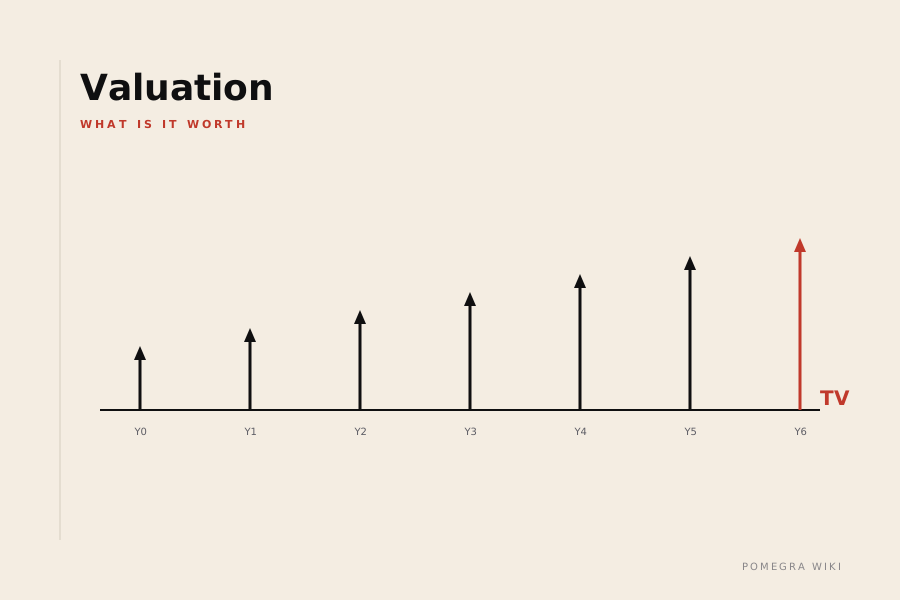
- Terminal Value The estimated value of all cash flows beyond the explicit forecast period in a discounted cash flow valuation, typically representing 60-80% of total enterprise value.
- Terminal Value Estimation Methods for capturing the value of cash flows beyond an explicit DCF forecast horizon, critical to long-term investment analysis.
- Terminal Value in Dividend Models How the assumed end-of-horizon dividend stream is capitalised to anchor total DDM value.
- Terminal Value in Small Business Valuation Terminal value represents the business's residual worth at the end of a valuation period; for small firms, exit multiples and finite-life assumptions often replace perpetual-growth models.
- Three-Stage DCF An extended discounted cash flow model that explicitly models a transition period where growth rate declines from a high initial rate to a stable perpetual rate.
- Three-Stage Dividend Discount Model A refinement of the two-stage DDM that adds a transitional growth phase between high-growth and stable-growth periods.
- Timing Option The value embedded in the right to defer an investment decision until uncertainty resolves, allowing capture of more favorable market conditions.
- Tobin's Q The ratio of a firm's market value to the replacement cost of its assets, signalling whether the market is pricing value creation or destruction.
- Trailing P/E Ratio The classic P/E multiple using the four most recently reported quarters, grounding valuation in realised earnings.
- Transaction Multiples vs Trading Multiples How transaction multiples from M&A deals differ from public-market trading multiples, and why control premiums matter when benchmarking valuations.
- Treating Share-Based Compensation in DCF Models Share-based compensation in DCF valuation: whether to add back or deduct equity expense, dilution treatment, and valuation impact of stock options and RSUs.
- Two-Stage DCF A simplified discounted cash flow model with an explicit forecast period of high growth followed by a single terminal value assuming stable perpetual growth.
- Two-Stage Dividend Discount Model A valuation method that forecasts dividends in two distinct phases: an initial high-growth period followed by stable perpetual growth.
- Unlevered Cost of Equity The cost of equity adjusted for the absence of financial leverage, used to discount asset-level cash flows independent of capital structure.
- Using the Dividend Discount Model for Cyclical Companies Apply dividend discount models to cyclical stocks with volatile payouts by normalizing earnings, using two-stage growth, or adjusting for dividend sustainability.
- Value of Waiting The economic benefit—often large and quantifiable—of postponing an irreversible investment decision when future uncertainty is high and flexibility has tangible worth.
- Valuing Preferred Stock with the Dividend Discount Model The dividend discount model values preferred stock as a perpetuity; adjustments account for callability, cumulative arrears, and conversion features.
- Venture Capital Method A back-solved valuation technique that derives a company's pre-money value from an expected exit multiple and required investment return.
- WACC for an Unlisted Firm How to calculate WACC for a private company by proxying equity cost and capital structure using public comparables and beta adjustments.
- Waterfall Analysis: Preferred vs Common Stock in Private Companies How waterfall analysis models liquidation preferences and participation rights to allocate proceeds between preferred and common shareholders in private companies.
- Weighted Average Cost of Capital The blended discount rate combining debt and equity costs, weighted by their market values, used in discounted cash flow valuations.
- Weighted Average Cost of Capital The blended cost of capital for a company, accounting for the cost of debt and cost of equity weighted by their market values. The discount rate used in most valuation models.
- What Happens in the DDM When Dividend Growth Exceeds the Discount Rate When dividend growth (g) equals or exceeds the discount rate (r) in the Gordon Growth Model, the formula produces nonsensical results. Multi-stage models and explicit forecast periods solve the problem.
- Why Terminal Value Dominates a DCF and What to Do About It Why terminal value often represents 70–90% of a DCF valuation and the methods analysts use to sanity-check and stress-test it.
- Working Capital Changes in DCF How incremental investment in operating assets and liabilities reduces free cash flow in DCF valuations of growing companies.
Looking for something specific? Use the search box up top, or browse every category →